Health Secretary Robert F. Kennedy Jr. Doubles Down on Vaccine Skepticism During Children’s Health Defense Keynote

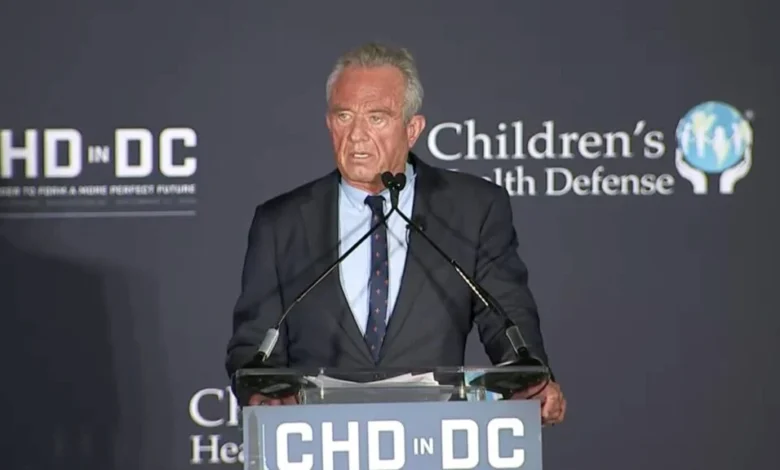
WASHINGTON — Health and Human Services Secretary Robert F. Kennedy Jr. returned to the ideological heart of his career on Thursday, delivering a keynote address at the annual conference hosted by Children’s Health Defense (CHD), the influential anti-vaccine nonprofit he helped establish. The appearance served as both a strategic consolidation of his base and a victory lap for the Make America Healthy Again (MAHA) movement. Occurring just weeks before midterm elections that analysts predict will serve as a referendum on the administration’s aggressive health care reform agenda, the speech marked a pivotal moment in the normalization of vaccine skepticism within the federal government.
For decades, Kennedy served as the face of the anti-vaccine movement, a position he initially sought to downplay upon his appointment to the cabinet. However, the Thursday address signaled a definitive pivot: Kennedy is no longer distancing himself from his foundational work but is instead embedding his long-held skepticism of immunization protocols into the core legacy of his tenure as the nation’s top health official.
A Convergence of Agendas: From Food Pyramids to Vaccine Protocols
The first half of Kennedy’s remarks focused on the administrative pillars of his tenure: the restructuring of the U.S. food pyramid, intensified regulatory scrutiny of chemical additives in the food supply, and a mandate to overhaul hospital nutritional standards. These initiatives have garnered support from a diverse coalition of voters concerned about rising rates of obesity and metabolic syndrome.
However, the tone shifted abruptly when Kennedy transitioned to the more controversial aspects of his portfolio. After discussing ongoing agency research into electromagnetic frequency exposure and the government’s stance on atmospheric aerosol injection—a topic often associated with "chemtrails" conspiracy theories—Kennedy addressed the vaccine-distrusting base that has fueled his political rise.
“The question is: Should we be looking at the potential that some of these chronic illnesses are associated with vaccines?” Kennedy asked the audience. As he spoke, an image of a hepatitis B vaccine package insert was projected onto the large screens flanking the ballroom stage.
Fact-Checking the Clinical Trial Narrative
Kennedy’s critique centered on the clinical trial process, specifically pointing to a study involving 147 infants that served as part of the safety data for the hepatitis B vaccine. “They were monitored for only five days, and there was no placebo,” Kennedy asserted. “There’s no way any other product would get FDA approval with that few people.”
Public health experts, however, emphasize that the clinical trial cited by Kennedy was only one component of a broader regulatory approval process. At the time of the vaccine’s approval, the FDA reviewed that trial in conjunction with extensive longitudinal data from thousands of children who had received earlier versions of the immunization. Furthermore, the subsequent decades of post-market surveillance have provided one of the most robust safety profiles in medical history.
Data from the Centers for Disease Control and Prevention (CDC) historically demonstrated that universal newborn vaccination against hepatitis B resulted in a 99% reduction in chronic infections among children and adolescents. Despite this, the Trump administration officially rescinded the universal newborn vaccination recommendation last year, a move that public health organizations—including the American Academy of Pediatrics—have characterized as a significant regression in preventive care.
The VAERS Debate and the Quest for Data
A central theme of Kennedy’s address was the inadequacy of current adverse event monitoring. He identified the Vaccine Adverse Event Reporting System (VAERS) as a broken apparatus that fails to capture the true scale of vaccine-related complications. Kennedy announced that HHS is currently working to automate the reporting process and plans to implement financial incentives for medical providers who submit detailed data regarding potential side effects.
“There are 454 adverse events listed in total, and they include almost all of the injuries, like diabetes, death, sudden infant death syndrome, anorexia, allergic reactions, allergies, asthma, and autoimmune diseases,” Kennedy claimed.
Medical researchers note that VAERS, by design, is an "early warning system" that accepts unverified reports from the public and clinicians. The FDA has repeatedly cautioned that the presence of an event in the VAERS database is not evidence of causation. Vaccine manufacturers are legally required to list any adverse event reported after administration—regardless of whether there is a proven link—precisely because the system is intended to be an open repository for data gathering rather than a diagnostic tool.
A Chronology of Policy Shifts
The current administration’s shift in health policy represents a sharp departure from the consensus held by the medical establishment over the last century.
- 2025 (Spring): Secretary Kennedy announces plans to overhaul the VAERS system, citing a need for greater transparency and data collection.
- 2025 (September): The Trump administration ends the long-standing policy of universal newborn hepatitis B vaccination, sparking widespread debate within the medical community.
- 2025 (December): HHS publishes a status report officially distancing the agency from previous CDC recommendations regarding newborn immunizations.
- 2026 (January): The CDC releases a revised childhood immunization schedule, which has become the subject of ongoing litigation between the administration and public health advocacy groups.
- 2026 (August): President Trump signs an executive order solidifying the administration’s commitment to the new vaccine policy framework.
Broader Implications and Institutional Friction
The divergence between the White House and the scientific community has created a profound rift within the Department of Health and Human Services. While Kennedy insists his mission is to uncover hidden risks, critics—including representatives from major biotech firms and professional medical associations—argue that the administration is dismantling the framework that has effectively eliminated or controlled diseases like measles, polio, and rubella.
The urgency of this debate has been underscored by recent public health crises. Measles, once declared eliminated in the United States, has seen a resurgence across multiple states, including a significant outbreak in Pennsylvania that has resulted in at least four confirmed deaths. When asked about these outbreaks, Kennedy maintained that the government’s responsibility is to address rare adverse reactions with the same fervor as infectious disease management. "We care about every child who dies from measles. They get headlines," he stated, though he stopped short of detailing how the administration plans to manage the growing risk of vaccine-preventable diseases.
Political Backing and the "Strong Friend" in the White House
The conference concluded with a resolute declaration of unity. Addressing the potential concern that his policies might face a reversal in future administrations, Kennedy assured his supporters that he remains in lockstep with the President.
“Let me be clear: You have a strong and steadfast friend at the White House,” Kennedy said, drawing sustained applause from the audience. As he exited the stage, the event organizers introduced the next speaker: Andrew Wakefield, the British physician whose 1998 research—later retracted for ethical violations and falsified data—is widely credited with catalyzing the modern anti-vaccine movement.
The association of Kennedy’s department with figures like Wakefield highlights the ideological trajectory of the current administration. As the midterm elections approach, the political implications remain uncertain. For the MAHA movement, the election is a chance to solidify a permanent shift in federal health priorities. For the public health community, the upcoming months represent a critical period in which the long-term impact of these policy changes on population immunity will be closely monitored.
The Department of Health and Human Services continues to conduct research on over 150 serious adverse events reported post-vaccination, with a specialized task force currently reviewing the safety, timing, and sequence of childhood immunizations. Whether this research will produce a change in the scientific consensus or further widen the gap between the administration and the nation’s medical experts remains the central question of this political cycle.
Related posts: