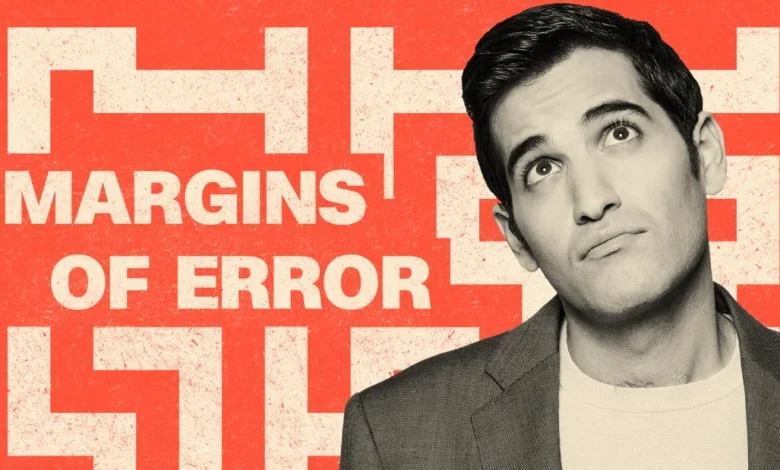
Look closely at almost anything and you will find data—lots of it. But when you push past the calculations, what are all those numbers really saying about who we are and what we believe? CNN data reporter and analyst Harry Enten has dedicated his investigative curiosity to finding out through his engaging audio program, "Margins of Error." The podcast peels back the layers of everyday life, challenging conventional wisdom and cultural norms by examining the statistics that govern modern society. From dissecting the subtle sociological clues hidden within regional accents to calculating the exact financial threshold of human happiness, Enten uses hard data to answer eccentric, profound, and universally relatable questions.
As society becomes increasingly digitized, the volume of available metrics continues to expand exponentially. However, numbers alone rarely tell the complete story. "Margins of Error" bridges the gap between raw statistical analysis and human behavior, offering listeners a nuanced look at why we do what we do. By tackling topics ranging from the psychological appeal of sports underdogs to the curious American resistance to the metric system, the podcast demonstrates that data is not merely a tool for political forecasting or financial markets, but a mirror reflecting the quirks of human culture.
Deconstructing the Modern Travel Dilemma
Opening a window into the logistical frustrations of contemporary life, the episode titled "Pains, Trains and Automobiles" addresses a universal grievance: the inherent stress of travel. While vacations and holiday getaways are universally desired, the mechanics of getting from point A to point B frequently involve cramped seating configurations, soaring fuel costs, and unexpected service fees. Enten consults logistics experts and transportation researchers to explore how modern innovations might alleviate these commuting pains.
The discussion highlights cutting-edge applications of artificial intelligence designed to compute the most efficient road trips across the United States, drawing on optimization algorithms popularized by researchers like Randy Olson. Furthermore, the episode dives into the surprisingly complex mathematics behind airplane boarding strategies—a process that airlines continually attempt to streamline. Looking toward the horizon, Enten even investigates alternative energy sources, asking whether sustainable materials like kelp could eventually power the transportation infrastructure of tomorrow.
The Psychology of the Underdog and Cultural Icons
In "Why are Losers the Favorites?", Enten pivots toward sports psychology and human empathy, exploring why psychological studies consistently show that a majority of observers lean toward supporting underdogs rather than dominant favorites. This phenomenon extends far beyond athletic competition, weaving its way into political preferences and personal narratives.
To unpack this complex emotional response, Enten is joined by prominent statistical analyst Neil Paine, formerly of FiveThirtyEight, along with underdog psychology expert Nadav Goldschmied. The conversation is further enriched by the insights of CNN’s Coy Wire, a former professional football player for the Buffalo Bills who brings firsthand experience of being consistently underestimated on the gridlock of the athletic field. The episode culminates in a data-driven debate regarding which franchise truly holds the cultural title of "America’s Team," challenging traditional assumptions about popular sports dynasties like the New York Yankees or the Dallas Cowboys.
Climate, Forecasting, and the Evolution of Weather Prediction
Meteorological forecasting is a daily ritual for millions, yet public frustration peaks the moment a forecast proves inaccurate. In "Forecasting the Future of Weather," Enten examines the science and reliability of modern meteorology, reassuring listeners that forecasting technology is objectively more advanced today than at any point in human history.
The episode breaks down the complex computer models and atmospheric data collection methods used by meteorologists to predict everything from localized afternoon showers to catastrophic hurricanes. However, Enten also addresses a looming challenge: the destabilizing effects of climate change. As global weather patterns become increasingly erratic, long-term forecasting faces unprecedented variables, making future predictions significantly more complicated for scientists striving to maintain high levels of accuracy.
Modern Romance and the Declining Statistics of Intimacy
Despite a cultural saturation of reality television shows centered on dating, romance, and matrimony, statistical trends indicate that traditional romance may actually be in decline. In "The Mysterious Disappearance of Love, Sex and Romance," Enten adopts the persona of a statistical detective to investigate shifting demographic data.
Indicators such as declining frequencies of sexual activity, rising populations of single adults, and a reduction in traditional romantic gestures point toward a broader societal shift in how human relationships are formed and maintained. To investigate the modern landscape of courtship, Enten immerses himself directly in the cultural phenomenon, even attending a Regency-era themed Bridgerton Ball to observe contemporary expressions of courtship firsthand, blending observational sociology with hard demographic data.
The Persistent American Resistance to the Metric System
Few cultural quirks are as uniquely stubborn as the United States’ continued reliance on the imperial measurement system. In "Why Americans Won’t Give an Inch on Metric," Enten explores why the U.S. remains one of the very few nations globally that has not fully transitioned to the International System of Units (SI).
Rather than viewing this as a simple oversight, Enten discovers that Americans exist comfortably within a hybrid world of liters and gallons, inches and centimeters. Historical analysis reveals that national identity, political resistance, economic costs, and deep-seated cultural pride are inextricably linked to yards, pounds, and Fahrenheit. The episode illustrates how deeply ingrained measurements are within a country’s historical consciousness, making structural change a remarkably slow and contentious process.

The Linguistic Shift from ‘Diet’ to ‘Zero Sugar’
Consumer habits and marketing language undergo constant evolution, often driven by subtle psychological triggers. In "When Did ‘Diet’ Become a Dirty Word?", Enten investigates the beverage industry’s gradual phasing out of the word "diet" in favor of "zero sugar."
As a self-professed aficionado of diet soda, Enten analyzes the corporate motivation behind this rebranding effort. The investigation questions whether this shift represents a substantive change in product formulation or merely a sophisticated marketing war of words designed to appeal to younger, health-conscious demographics who view older terminology with skepticism.
Quantifying Human Happiness and Financial Thresholds
The eternal question of whether money can buy happiness is subjected to rigorous empirical analysis in "Cashing in on Happiness." Enten interviews Matt Killingsworth, creator of a specialized mobile application designed to track human happiness in real time across large populations.
The episode evaluates the exact financial thresholds required to achieve life satisfaction, contrasting the pursuit of six-figure salaries with alternative paths to personal fulfillment. Crucially, the discussion highlights data suggesting that investing money in experiences rather than material possessions yields higher long-term emotional dividends—a theory that Enten tests personally by attempting a high-flying trapeze lesson with the assistance of the Trapeze School New York.
Societal Perceptions of Eyewear and Intelligence
The social stigma historically attached to wearing eyeglasses has undergone a dramatic transformation over the past century. In "Harry Makes a Spectacle of Himself," Enten traces the origins of cultural stereotypes surrounding corrective lenses, investigating whether any factual correlation exists between wearing glasses and perceived intelligence.
Furthermore, the episode explores unexpected practical applications of eyewear, uncovering why criminal defense attorneys frequently utilize specific frames as tactical accessories to influence courtroom perceptions of their clients before juries. Enten supplements these cultural observations with expert medical context provided by Dr. Craig Moskowitz of Moskowitz Eye Care.
Historical Norms of Hygiene and the Evolution of Bathing
Hygenic standards are rarely static, and modern expectations regarding cleanliness are surprisingly recent historical developments. In "Bursting the Bath Time Bubble," Enten explores the anthropological history of human washing habits, tracing practices from the communal bathhouses of Ancient Rome to contemporary daily shower routines.
Consulting hygiene experts, Enten evaluates the actual biological necessity of frequent bathing against modern societal norms and marketing pressures. In a particularly daring investigative segment, Enten explores the consequences of living temporarily without standard deodorant, providing listeners with a humorous yet informative look at the microbial realities of human odor.
Linguistic Uniformity and the Fate of Regional Accents
In "Do I Sound Funny to You?", Enten addresses the fascinating illusion of regional speech patterns. While individuals rarely believe they possess a distinct accent, linguistic data proves that every population group maintains unique phonetic signatures. However, increased geographic mobility and mass media exposure are driving a subtle process of linguistic homogenization across the United States.
Enten investigates whether distinct regional dialects are slowly disappearing under the weight of national cultural conformity. To fully understand the mechanics of regional speech, the episode features linguistic analysis and culminates in an entertaining demonstration of Enten attempting to speak in entirely unfamiliar regional accents.
Broader Impact and Implications of Data-Driven Storytelling
Through "Margins of Error," CNN and Harry Enten have established a distinctive niche in audio journalism, demonstrating that quantitative data analysis can be applied to the most unexpected facets of daily life. By combining rigorous statistical research with accessible, humorous, and deeply human storytelling, the podcast encourages audiences to look beyond surface-level assumptions.
The broader implications of Enten’s work highlight the importance of media literacy and critical thinking in an era saturated with information. Whether examining the aerodynamics of airplane boarding, the fading art of romance, or the cultural weight of a measurement system, "Margins of Error" successfully translates complex datasets into compelling narratives that enrich public understanding of modern culture.