Shark Tank Investor Kevin O’Leary Faces Growing Opposition Over Massive Utah Data Center Project Stratos

The approval of a massive new data center in northern Utah has sparked a significant confrontation between local residents, environmental advocates, and one of the world’s most recognizable venture capitalists. Kevin O’Leary, the Canadian businessman known as “Mr. Wonderful” on the television program Shark Tank, is the primary financial force behind Project Stratos, a hyperscale computing facility proposed for Box Elder County. While the project promises to position Utah as a central hub in the burgeoning artificial intelligence (AI) economy, its reliance on fossil fuel energy and its projected impact on the region’s natural resources have led to a groundswell of public resistance. On Monday, the Box Elder County Commission officially approved a permit for the billion-dollar project, despite a backdrop of protests and thousands of formal objections filed with state regulatory bodies.
Project Stratos represents a pivot in the nature of celebrity-led tech investment. While many high-profile figures have focused on software or generative AI startups, O’Leary is targeting the physical infrastructure that makes AI possible. The scale of the proposal is nearly unprecedented for the region; at full capacity, the data center campus would cover an area roughly two-and-a-half times the size of Manhattan. This massive footprint is necessary to house the tens of thousands of high-density server racks required to train and run modern large language models. However, the physical size of the facility is secondary to its environmental footprint, which has become the primary flashpoint for local opposition.
The Energy Dilemma: Natural Gas in a Green Transition
The most controversial aspect of Project Stratos is its power source. Unlike many modern tech campuses that strive for carbon neutrality through power purchase agreements with wind or solar farms, Stratos is designed to be powered 100 percent by onsite gas-fired generators. Developers for the project confirmed to the Salt Lake Tribune that the facility would operate independently of the traditional power grid by burning natural gas to meet its immense electricity demands.
The environmental implications of this decision are stark. A professor at the University of Utah recently estimated that the emissions from this single project could increase the state’s total net greenhouse gas emissions by as much as 50 percent. This projection comes at a time when Utah is struggling with air quality issues, particularly along the Wasatch Front, and is under pressure to meet federal air quality standards. The use of natural gas at such a scale introduces significant amounts of nitrogen oxides and carbon dioxide into the atmosphere, leading critics to argue that the project is a massive step backward for the state’s climate goals.
Proponents of the project, including O’Leary, argue that the decision to use gas is a matter of reliability and necessity. The global demand for AI processing power is growing faster than the renewable energy grid can currently support. By utilizing onsite generation, the project avoids putting additional strain on Utah’s existing electrical infrastructure, which is already facing challenges due to population growth and the retirement of coal-fired power plants.
Chronology of Development and Public Resistance
The path to approval for Project Stratos has been swift, often bypassing traditional local oversight through its partnership with the Military Installation Development Authority (MIDA). MIDA is a state-created entity designed to facilitate development on or near military land, often providing significant tax incentives and streamlined permitting processes.
The timeline of the project highlights the rapid escalation of tensions:
- Late 2025: Initial discussions between O’Leary’s investment group and Utah state officials began regarding a "hyperscale" data center project.
- Early 2026: MIDA granted Project Stratos significant tax breaks, designating the site as a project area. This move allowed the developers to capture a portion of future property tax revenue to fund infrastructure.
- April 2026: Environmental groups and local residents began to sound the alarm as the scale of the natural gas power plant became public knowledge.
- May 1, 2026: Over 3,700 formal protests were filed with the Utah Division of Water Rights, specifically targeting the project’s request for water permits. Data centers require millions of gallons of water daily for cooling systems, a major concern in the nation’s second-driest state.
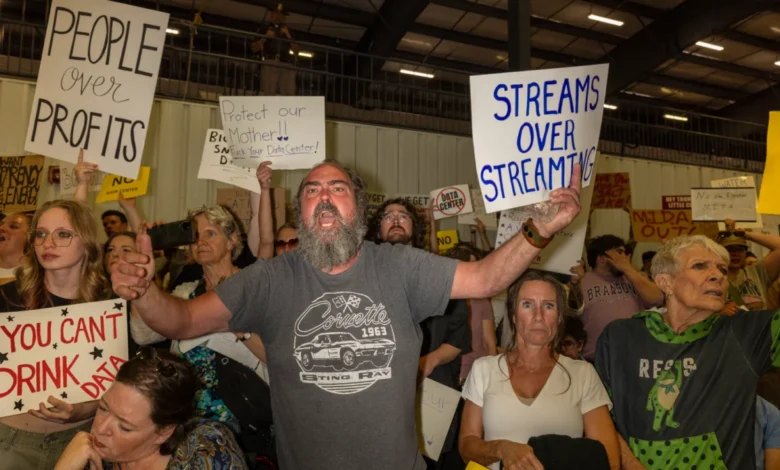
- May 4, 2026: The Box Elder County Commission held a public meeting. Hundreds of protesters gathered, though they were reportedly barred from providing public comment before the commissioners voted to approve the permit.
- May 5, 2026: Kevin O’Leary released a video statement on social media platform X, defending the project and dismissing the protesters as "out-of-state professionals."
Public Sentiment and the "Professional Protester" Narrative
The scene at the Box Elder County Commission meeting reflected a deep-seated frustration among the local populace. Residents arrived with signs citing concerns over air quality, water scarcity, and the noise pollution generated by massive cooling fans and gas turbines. Despite the high turnout, the procedural format of the meeting prevented a public forum, leading to accusations that the commission was "rubber-stamping" a project with generational impacts.
O’Leary’s response to the protests has further polarized the situation. In a video posted to his X account, he claimed that over 90 percent of the protesters were not Utah residents but were instead "paid activists" bused in to disrupt the proceedings. "I’m the only developer of data centers on earth that graduated from environmental studies," O’Leary stated, attempting to establish his credentials as a steward of the land. He suggested that his team was fully aware of the concerns regarding air, water, and noise, but insisted that sustainability was "at the heart" of the proposal.
However, local organizers have pushed back against these claims, asserting that the opposition is grassroots. The 3,700 filings with the Division of Water Rights include names of local farmers, ranchers, and homeowners who fear that the data center’s water consumption will deplete the local aquifer and negatively impact the Great Salt Lake, which is already at historically low levels.
Economic Incentives and State Support
Despite the public outcry, the project enjoys robust support from state economic development officials. The attraction of a billion-dollar investment is significant for Box Elder County, promising construction jobs and a long-term increase in the tax base, even with the incentives provided by MIDA. Utah has marketed itself as "Silicon Slopes," a tech-friendly alternative to California, and securing a major AI infrastructure project is seen by some as a vital win for the state’s future economy.
The involvement of MIDA is particularly noteworthy. By utilizing MIDA’s authority, the project can navigate a more favorable regulatory landscape. MIDA projects often operate under different rules than standard private developments, which critics argue reduces transparency and local control. The tax breaks granted to Project Stratos are intended to offset the massive upfront costs of building a self-sustaining power plant and the necessary fiber-optic connectivity.
Broader Implications for the AI Industry
The conflict in Utah is a microcosm of a larger global challenge: the massive energy and water requirements of the AI revolution. As companies like OpenAI, Google, and Meta race to build more powerful models, the demand for "compute" has skyrocketed. This has led to a resurgence in the construction of fossil-fuel-powered infrastructure, as renewable energy projects often face years of delays due to permitting and grid interconnection issues.
O’Leary’s foray into this space marks a shift in how venture capital views the AI stack. While software gets the headlines, the "bricks and mortar" of the digital age—data centers—are becoming high-yield, albeit high-conflict, assets. O’Leary is also backing Bitzero, a company focused on "green" data centers, though his Canadian projects have reportedly stalled over the last year.
The Utah project serves as a test case for whether states can balance aggressive tech recruitment with environmental preservation. If Stratos proceeds as planned, it will become one of the largest emitters of greenhouse gases in the Western United States. For Utah, the trade-off is clear: the prestige and economic potential of being an AI leader versus the potential degradation of its air quality and water security.
Conclusion and Future Outlook
The approval by the Box Elder County Commission is a significant milestone for Project Stratos, but it is not the final hurdle. The project still faces a deluge of challenges regarding water rights and potential litigation from environmental groups. The Utah Division of Water Rights must still rule on the thousands of protests filed, a process that could take months or even years to resolve.
Kevin O’Leary remains undeterred, betting that the global hunger for AI processing power will eventually outweigh local environmental concerns. However, the intensity of the opposition suggests that the days of quiet data center expansion are over. As these facilities grow to the size of cities and consume the resources of entire counties, they are moving from the periphery of public consciousness to the center of the climate debate. Whether "Mr. Wonderful" can bridge the gap between hyperscale ambitions and local sustainability remains to be seen, but for now, the battle over the Utah desert is only just beginning.
Related posts: