Julius Randle Unfazed by Uncertainty as Brooklyn Nets Navigate Rebuild and Future Roster Decisions

While the ongoing offseason discourse surrounding the Brooklyn Nets has largely gravitated toward Michael Porter Jr. and his multifaceted role as both an offensive weapon and a prime trade asset, a more complex and critical narrative quietly centers on Julius Randle. As the undisputed focal point of the franchise and the lone current All-Star inhabiting the Barclays Center locker room, Randle represents a high-stakes puzzle piece for an organization firmly entrenched in a multi-year rebuilding phase. Approaching his 32nd birthday and armed with a player option that could allow him to test the unrestricted free-agent market as early as next summer, Randle’s long-term future in New York remains one of the league’s most compelling subplots. Yet, despite the swirling external speculation regarding whether he will finish his current contract in Brooklyn or be redirected to a championship contender via trade, the veteran forward remains remarkably unperturbed by the uncertainty.
The Main Facts of the Brooklyn Roster Dilemma
The Brooklyn Nets enter the upcoming NBA campaign at a distinct crossroads in their organizational trajectory. Having pivoted toward a youth-oriented rebuild, the front office has accumulated future draft capital and developmental prospects designed to establish a sustainable foundation for the next decade. Within this landscape, Michael Porter Jr. has dominated headlines due to his dynamic scoring output, his distinctive contract status, and the intense league-wide interest regarding his potential availability on the trade market. Front offices around the association frequently monitor Porter’s timeline to gauge whether the Nets will cash him in for additional draft assets or retain him as a building block.
However, basketball reality dictates that talent hierarchy supersedes timeline optics, and Julius Randle stands alone at the pinnacle of the Nets’ current roster. As a proven multi-time All-Star, Randle brings an aggressive, physical style of play and elite offensive creation that elevates the team’s competitive floor on any given night. This creates a fascinating philosophical dilemma for the front office: keeping an established, veteran star in his prime on a roster full of teenagers and early-career prospects can sometimes create a paradox, anchoring the team to a level of competitiveness that hinders maximum lottery odds while simultaneously providing invaluable mentorship and professional standards for the younger players.
Compounding this dynamic is Randle’s impending contract flexibility. With a player option looming that grants him the unilateral right to bypass the final year of his deal and enter unrestricted free agency, the clock is ticking for the Nets. They must determine whether Randle figures into their competitive window beyond the immediate future or if maximizing his trade value before his contractual leverage peaks is the most prudent path forward.
Chronology and Context of Randle’s Tenure in Brooklyn
To fully comprehend the current crossroads, one must trace the timeline of how Randle arrived at the epicenter of the Brooklyn basketball landscape. Following high-profile veteran trades and a strategic recalibration by the front office, the franchise acquired Randle to stabilize the culture and provide a reliable, high-usage offensive hub. His integration into the locker room immediately altered the team’s identity, instilling a hard-nosed competitive temperament that coaching staffs covet during turbulent transitional periods.
Throughout the previous season, Randle’s performance validated his status as the team’s premier player. He consistently drew double-teams, manufactured high-percentage opportunities for his teammates, and provided veteran poise during late-game execution sequences. Concurrently, the front office spent the subsequent months managing parallel storylines. While trade rumors involving Michael Porter Jr. dominated media cycles throughout the spring and summer—with analysts dissecting cap space implications and potential landing spots—Randle quietly maintained his preparation, shifting his focus strictly to physical conditioning and leadership responsibilities.
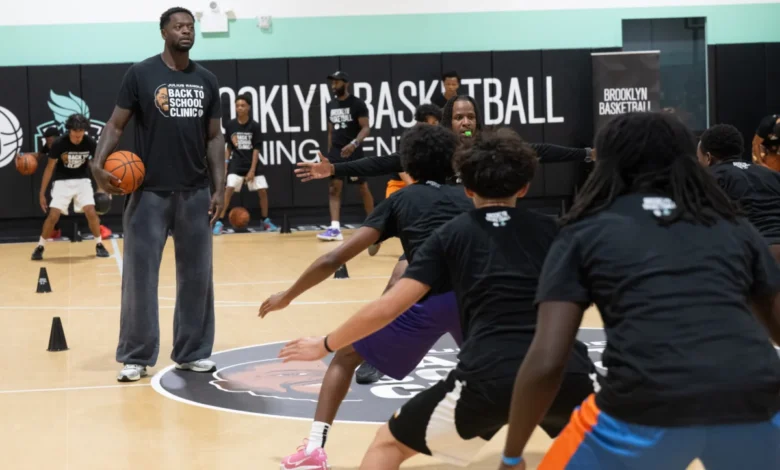
The intersection of these storylines came to a head during a community basketball clinic held over the weekend at the Brooklyn Basketball Training Center. Surrounded by aspiring young athletes and grassroots basketball development initiatives, Randle addressed the media swarm, offering a glimpse into his psychological approach toward the persistent speculation surrounding his contract and career trajectory.
Player Reactions and Internal Perspective
Faced with relentless inquiries regarding his impending free agency and whether he expects to be wearing a Nets uniform for the long haul, Randle maintained a stoic and disciplined demeanor. Rather than engaging in hypotheticals or expressing anxiety over his uncertain future, the veteran forward emphasized a philosophy centered on personal accountability and mental focus.
"I mean, I just focus on the main thing," Randle stated during his appearance at the Brooklyn Basketball Training Center. "I don’t really put my attention or energy on things that aren’t in my control or focus. I really just focus on things that are under my control. That’s just who I am as a person, you know?"
This pragmatic stance is characteristic of a veteran who has navigated multiple organizational shifts, high-pressure markets, and major contract negotiations throughout his professional career. By stripping away external noise—such as front-office calculations, trade deadline chatter, and media projections—Randle insulates himself from the psychological toll that rebuilding seasons can often inflict on established stars. His primary directive remains straightforward: prepare his body, perform at an All-Star level when he steps onto the hardwood, and lead by example for a locker room heavily populated by impressionable youth.
Supporting Data and Roster Construction Metrics
A rigorous examination of the Brooklyn Nets’ financial ledger and statistical profile underscores why Randle’s situation commands such intense league-wide scrutiny. Statistically, Randle remains a prolific offensive engine, routinely averaging robust figures in points, rebounds, and assists. His ability to initiate offense from the elbows, punish smaller defenders in the post, and collapse opposing defenses draws defensive attention that creates open three-point opportunities for perimeter shooters.
From a salary cap perspective, Randle occupies a significant financial footprint that reflects his elite pedigree. While this compensation is commensurate with his production, it presents a delicate balancing act for a rebuilding franchise. Operating under the current collective bargaining agreement, teams must meticulously manage their long-term cap liabilities to maintain maximum flexibility. If the Nets commit a massive multi-year extension to a player entering his mid-30s, it could potentially restrict their financial maneuverability precisely when their younger draft picks are ready for lucrative rookie-scale extensions.
Conversely, letting an asset of Randle’s magnitude walk away for nothing in free agency represents a catastrophic asset-management failure for a rebuilding franchise. Consequently, the front office faces a binary choice as the season approaches: either engage in serious extension talks to lock him into the culture long-term or orchestrate a pre-emptive trade that yields a haul of future draft picks and young prospects before his player option decision triggers an unwelcome departure.
Broader Impact and Strategic Implications for the Franchise
The management of Julius Randle’s future extends far beyond individual statistics or contract numbers; it serves as a litmus test for the overarching philosophy of the Brooklyn Nets’ front office. Rebuilding projects in the modern NBA require a delicate calibration between cultivating a losing environment for draft positioning and maintaining a professional culture that fosters proper habits. Randle represents the ultimate embodiment of that tension.
On one hand, his presence ensures that the Nets remain competitive, preventing the culture from devolving into the rudderless dysfunction that often plagues tanking organizations. Young players learn how to prepare, how to handle physical contact, and how to execute under pressure by sharing the floor with an established All-Star. For a franchise trying to establish a proud, resilient identity in New York City, having a player of Randle’s caliber set the daily standard is an invaluable intangible asset.
On the other hand, the reality of the timeline cannot be ignored. By the time the Nets’ younger core matures into a playoff-ready unit, Randle will have transitioned into the twilight of his prime years. This temporal mismatch is precisely why general managers across the league monitor Brooklyn’s front office with intense anticipation. A player of Randle’s skill set is often the missing piece for an upper-echelon contender looking to push itself over the top, meaning the trade market for his services—should the Nets decide to pivot—would be robust and lucrative.
As the team prepares for the rigors of the upcoming NBA season, the dual narratives of Michael Porter Jr.’s trade potential and Julius Randle’s contractual crossroads will continue to shadow the franchise. Yet, despite the external anxiety and media projections, the central figure of the drama remains unbothered. For Julius Randle, the noise of the front office and the speculation of the tabloids are merely background static. His singular focus remains anchored in the gym, on the court, and entirely within his control—leaving the Brooklyn front office with the ultimate responsibility of deciding how his story in New York will ultimately unfold.