AMD Unveils Helios Rack System to Challenge Nvidia’s Dominance in AI Infrastructure Market

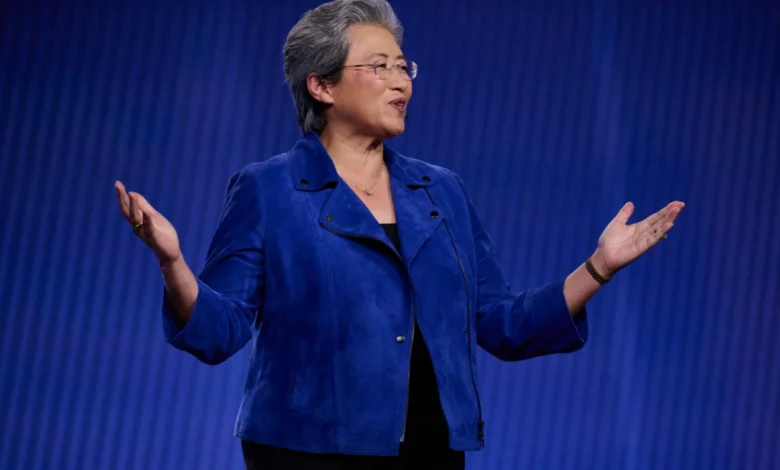
San Francisco, CA – Advanced Micro Devices (AMD) has escalated its direct challenge to competitor Nvidia, unveiling its latest high-performance hardware designed to power the most demanding artificial intelligence (AI) workloads: the Helios rack-scale system. This strategic move, announced at the company’s sold-out Advancing AI conference in San Francisco on Thursday, positions AMD to capture a significant share of the rapidly expanding market for AI compute infrastructure, a segment historically dominated by Nvidia.
Dr. Lisa Su, AMD Chair and CEO, took center stage to promote the Helios system, highlighting its capabilities and a burgeoning list of high-profile customers, including Microsoft, OpenAI, Meta, Oracle, and Anthropic. The company confirmed that shipments of the Helios system are slated to begin later this year, marking a critical juncture in AMD’s ambition to become a leading provider in the AI acceleration space. Beyond the rack system, Dr. Su also introduced new chips specifically engineered to meet the insatiable computational demands of the burgeoning AI industry, reinforcing AMD’s full-stack approach.
The Strategic Imperative: Challenging a Juggernaut
The unveiling of Helios represents a concerted effort by AMD to penetrate a market where Nvidia has long held a near-monopoly. Nvidia’s Vera Rubin and Grace Blackwell rack-scale systems have set the benchmark for AI training and inference in large-scale data centers. For years, Nvidia’s CUDA software platform, coupled with its powerful GPUs, has created a formidable ecosystem that has been difficult for competitors to breach. AMD’s strategy with Helios, backed by its ROCm open-source software platform and powerful Instinct GPUs, is to offer a compelling alternative that not only matches but, by some performance metrics, surpasses the incumbent’s offerings. Reports from industry publications like The Register suggest that Helios demonstrates superior performance against Nvidia’s Vera Rubin in several key benchmarks, signaling a serious contender has entered the arena.
Rack systems are the foundational building blocks of modern AI infrastructure. They integrate numerous processors, typically Graphics Processing Units (GPUs) optimized for parallel computation, into a single, high-density unit. These systems are meticulously engineered for data centers, where they undertake the monumental tasks of training complex AI models, running sophisticated simulations, and executing other compute-intensive workloads that underpin today’s most advanced AI applications. Dr. Su lauded Helios as the tech industry’s "highest-performance AI rack," emphasizing its design to "train and run the most demanding frontier models in the world at massive scale." The sheer ambition of this claim is underscored by the company’s projection that the system will be deployed by leading AI companies at "gigawatt-scale," indicating an unprecedented level of computational power and energy consumption.
A Timeline of Innovation and Market Entry
The journey of Helios to market has been a carefully orchestrated one, with its initial reveal in 2025 generating significant industry buzz. The system made a physical appearance onstage at CES 2026 in January, offering a tangible glimpse into its scale and design – weighing as much as two compact cars, a testament to its density and componentry. This gradual unveiling has built anticipation, culminating in Thursday’s detailed exposition and customer announcements.
The pre-release customer adoption list is particularly striking, featuring some of the most influential players in the AI landscape. OpenAI, Meta, Oracle, Anthropic, and Microsoft have all committed to deploying the Helios system, signaling a strong vote of confidence in AMD’s capabilities. Microsoft CEO Satya Nadella publicly affirmed his company’s intent to expand its Azure cloud infrastructure with Helios, underscoring the strategic importance of this partnership for both companies. Azure, one of the world’s largest cloud providers, will offer Helios-powered instances, making AMD’s advanced AI compute accessible to a broader developer and enterprise ecosystem.
Further solidifying AMD’s position, a strategic partnership with Anthropic was announced just days prior to the Advancing AI conference. This collaboration entails the deployment of up to two gigawatts of AMD Instinct MI450 Series GPUs via the new rack system. The MI450 series GPUs are AMD’s latest generation of accelerators designed for demanding AI and High-Performance Computing (HPC) workloads, offering significant improvements in compute performance, memory bandwidth, and energy efficiency over previous generations. This partnership with Anthropic, a leading AI safety and research company known for its Claude large language model, not only validates Helios’s performance but also provides AMD with a critical feedback loop for optimizing its hardware and software stack for cutting-edge AI development.
Expanding the Portfolio: Venice-X CPU for Data Centers
Beyond the spotlight on Helios, AMD also utilized the conference to introduce another significant product: the Venice-X CPU. Designed specifically for data centers and high-computing workloads, the Venice-X is positioned to address the CPU-intensive aspects of modern data center operations, complementing the GPU-focused Helios system. Slated for a 2027 launch, Venice-X is expected to feature an impressive 1152 MB of 3D V-Cache, 96 cores, and a boost clock of up to 5.15 GHz, built on the Zen 6 architecture. This CPU aims to deliver substantial performance gains for applications requiring massive memory bandwidth and core count, further strengthening AMD’s comprehensive offering for the data center market. The introduction of Venice-X underscores AMD’s holistic approach to data center infrastructure, providing both GPU and CPU solutions tailored for the escalating demands of AI and general-purpose computing.
Dr. Su’s Vision: The Trillion-Dollar AI Accelerator Market
A significant portion of Dr. Su’s keynote addressed the overarching trajectory of the chip industry, particularly the explosive growth anticipated in the AI sector. She projected that by the year 2030, chips powering AI will constitute a massive proportion of the overall computing market, driven by what she termed a "step change in compute demand." This dramatic shift, according to Dr. Su, is largely fueled by the rise of "agentic AI."
Agentic AI refers to a new paradigm where AI systems are not merely reactive but are capable of autonomous decision-making, planning, and executing multi-step tasks to achieve a goal. Unlike traditional AI models that might perform a single, predefined function, agentic AIs can reason, utilize various tools, access diverse data sources, and iterate through multiple steps until a problem is solved. This iterative, complex problem-solving process inherently demands vast amounts of computational power. "When you ask the agent to do something, it actually has dozens of steps, and it has to reason, and it has to call tools, and it has to access data, and it has to keep doing it over and over until it solves the problem, and so you need lots of GPUs to do all that," Dr. Su explained.
This escalating demand translates into staggering market projections. Dr. Su announced, "We’re now expecting that by 2030, the AI accelerator market is going to reach about $1.4 trillion." To put this into perspective, she added, "What that means is, by the end of the decade, the AI accelerator market is going to approach the size of the entire semiconductor market today." This projection underscores the profound economic transformation AI is expected to catalyze, repositioning the entire semiconductor industry around AI-specific hardware.
Furthermore, Dr. Su elaborated on the specific role of GPUs within this burgeoning market. "We do expect that GPUs are going to make up the vast majority of that market because the algorithms are still very much in their infancy, and we’re still continuing to see the workloads change, and that favors programmability in the overall silicon ecosystem," she stated. The inherent flexibility and programmability of GPUs make them ideally suited for the rapidly evolving nature of AI algorithms, where new architectures and training methods are constantly emerging. This adaptability is crucial in a field where the fundamental computational primitives are still being defined, giving GPUs a significant edge over more specialized, less flexible hardware.
Broader Impact and Implications
AMD’s aggressive push into the AI accelerator market with Helios and its comprehensive suite of products carries significant implications for the broader technology landscape. For AMD, it represents a monumental opportunity to diversify its revenue streams beyond traditional CPU and discrete GPU markets, tapping into a sector with exponential growth potential. Successfully challenging Nvidia’s entrenched position could significantly alter the competitive dynamics, fostering innovation and potentially leading to more competitive pricing and broader availability of high-performance AI compute.
For the AI industry, the emergence of a strong alternative to Nvidia’s ecosystem could accelerate development. A more diverse supplier base reduces reliance on a single vendor, mitigating supply chain risks and fostering greater choice for AI labs and cloud providers. The commitment to "gigawatt-scale" deployments also highlights the unprecedented energy demands of frontier AI models. This will necessitate significant investment in sustainable data center infrastructure, advanced cooling technologies, and potentially the development of more energy-efficient AI algorithms and hardware. The sheer power required also raises questions about the environmental footprint of future AI advancements, pushing the industry to innovate in energy conservation.
The endorsements from industry giants like Microsoft, OpenAI, and Anthropic are not just customer wins; they are strategic partnerships that will help shape the future of AMD’s AI hardware and software roadmap. These collaborations provide AMD with invaluable insights into the real-world demands of cutting-edge AI research and deployment, allowing them to fine-tune their offerings to meet evolving needs.
In conclusion, AMD’s Advancing AI conference marks a pivotal moment in the AI chip race. With the Helios rack-scale system, the Venice-X CPU, and a clear strategic vision articulated by Dr. Lisa Su, AMD is not just participating in the AI revolution; it is actively working to shape its computational foundation. The coming years will reveal whether AMD can sustain this momentum and truly disrupt Nvidia’s long-held dominance, ultimately redefining the landscape of AI infrastructure for the next decade.
Related posts: