Bridges to Nowhere: The Multimillion-Dollar Federal Subsidy Wiring Alaskas Ghost Towns

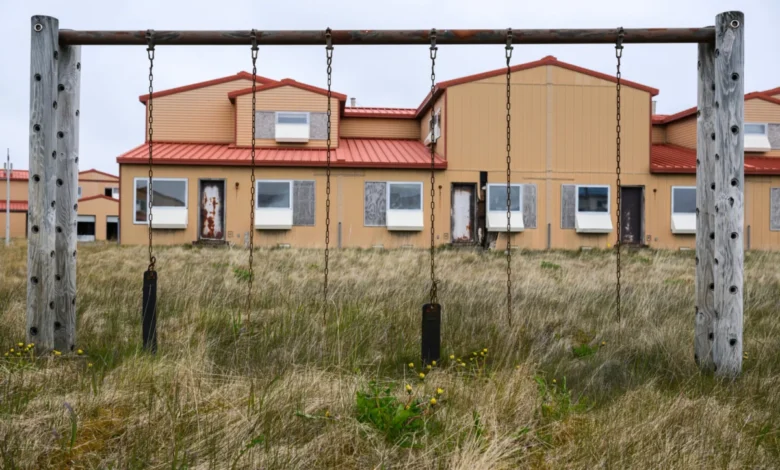
On a desolate island in the Bering Sea, approximately 1,200 miles from the bustling hub of Anchorage, Alaska, stands a stark monument to bureaucratic inertia and the misallocation of federal resources. It is an abandoned house on what was once a thriving United States Navy base. The structure is a shell; furniture is absent, and the relentless Aleutian winds howl through shattered windowpanes. The human inhabitants of this home departed decades ago, leaving the property to the elements. Yet, emerging from the weathered exterior wall is a vibrant orange pipe, housing a sophisticated black fiber-optic cable that disappears into the subarctic soil.

This cable was not a relic of the Cold War but a modern installation intended to bridge the digital divide. It was laid to connect this specific home—and hundreds of others like it—to the high-speed internet long after the military base had been shuttered. Today, the cost of maintaining this connection for a single abandoned building, along with hundreds of other largely vacant structures, exceeds $340,000 annually. It is an internet service that, by all local accounts, no one uses, funded by a multibillion-dollar federal program that continues to funnel money into the Alaskan wilderness with minimal oversight.
The Mechanics of the Universal Service Fund
The capital fueling this waste is drawn directly from the pockets of the American public. It originates from a "Universal Service" fee added to nearly every monthly phone bill in the United States. These contributions flow into the Universal Service Fund (USF), a Federal Communications Commission (FCC) initiative designed to ensure that fast, affordable communication services are available to even the most remote and economically challenged regions of the country.

However, a joint investigation by the Anchorage Daily News and ProPublica has revealed a systemic failure in how these funds are administered in the state of Alaska. The USF often pays for internet speeds that are functionally obsolete, provided to customers who have long since migrated to more efficient private-sector alternatives. Despite these discrepancies, the FCC has maintained a consistent flow of capital to telecommunications companies, regardless of their performance metrics or the legal standing of their leadership.
The investigation highlighted instances where federal payments continued even under egregious circumstances. In one case, a Fairbanks-based telecommunications firm received subsidies while its owner was serving time in federal prison for tax evasion. In another, Alaska’s largest telecommunications provider, GCI, continued to receive government funds following a $40 million settlement over allegations of fraud related to the subsidy program. While the settlement did not constitute an admission of guilt, it underscored the lack of stringent safeguards protecting the fund from potential exploitation.

Adak: A Case Study in Regulatory Failure
Nowhere is the failure to safeguard public funds more evident than on the island of Adak. During the height of the Cold War, Adak served as a strategic outpost, housing thousands of Navy personnel and their families. When the base officially closed in 1997, the island’s population collapsed. While official state estimates suggested a population of 77 residents last year, local inhabitants claim the year-round population is closer to two dozen.
Based on these local figures, the federal internet subsidy provided to the local telecommunications company, Adak Eagle, amounts to roughly $14,000 per person per year. Field reporting involved visiting every single building that Adak Eagle claimed to serve in its regulatory filings. The results were unanimous: not a single resident interviewed subscribed to the subsidized service. Instead, the community has turned to Starlink, the satellite internet service operated by Elon Musk’s SpaceX. Starlink arrived on the island in 2023 without a cent of FCC subsidy. Residents report that Starlink is up to 40 times faster than the subsidized landline service and costs between $90 and $140 per month—a fraction of the hundreds of dollars Adak Eagle once charged on top of its federal checks.

A Chronology of Subsidies and Scrutiny
The history of Adak Eagle is inextricably linked to federal largesse. The company’s infrastructure was built almost entirely on public money, beginning in the early 2000s with FCC subsidies and federal loans intended to upgrade antiquated telephone wires to modern fiber-optic lines. By 2011, the company was drawing $2.68 million annually from the Universal Service Fund.
The company’s financial practices have faced federal scrutiny before. A 2013 federal order revealed that Adak Eagle’s president, Larry Mayes, had utilized telecom subsidy funds to purchase a fleet of vehicles and a fishing boat that were deemed unnecessary for the business’s core operations. Furthermore, the audit found that Mayes’ annual salary of $237,455 was "unreasonable" and "disproportionate" for a company of its size, particularly when compared to industry standards in Anchorage.

In its defense at the time, the company argued that salaries should be viewed through the lens of a small-scale operation where employees performed multiple roles, citing the island’s extreme remoteness and harsh weather as justifying factors. Since 2016, Adak Eagle has received approximately $3.6 million from the federal broadband subsidy. This is supplemented by $3.54 million from an FCC program designed to replace lost revenue from long-distance call connections and an additional $3.75 million from the Alaska Universal Service Fund.
When confronted with questions regarding the use of these funds and the wiring of abandoned buildings, Mayes declined to comment, stating only that his company operates within the established rules of the FCC program. The FCC itself has remained silent, failing to respond to multiple inquiries regarding the efficacy of its Alaskan subsidies.

The "Walking Dead" Landscape of Adak
The physical reality of Adak stands in sharp contrast to the high-tech connectivity promised by federal filings. The town resembles a post-apocalyptic set; streets are empty, and the silence is broken only by the wind and the cries of seabirds. Relics of the mid-2000s are frozen in time: a shuttered McDonald’s still displays 99-cent hamburger advertisements, and yellowing magazines from 2006 sit in abandoned living rooms.
The housing subdivisions, originally built for military families, are in various states of collapse. In the neighborhood once known as "Officer’s Country," homes have been literally torn in half by Aleutian storms, exposing bathrooms and kitchens to the relentless rain. Even in the more intact neighborhoods, rotted walls and bird nests are common. Despite this decay, Adak Eagle’s 10-year plan, approved by the FCC in 2016, obligated the company to maintain lines to 346 locations—essentially every building left standing.

In 2022, the FCC reduced the number of mandated service locations to 306 after the company acknowledged that some buildings were unlivable. Crucially, however, the total subsidy amount remained unchanged. Federal data shows that the company has reported broadband availability at up to 283 locations, many of which are rusted, open-air shells with no furniture or appliances, yet often featuring a single, incongruous telephone jack.
Technological Displacement and the Starlink Factor
The arrival of satellite-based internet has fundamentally shifted the telecommunications landscape in rural Alaska, rendering expensive landline subsidies increasingly difficult to justify. For residents like 26-year-old Steven Ivanoff, a competitive online gamer, the subsidized landline service was never a viable option. Before Starlink, the island’s limited bandwidth was a source of constant community friction, as a single user could effectively "clog" the network for everyone else.

Under the subsidized Adak Eagle service, download speeds ranged from 1 to 10 megabits per second—well below the FCC’s own 100-megabit standard for modern broadband. In contrast, a speed test of Ivanoff’s Starlink connection recorded 447 megabits per second. This technological leap has allowed residents to perform tasks that were previously impossible, such as high-definition video calling with family members overseas or streaming modern entertainment.
The ultimate irony of the situation is visible at Adak Eagle’s own local office. The building is surrounded by the same orange piping used to wire the island’s ghost houses. Yet, mounted prominently above the front door are two Starlink satellite dishes. Even the provider of the subsidized service has opted for a private-sector alternative to conduct its business.

Geopolitical Implications and Future Prospects
While the current residents of Adak have moved on from subsidized landlines, the island’s strategic value remains a topic of intense national interest. Located at a critical juncture in the North Pacific, Adak’s proximity to Russian and Chinese naval routes has led some lawmakers to call for a renewed military presence.
U.S. Senator Dan Sullivan of Alaska has been a vocal advocate for reopening a base on the island, citing the need for "Arctic infrastructure" in an increasingly contested region. Last year, Congress allocated $115 million for the exploration and development of such infrastructure. A Pentagon-led task force is currently evaluating the feasibility of these proposals.

If a military return to Adak does materialize, the existing fiber-optic network—currently serving empty rooms and rotted floorboards—might finally find a purpose. However, the current state of affairs remains a glaring example of "policy lag," where federal programs continue to fund the solutions of the past while the communities they are meant to serve have already embraced the technology of the future.
Conclusion: A Call for Accountability
The situation in Adak is a microcosm of a broader challenge facing federal subsidy programs: the difficulty of maintaining oversight in geographically isolated regions. As the FCC continues to collect fees from millions of American phone users to fund the Universal Service Fund, the "ghost connections" of Adak serve as a reminder that without rigorous auditing and a willingness to adapt to new technologies, public funds can easily vanish into the tall grass of the Alaskan tundra.

The disconnect between the data reported to regulators and the reality on the ground suggests that the "digital divide" is being bridged not by government-subsidized copper and fiber, but by the rapid advancement of private satellite constellations. For the taxpayers of the United States, the orange pipes of Adak represent a costly lesson in the importance of ensuring that federal investments are tied to actual usage and modern performance standards, rather than simply maintaining the appearance of connectivity in a town that time—and the Navy—left behind.
Related posts: