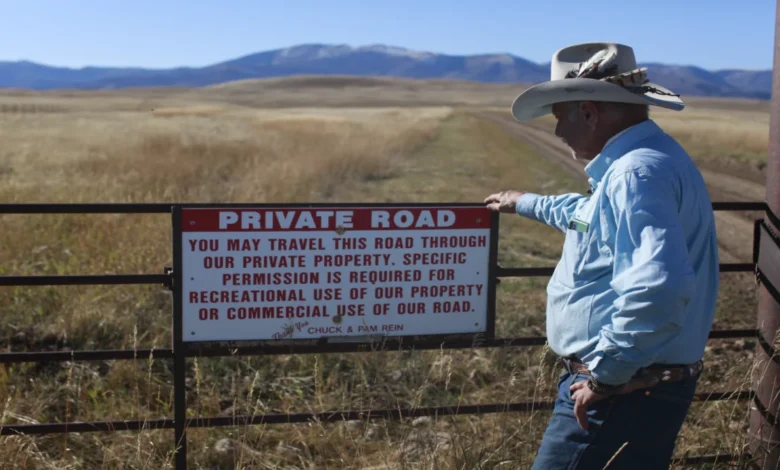
At the terminus of a winding dirt road on the northeastern periphery of Montana’s Crazy Mountains, a modest sign serves as a sentinel, informing visitors that they have transitioned from public domain into private territory. For Brad Wilson, a fifth-generation Montanan and former sheriff’s deputy, this sign represents more than a boundary; it is the physical manifestation of a profound loss. Wilson, a lifelong hunter who grew up herding sheep in the shadow of these jagged peaks, views the closure of this historic access point as a harbinger of a broader national trend: the systematic transfer of public resources into the hands of the global elite.
The road beyond the gate was once a primary artery into the eastern side of the Crazy Mountains, a trail used by the public for over a century. However, in early 2025, the U.S. Forest Service formally relinquished this access as part of a complex and highly controversial land exchange with the Yellowstone Club. Located approximately 100 miles away in Big Sky, the Yellowstone Club is an ultra-exclusive residential community and ski resort catering to billionaires and celebrities. To critics like Wilson and various conservation advocates, the swap is a definitive example of how wealthy private interests are leveraging political influence to reshape the American West.
The Architecture of Exclusivity: The Yellowstone Club and CrossHarbor Capital
To understand the friction in the Crazy Mountains, one must look at the scale of the Yellowstone Club’s operations. Perched at an elevation of 7,000 feet, the club was established in the 1990s through initial land exchanges with the Forest Service. Since its 2009 acquisition by Boston-based CrossHarbor Capital Partners, the club has expanded its footprint to over 15,000 acres, creating what is arguably the most exclusive gated community on Earth.
The membership roster of the Yellowstone Club reads like a directory of the world’s most influential figures, including tech titans Bill Gates and Mark Zuckerberg, financial giants Warren Buffett and Bill Ackman, and high-profile athletes like Tom Brady. Within its boundaries, members enjoy 3,000 acres of private ski slopes, a dedicated fire department, and undeveloped lots that have commanded prices as high as $10 million.
Through its subsidiary, Lone Mountain Land Company, CrossHarbor Capital has become one of the largest luxury resort developers in the Rocky Mountains. This expansion has not been without controversy. In 2016, the club faced public outrage after more than 30 million gallons of sewage overflowed into the Gallatin River, resulting in over $300,000 in penalties. Despite these incidents, the club’s influence has only grown, bolstered by its status as a preferred retreat for high-ranking political figures.
The Intersection of Wealth and Federal Policy
The fight over Montana’s public lands is intrinsically linked to the shifting priorities of the federal government. Under the first and second Trump administrations, public land management has undergone a paradigm shift, moving away from conservation and toward a model that treats federal acreage as "assets on a balance sheet."
A central figure in this transition is Interior Secretary Doug Burgum. As the head of the Department of the Interior, Burgum oversees roughly 500 million acres of federal land. He is also a prominent member of the Yellowstone Club. Financial disclosures reveal that Burgum owns a $22 million condominium at the club, held through an entity called Lone View, LLC, which generated between $100,000 and $1 million in rental income in 2024. Furthermore, Burgum holds an ownership stake in the club itself valued at up to $250,000.
While Burgum’s office maintains that he has complied with all federal ethics requirements, critics point to a potential conflict of interest as the administration pursues policies that favor private development. These policies include a proposed $1 billion cut to the National Park Service budget, the repeal of the 2001 Roadless Rule—which protects nearly 60 million acres from timber harvesting and road construction—and the exploration of selling public lands to address the national housing crisis. Advocates argue that such land sales would likely benefit luxury developers rather than the average citizen, as remote public parcels lack the infrastructure required for affordable housing.
A Chronology of Conflict in the Crazy Mountains
The tension in the Crazy Mountains is rooted in a 19th-century policy known as "checkerboarding." In the late 1800s, the U.S. government incentivized the construction of transcontinental railroads by granting companies every other square mile of land along the tracks. This created a mosaic of public and private ownership that has led to a century of disputes.
2016: The conflict intensified when landowners began blocking historic trails that crossed their private sections. A U.S. forest ranger who attempted to defend public access by installing Forest Service signage was reportedly pressured by local elites. Following complaints to Montana Senator Steve Daines and then-Agriculture Secretary Sonny Perdue, the ranger was reassigned, a move many locals viewed as political retribution.
2017: Although the ranger was eventually reinstated, the incident underscored the power imbalance in the region. Around this time, consultants representing the Yellowstone Club began quiet negotiations for a land swap that would grant the club land for a new "expert ski run" in Big Sky in exchange for resolving access issues in the Crazy Mountains.
2021–2023: The details of the land swap, known as the East Crazy Inspiration Divide Land Exchange, were slowly revealed. During this period, the Yellowstone Club purchased the 18,000-acre Crazy Mountain Ranch at the southern end of the range. This move was described by conservationists as a "bait and switch," as the club had previously suggested it had no intentions of developing in the Crazies.
2024: The Yellowstone Club began converting the ranch into a private membership experience, including a luxury spa and golf course. State regulators sued the ranch after it was discovered they were illegally withdrawing water for irrigation before obtaining the necessary permits.
2025: The Forest Service officially authorized the land swap. The deal moved 4,000 acres of public land into private hands in exchange for 6,000 acres of private land. While the public gained a higher total acreage, the quality of the land was vastly different.
Analyzing the Swap: Value versus Accessibility
On paper, the East Crazy Inspiration Divide Land Exchange appeared to be a benefit for the public. Appraisals valued the land gained by the public at $9.6 million, compared to $8.5 million for the land relinquished. However, a closer examination of the terrain reveals a different story.
The land given up by the Forest Service consisted of low-elevation, accessible hillsides ideal for elk hunting and family hiking. In contrast, much of the land gained by the public is situated at high altitudes, characterized by steep shale slopes and rugged peaks. An independent appraiser hired by the Forest Service noted that some of the new public parcels are so "difficult to reach" that a visitor would essentially need to be a "skilled rock climber" to navigate them.
Furthermore, the swap consolidated public land in the center of the range, effectively creating a "ring of private ownership" around it. This consolidation benefits large private landowners, such as Yellowstone Club member David Leuschen, who owns a nearly 8,500-acre ranch in the Crazies. These landowners now enjoy exclusive "backdoor" access to prime public backcountry, while the general public is forced to navigate a new, more grueling 22-mile trail at higher elevations.
Official Responses and Tribal Concerns
The U.S. Forest Service has defended the exchange, asserting that it resolves long-standing access disputes and creates a contiguous block of wild country. Mary Erickson, a former Forest Service supervisor, emphasized that the new trail system would meet all federal standards and provide a durable solution to the checkerboard problem.
The Yellowstone Club has also issued statements characterizing itself as a "good neighbor" and emphasizing its investment in wastewater treatment and conservation. Regarding the Crazy Mountain Ranch, a club representative stated that the acquisition was a late-stage development that "enhanced the benefits to the public."
A significant point of contention remains the impact on the Crow Tribe, for whom the Crazy Mountains (specifically Crazy Peak) are sacred. Proponents of the swap claimed it would secure tribal access to these sites through a formal agreement with David Leuschen. However, no independent third party has verified the existence of this agreement, and Leuschen has publicly denied its existence in some contexts. Tribal officials have expressed a desire for increased access but remain wary of the land swap’s overall implications for their ancestral territory.
Broader Implications for America’s Public Lands
The events in the Crazy Mountains are a microcosm of a national struggle over the future of the American landscape. From the handover of sacred Indigenous sites to copper mining interests in Arizona to the overturning of mining bans in Minnesota’s Boundary Waters, the trend toward privatization is accelerating.
Critics argue that the current trajectory represents a "crisis of representation." When two-thirds of public comments oppose a land swap, yet federal agencies proceed regardless, it suggests that the voices of local citizens are being drowned out by the financial weight of oligarchs and their political allies.
As the Yellowstone Club continues to expand its "private membership experiences" across the West, the traditional Montana way of life—defined by open access and shared stewardship of the land—is being replaced by a model of exclusive enclosure. For Brad Wilson and other advocates, the fight is no longer just about a single trail; it is about preventing the transformation of America’s wilderness into a private playground for the ultra-wealthy. The "assets on the balance sheet" that Secretary Burgum speaks of are, to many Americans, the irreplaceable heritage of the nation. In the words of the late conservationist Jim Posewitz, the message to those seeking to privatize these lands is simple: "Make ’em take it from you."
Related posts: