Florida Appeals Court Permits Continued Operation of Alligator Alcatraz Migrant Detention Center Overturning Previous Environmental Mandate

The United States Court of Appeals for the 11th Circuit issued a landmark 2-1 ruling on Tuesday, allowing the controversial migrant detention facility known as "Alligator Alcatraz" to remain operational. The decision effectively overturns a lower court’s order that would have shuttered the facility due to alleged violations of federal environmental statutes. This ruling marks a significant victory for the administration of Florida Governor Ron DeSantis, which has maintained that the state-funded facility is a necessary response to federal immigration shortfalls, despite fierce opposition from environmentalists and human rights advocates.
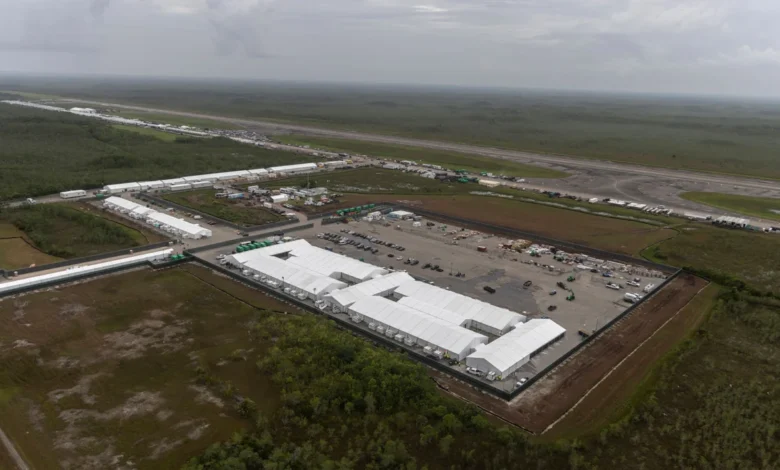
Located deep within the Florida Everglades at the site of the Dade-Collier Training and Transition Airport, the facility has become a flashpoint for legal and political battles since its inception. The appellate court’s decision centers on the jurisdictional reach of the National Environmental Policy Act (NEPA), concluding that the environmental groups challenging the site failed to demonstrate sufficient federal involvement to trigger the law’s stringent review requirements.
The Legal Conflict and Appellate Ruling
The legal challenge against Alligator Alcatraz was spearheaded by a coalition of environmental organizations, including Friends of the Everglades. The plaintiffs argued that the construction and operation of a massive detention complex in the heart of a sensitive ecosystem required a comprehensive environmental impact statement under NEPA. They contended that because the facility serves the federal purpose of immigration enforcement, it should be subject to federal environmental oversight.
However, the majority opinion, authored by Chief Judge William Pryor, rejected this reasoning. Pryor, an appointee of President George W. Bush, argued that the facility is primarily a state-run enterprise. "Federal authority is, at most, indirect," Pryor wrote. "It is involved in the construction only insofar as it sets the terms for which the facility may be used for detention of aliens, but Florida officials dedicated its land to that use." The court found that because the state of Florida provided the land and the initial funding—totaling approximately $390 million to date—the project did not constitute a "major federal action."
In a sharp dissent, Judge Nancy Abudu, a Biden appointee, characterized the majority’s view as "just plain wrong." Abudu argued that immigration is an inherently federal responsibility and that Florida’s role is inextricably linked to federal policy. She noted that so long as Florida participates in the federal government’s detention scheme, it should be subject to the same regulatory hurdles as any federal agency.
A Chronology of Controversy
The rise of Alligator Alcatraz began in the summer of 2025, during a period of increased pressure on the Department of Homeland Security (DHS) to find additional housing for migrants pending deportation.
- June 2025: The DeSantis administration begins rapid construction of the detention center at the Dade-Collier Training and Transition Airport in Ochopee, Florida. Environmental groups immediately file suit to halt the project, citing lack of public comment and environmental reviews.
- July 4, 2025: Aerial images of the facility, dubbed "Alligator Alcatraz" by critics due to its remote, swamp-surrounded location, go viral, sparking national debate over the ethics of the site.
- August 2025: A federal judge in Miami rules in favor of the environmentalists, concluding the facility exists solely for federal immigration enforcement and ordering it to wind down operations within 60 days.
- September 2025: The 11th Circuit Court of Appeals grants a stay on the lower court’s order, allowing the facility to remain open while the appeal is processed.
- March 2026: Investigative reports surface detailing poor living conditions, including mosquito infestations and restricted water access. Senators Jon Ossoff and Dick Durbin launch a formal investigation into alleged abuses.
- April 7, 2026: The 11th Circuit hears oral arguments regarding the facility’s legal status.
- April 13, 2026: New allegations emerge regarding guards using pepper spray on detainees protesting the loss of telephone access.
- April 21, 2026: The 11th Circuit officially vacates the lower court’s decision, allowing the facility to stay open indefinitely.
Environmental Risks to the Everglades Ecosystem
The primary environmental concern involves the facility’s proximity to the Big Cypress National Preserve, a critical component of the Greater Everglades Ecosystem. The Dade-Collier airport, where the center is located, was originally intended to be the world’s largest jetport in the late 1960s, but that project was abandoned specifically because of the ecological damage it would have caused to the region’s water flow and wildlife.
Environmentalists have presented data suggesting that the detention center’s operations are already impacting local fauna. One of the most significant concerns is the Florida panther, an endangered species with a remaining population estimated at only 200 individuals. Court filings by environmental groups suggest that increased vehicle traffic on the remote roads leading to the facility significantly raises the risk of panther-vehicle collisions, which is the leading cause of death for the species.
Furthermore, the facility utilizes high-intensity security lighting that remains active throughout the night. Experts estimate this light pollution affects approximately 2,000 acres of habitat. Eve Samples, executive director of Friends of the Everglades, noted that this lighting disrupts the foraging patterns of local bat populations and other nocturnal wildlife. "The evidence of that harm is clear," Samples stated, emphasizing that the construction bypassed the very laws designed to prevent such ecological degradation.
Human Rights Allegations and Living Conditions
Beyond the environmental impact, Alligator Alcatraz has faced a barrage of criticism regarding the treatment of its inhabitants. The facility houses thousands of migrants in what have been described as primitive conditions. Reports from detainees and legal advocates highlight a recurring list of grievances:
- Climate and Pests: Due to its location in the Everglades, the facility is prone to flooding and extreme humidity. Detainees have reported severe mosquito and "no-see-um" infestations that lead to skin infections.
- Medical Care: Advocates allege that medical attention is lackluster and slow, with many detainees waiting days for basic triage.
- "The Box": Perhaps the most harrowing allegation involves the use of "the box," a form of disciplinary confinement where detainees are reportedly shackled and held in small, outdoor metal cages in direct sunlight for hours. Florida officials have denied these claims, calling them "false."
- Use of Force: Most recently, attorneys representing detainees told a judge that guards utilized pepper spray to quell a protest that began after the facility’s phone system was disabled. This incident allegedly occurred shortly after a court had ordered expanded legal access for those held at the site.
The bipartisan investigation launched by the U.S. Senate is currently seeking documents from the Florida Division of Emergency Management, which oversees the facility’s operations.
Financial and Political Implications
The operation of Alligator Alcatraz is a costly endeavor. Florida has already committed $390 million of state funds toward the project. However, the state is currently seeking a $608 million reimbursement grant from the Federal Emergency Management Agency (FEMA).
Critics argue that the facility is a "boondoggle" for taxpayers, noting that the state is spending massive sums on a function that is traditionally the responsibility of the federal government. Conversely, proponents of the facility argue that Florida is filling a vacuum left by the federal government’s inability to manage the border and deportation proceedings effectively.
The political stakes are equally high. Governor DeSantis has frequently used the facility as a symbol of his "Florida First" approach to immigration, often clashing with the Biden administration over enforcement priorities. The appeals court ruling reinforces the state’s ability to act independently in the realm of immigration-related infrastructure, provided they can prove the action is state-led rather than federally mandated.
Future Outlook and Broader Impact
While the 11th Circuit’s ruling is a significant setback for those seeking to close the facility, the legal battle is not over. The case has been remanded to the district court for further proceedings. Plaintiffs may seek a rehearing en banc (before the full roster of 11th Circuit judges) or appeal to the U.S. Supreme Court.
The implications of this case extend beyond the borders of Florida. If the ruling stands, it could provide a blueprint for other states to build their own detention or enforcement facilities without adhering to federal environmental or administrative standards, provided they can structure the projects as "state-funded" initiatives.
For the Everglades, the ruling means the continued presence of a high-density industrial and residential complex in a zone previously earmarked for conservation. For the thousands of individuals currently detained within the walls of Alligator Alcatraz, the ruling means their environment—and the conditions of their confinement—will remain unchanged for the foreseeable future.
"This fight is far from over," Eve Samples of Friends of the Everglades stated following the ruling. "Alligator Alcatraz will go down in history as a flagrant assault on the Everglades, and we look forward to returning to the District Court to advance our case to shut it down." As the legal process continues, the facility remains a stark symbol of the ongoing tension between state sovereignty, environmental protection, and the complex reality of American immigration policy.
Related posts: