Father’s House: DR Sales Boards Radical Cult Documentary Featuring David Dencik and Trine Dyrholm

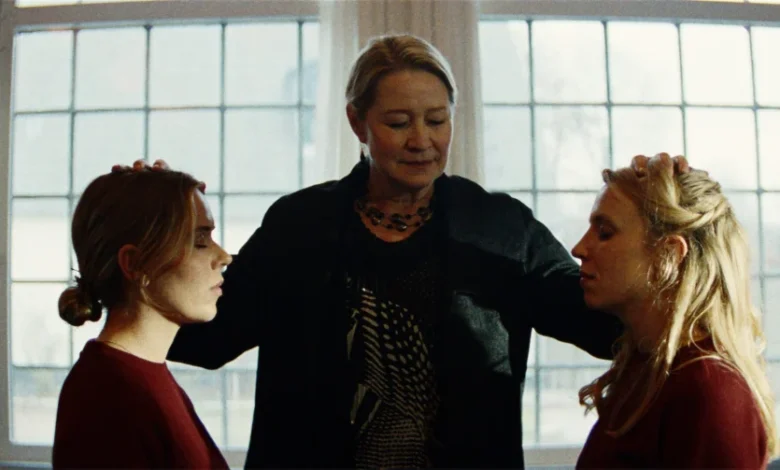
The international distribution landscape for high-stakes, hybrid documentary filmmaking has seen a significant shift as Copenhagen-based DR Sales announced it has acquired the global rights to Father’s House, a daring new project that interrogates the psychological mechanisms behind the Danish Christian sect Faderhuset. Directed by a triumvirate of acclaimed documentary specialists—Andreas Koefoed, Eva Mulvad, and editor-turned-director Adam Nielsen—the film is poised for a major festival run, having already secured spots in the international documentary competition at the Tallinn Black Nights Film Festival and the prestigious Signed section at the International Documentary Film Festival Amsterdam (IDFA).
The film represents a bold departure from traditional non-fiction storytelling, blending reenactments, archival-style sequences, and a meta-commentary on the filmmaking process itself. By casting A-list Danish talent, including David Dencik, known for his roles in No Time to Die and The Chestnut Man, and Trine Dyrholm, celebrated for her performances in The Danish Woman and Queen of Hearts, the directors have created a bridge between the clinical reality of cult trauma and the visceral, dramatic reconstruction of those experiences.
A Chronology of Control: The Rise and Fall of Faderhuset
To understand the weight of the film, one must examine the history of the sect it portrays. Faderhuset, or "Father’s House," emerged in the 1990s as a radical Christian congregation. Under the charismatic and often polarizing leadership of Ruth Evensen—played in the film by Dyrholm—the sect gained notoriety for its strict, often militant interpretation of religious doctrine.
Between the 1990s and its eventual dissolution in 2013, the group was the subject of intense media scrutiny in Denmark. Allegations of exorcisms, the practice of speaking in tongues, and the psychological and physical isolation of members were staples of public discourse. The sect’s influence peaked in the mid-2000s, but as internal dissent grew and former members began to speak out, the cracks in its foundation widened. By the time the congregation officially closed in 2013, it had left a trail of fractured families and disillusioned individuals struggling to reclaim their autonomy in the secular world.
The Hybrid Methodology: Merging Fiction and Fact
The creative decision to employ a "hybrid" format was not merely an aesthetic choice but a narrative necessity. The directors noted that because there was no surviving footage of the most intimate and abusive moments inside the sect, a standard documentary approach would have felt incomplete.
"We wanted the best of both worlds," the directing trio explained in a joint statement. By utilizing reenactments, the filmmakers sought to capture the "rich and crazy" material provided by former members without forcing real-life trauma into the rigid, often artificial structure of a traditional narrative screenplay.
The process was deeply collaborative. Former member Camilla Louise Johnson, whose book served as the initial catalyst for the project, acted as a primary consultant and gatekeeper. Her involvement ensured that the reenactments—which feature Dencik as the former member Jerry and Laura Kronborg Kjær as Camilla—remained tethered to the emotional truth of the survivors. The directors found that when the real former members interacted with the actors, the dynamic was "electric," revealing not just the story of the cult, but the inherent manipulation involved in any act of filmmaking.
Data and Impact: Why We Join Cults
The sociological implications of Father’s House extend far beyond the borders of a specific Danish religious group. The film serves as a mirror for the universal human condition. In their research, the filmmakers delved into the psychology of group dynamics, asking why individuals in a "free world" choose to surrender their agency.
According to data from various studies on high-control groups and sectarian communities, individuals most susceptible to recruitment often possess high levels of idealism or are navigating major life transitions. The film argues that Faderhuset was not an anomaly, but rather an extreme manifestation of a human desire for belonging.
"What truly terrified us wasn’t just the group itself, but rather the lengths to which we as humans will go in our desperate search for love, acceptance and a sense of belonging," the directors noted. This focus on the "gut feeling" and the suppression of intuition is a core theme that the film aims to communicate to its audience, hoping to foster a broader societal conversation about manipulative behavior in all its forms—from workplace environments to domestic relationships.
Industry Reception and Distribution
For DR Sales, the acquisition of Father’s House represents a continuation of their commitment to high-caliber, socially conscious documentary work. Kim Christiansen, the executive producer for DR Sales, highlighted the internal reaction to the early cuts of the film, describing the team as being "blown away" by its originality.
The film is being shopped as both a 90-minute feature and a two-part series, offering flexibility to international broadcasters and streamers. Produced by Pernille Rose Grønkjær and Malthe Koch for Danish Documentary, the film has also secured support from major Nordic public broadcasters, including NRK and SVT. Following its festival circuit debut, the film is scheduled for a theatrical release in Denmark on November 19, via Camera Film.
Broader Implications for Documentary Filmmaking
The success of films like Father’s House, as well as the previously noted inspiration of Kaouther Ben Hania’s Four Daughters, suggests a paradigm shift in how historical trauma is documented. The "meta-layered" approach, where the film acknowledges its own artifice, has become an effective tool for navigating the ethics of trauma. By pulling back the curtain, the filmmakers avoid the "white savior" or "voyeuristic" traps that often plague documentary filmmaking.
By allowing the actors to learn the specific religious language of the sect—a vocabulary dominated by concepts of the devil, praise, and spiritual warfare—the film creates an immersive experience that feels authentic to those who lived it. Furthermore, the inclusion of an editor like Adam Nielsen in the directing chair highlights a growing trend of post-production professionals taking a more active role in the conceptualization of films, ensuring that the "emotional structure" of the narrative is prioritized over a standard linear timeline.
Conclusion: A Call to Intuition
As Father’s House moves toward its public release, its primary objective remains the empowerment of the audience. The directors believe that by exposing the mechanics of gaslighting and manipulation within a controlled environment, viewers will be better equipped to identify similar patterns in their own lives.
The film serves as a poignant reminder that while it is easy to look at the screen and believe that one is immune to the influence of a cult, the reality of human social psychology is far more complex. By trusting their intuition and listening to the "inner voice" that the sect members in the film were forced to suppress, the audience is invited to move from a position of passive observation to one of critical reflection.
With its high-profile cast, rigorous research, and innovative form, Father’s House is positioned to be one of the most significant documentary releases of the year, marking a milestone in the ongoing effort to document the complexities of faith, power, and the search for identity in the 21st century.