At the Crossroads of Generosity and Fiscal Reality: California Faces a Defining Crisis for Medi-Cal

California’s healthcare safety net is standing at a treacherous precipice. For decades, the state has proudly worn the badge of having one of the most comprehensive and inclusive Medicaid programs in the United States, extending health coverage deeper into vulnerable populations than nearly any other jurisdiction. However, a compounding cocktail of systemic healthcare inflation, aggressive state-led expansions, mounting budget deficits, and impending federal legislative cuts has pushed Medi-Cal to its structural limits. As the state grapples with multi-billion-dollar shortfalls and a shifting political landscape in Washington, policymakers and gubernatorial candidates alike are forced to confront an uncomfortable question: How much generosity can a single state afford before the entire system buckles under its own weight?
The Anatomy of a Funding Crisis
The cracks in California’s fiscal foundation became glaringly apparent in March 2025, when the state’s coffers ran dry of Medicaid funds required to reimburse doctors, clinics, and hospitals. To keep the massive healthcare apparatus afloat, California executed an internal, short-term maneuver by borrowing $3.4 billion from its general fund. While state officials, including representatives for Governor Gavin Newsom, defended the move as a routine cash-flow practice utilized intermittently over the years, the situation quickly escalated beyond historical norms.
Just months later, as the loan ballooned to $4.4 billion, Governor Newsom and Democratic state lawmakers reached an agreement that marked a dramatic departure from standard budgetary protocol. Instead of paying back the loan within the fiscal year as traditionally required, officials opted to stretch the repayment schedule across a grueling 10-year period.
The decision drew immediate fire from fiscal conservatives and Republican lawmakers, who condemned the maneuver as an attempt to "paper over" the state’s structural deficit and defer accountability to future administrations. A memo issued by GOP senators in July 2025 warned that the strategy left future governors and legislatures to clean up an avoidable financial mess. The nonpartisan Legislative Analyst’s Office (LAO) similarly labeled the long-term debt-stretching strategy as highly unusual for managing operational cash shortages.
A Chronology of Expansion and Strain
To understand how Medi-Cal arrived at this fiscal crossroads, health policy analysts point to a multi-decade trajectory of continuous expansion that transformed a targeted poverty safety net into a sprawling healthcare system covering nearly a third of the state’s population.
Established in 1965 under federal legislation signed by President Lyndon B. Johnson, Medicaid was originally engineered to serve distinct, high-vulnerability groups: low-income families with children, the elderly, and individuals with severe disabilities. Over the ensuing six decades, federal and state policy shifts steadily widened that gateway. The most significant historical pivot occurred under the Affordable Care Act (ACA), which allowed states to expand Medicaid to low-income, childless adults.
California did not stop at federal minimums. Over the years, the state aggressively stacked non-mandated benefits onto Medi-Cal, ranging from specialized physical therapy and hospice care to housing assistance. Starting in 2024, California took its most ambitious step yet by offering state-funded healthcare coverage to all low-income residents regardless of age or immigration status—though fiscal pressures have since forced lawmakers to scale back some of those provisions.
The sheer scale of this growth is staggering. Since 2010, Medi-Cal enrollment has nearly doubled, while annual expenditures have skyrocketed from approximately $50 billion to $222 billion. According to the LAO, Medi-Cal now consumes more than 40% of California’s total state budget, making it by far the largest single item of public expenditure and outstripping the combined Medicaid spending of New York and Texas.
The Federal Threat: Washington’s Impending Cuts
Compounding California’s internal financial pressures are sweeping federal policy changes orchestrated by congressional Republicans. The federal legislation—dubbed the "One Big Beautiful Bill Act" by its proponents and criticized as the "Big Ugly Bill" by Governor Newsom—is projected to slash federal Medicaid spending by more than $900 billion over the next decade.
The federal legislation introduces stringent new work requirements for adult beneficiaries under the age of 65 and curtails the utilization of healthcare provider taxes and other creative financing mechanisms that states have historically deployed to maximize federal matching funds.
Health policy researchers at the University of California, Berkeley Labor Center and the UCLA Center for Health Policy Research project that these combined federal and state policy shifts could leave more than 2 million Californians under 65 without health insurance over a four-year window. At least 730,000 residents have already been disenrolled from the program since June 2025 as the state navigates eligibility redeterminations and administrative rollbacks.
Furthermore, upcoming federal mandates set for 2028 will require states to impose service fees on certain enrollees, creating additional hurdles for low-income individuals trying to maintain consistent coverage.
The Human Toll: On the Ground in Los Angeles
While macroeconomic debates rage in Sacramento and Washington, the real-world consequences are playing out daily in overcrowded emergency departments and underfunded community clinics across California.
Take the case of Nelly, a 59-year-old resident of Los Angeles County. For years after leaving her corporate career to care for her aging mother, Nelly remained uninsured, choosing to forgo medical care entirely. That changed abruptly three years ago when she woke up and lost the sight in her left eye.
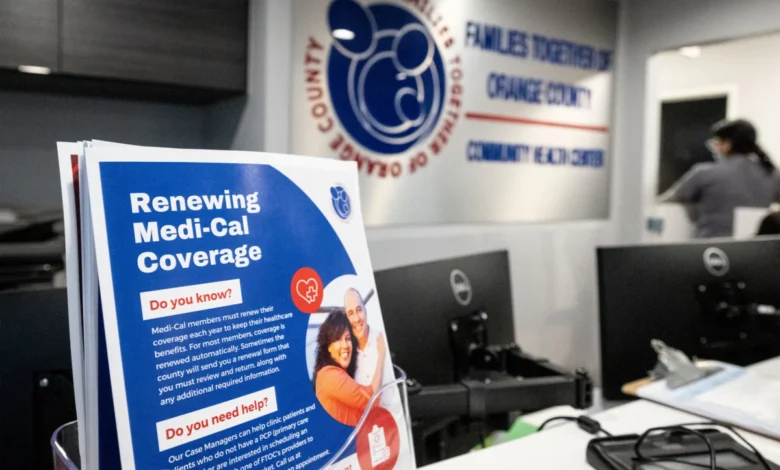
Nelly enrolled in Medi-Cal directly through an emergency room intake desk. The program now covers her essential appointments with eye specialists and provides coordinated transportation to medical facilities. Although her medical condition may ultimately exempt her from upcoming work requirements, Nelly lives in constant anxiety about maintaining her coverage, having already navigated numerous bureaucratic paperwork hurdles simply trying to complete routine renewals.
"I understand that not everyone on the program may need it," Nelly shared, requesting anonymity to protect her privacy from family members unaware of her health crisis. "But it should be there for someone like me."
Yet, the institutions tasked with treating patients like Nelly are operating past the breaking point. At Martin Luther King Jr. Community Hospital in Los Angeles, patient volume routinely exceeds design capacity by a factor of five. Approximately 80% of the hospital’s patients are either uninsured or enrolled in Medi-Cal. The crisis of uncompensated care has reached such acute levels that the facility has erected triage tents in its parking lot to handle the overflow of emergency room patients.
"We already have an extremely overcrowded, overburdened emergency department," said Elaine Batchlor, CEO of MLK Community Healthcare. "Insured care will turn into uncompensated care, and the financial burden for that will fall squarely on providers."
The Political Landscape and the 2026 Gubernatorial Race
The fiscal and structural crisis is taking center stage in California’s 2026 gubernatorial race, where candidates are vying to succeed Governor Newsom as he terms out of office. Despite the magnitude of the looming upheaval, policy experts note that neither major candidate has yet offered a comprehensive, realistic blueprint for balancing fiscal solvency with healthcare access for the 13.6 million Californians—roughly 1 in 3 residents—relying on Medi-Cal.
Republican candidate Steve Hilton, a former television commentator, has adopted a hardline fiscal stance, arguing that the state’s current healthcare model is bloated, inefficient, and unsustainable. Hilton has pledged to pare back Medi-Cal eligibility criteria and eliminate coverage for immigrants without legal status, framing the current system as a departure from its original mandate.
"The role of safety net programs was just that—to be a safety net," Hilton said in an interview. "I don’t think it’s a particularly positive boast to say 40% of Californians should be on a program that was designed for people living in poverty."
Conversely, Democrat Xavier Becerra, a former U.S. Health and Human Services Secretary and longtime champion of government-funded healthcare expansion, has positioned himself as a defender of California’s safety net against federal cuts. Becerra has vocally opposed recent state decisions to freeze enrollment for undocumented adult immigrants and introduce monthly premiums, warning that such measures will only shift costs onto taxpayers by forcing patients into expensive emergency room care.
However, critics point out that Becerra has yet to detail how he plans to secure the tens of billions of dollars required to maintain the program’s current operational footprint without resorting to drastic tax hikes or severe benefit cuts.
Looking Forward: Hard Choices for the Next Administration
As California enters this turbulent era, state officials, hospital administrators, and advocacy groups agree that the status quo is mathematically untenable. Mark Ghaly, former Secretary of the California Health and Human Services Agency and current co-chair of the Future of Medi-Cal Commission, candidly acknowledged the shifting paradigm.
"We know we can’t afford to serve everybody we want to serve in the model that we have today," Ghaly said. "What can we do differently? What can we do smarter?"
Jennifer Kent, who oversaw Medi-Cal during the administration of Governor Jerry Brown, emphasized that every political promise carries a direct fiscal price tag. "California has always struggled with wanting to have as broad a program as possible but then having to figure out a way to pay," Kent observed. "There is no population that we have met that we don’t want to offer coverage to, and we’ve never met a benefit that we don’t like."
With billions in federal support evaporating, administrative backlogs mounting, and providers demanding immediate financial stabilization, the incoming governor will inherit one of the most volatile and politically radioactive policy landscapes in modern California history. Whether the state chooses to aggressively prune eligibility, discover unprecedented administrative efficiencies, or introduce new revenue streams, the era of unbridled Medi-Cal expansion has officially come to an end, leaving policymakers to navigate the narrow and painful path between compassion and fiscal reality.