The Iraqi government has initiated high-level direct negotiations with the United States to secure a strategic exemption from the comprehensive ban on Iranian airlines, a move necessitated by the severe logistical disruptions currently paralyzing travel across the country. The ban, which went into effect earlier this week, has caused significant strain at major transportation hubs, most notably at the airport in the holy city of Najaf—the primary gateway for Iranian pilgrims traveling to Iraq’s sacred Shia sites.
The Prime Minister’s media office confirmed on Saturday that the request for an exemption is grounded in humanitarian concerns. According to official statements, Baghdad is seeking to carve out a specific corridor for flights essential for medical evacuations, educational pursuits, religious tourism, and the general welfare of civilians. The ongoing reliance on these air routes is significant, as Iranian carriers are the primary service providers for Iraqi students studying in Iran, patients seeking specialized medical care, and thousands of religious pilgrims whose movement is integral to the cultural and religious fabric of both nations.
This diplomatic pivot comes as Iraq aligns itself with a broader coalition of nations, including the United Arab Emirates, in enforcing a stringent U.S.-led blockade on Iranian aviation. The mandate follows a stern directive from U.S. Treasury Secretary Scott Bessent, who warned that Iranian airlines would be "shut down" as part of a campaign to leverage economic pressure on Tehran. Failure to comply with these sanctions carries the threat of expulsion from the U.S. dollar system, a catastrophic prospect for any regional economy.
A Tense Diplomatic Landscape and the Strait of Hormuz
The aviation crisis is inextricably linked to the broader conflict in the Middle East, which has seen an escalation in military and economic warfare throughout the month of September 2026. At the center of the geopolitical struggle is the Strait of Hormuz, the world’s most critical maritime oil chokepoint.
As of late Friday, U.S. Central Command (CENTCOM) reported that the U.S. naval blockade had successfully redirected 122 commercial vessels since its reinstatement on July 14. In the last 48 hours alone, seven additional ships were diverted, while 40 million barrels of crude oil were transported through the strait under U.S. military escort—matching pre-war volumes.
Despite this, the situation remains volatile. On Friday, Iranian Foreign Minister Abbas Araghchi presented a proposed seven-day de-escalation plan to U.S. mediators in New York. The proposal, which mirrors parts of a 14-point Memorandum of Understanding (MoU) signed by President Trump in June, suggests that if specific conditions regarding sanctions relief and oil export restrictions are met, Iran would reopen the strait and resume negotiations for a final nuclear deal.
However, the U.S. administration remains cautious. Reports indicate that President Trump has rejected an immediate ceasefire proposal from Tehran, expressing skepticism regarding Iran’s willingness to adhere to his stringent demands. U.S. officials, speaking on condition of anonymity, noted that Washington feels it holds a strategic advantage in the strait, reducing the urgency to accept a deal that might not yield long-term security.
Escalation in Yemen and the Saudi Front
While the diplomatic focus remains on the U.S.-Iran dynamic, the conflict has metastasized into the Arabian Peninsula. The Saudi-led coalition, which has been engaged in a brutal struggle against the Iran-backed Houthi movement, reported on Saturday that it had intercepted two drones and two ballistic missiles launched by the militia.
The strikes, which targeted the Riyadh area and the air base city of Khamis Mushait, mark a significant escalation in a conflict that shattered a years-long truce in July. The Houthi leadership has been defiant; Hezam Al-Assad, a member of the Houthi Political Bureau, described the recent attacks as merely a "small-scale rehearsal" for a wider campaign.
The international community has begun to signal alarm. The United Nations Security Council, in a rare moment of consensus, condemned the Houthi attacks on Saudi infrastructure, particularly the targeting of civilian sites. Meanwhile, Pakistan’s Prime Minister Shehbaz Sharif delivered a stark warning at the UN, declaring that any further attacks on the holy city of Mecca would constitute a "red line" for Islamabad. This warning underscores the regional instability, as Pakistan, Turkey, and Saudi Arabia have recently solidified a defense pact aimed at mutual support against external aggression.
The Human Cost and Economic Fallout
The broader impact of the regional war is manifesting in a severe humanitarian and economic crisis. In Yemen, hospitals are reaching a breaking point. Medical facilities are being forced to turn away pregnant women and non-trauma patients as they struggle to manage the influx of war-wounded individuals. International organizations, including the IOM, report that over 130,000 people have been displaced in recent weeks due to the Houthi offensive along the Red Sea coast.
Economically, the European Union is feeling the sting of the conflict. EU Energy Commissioner Dan Jorgensen warned in a recent letter to ministers that the war has triggered a "price crisis" linked to supply disruptions. The fear is that the ongoing volatility in oil and gas markets will lead to persistent inflation and energy shortages as winter approaches.
Internal Dynamics: Leadership and Nuclear Inspections
Amidst the international pressure, Iran’s political establishment is attempting to manage perceptions of its stability and intent. President Masoud Pezeshkian, in a wide-ranging interview with CBS News, sought to clarify Iran’s stance on nuclear transparency. He affirmed that Tehran would allow UN nuclear inspectors full access to its facilities as part of a comprehensive peace deal, while simultaneously restating that the development of nuclear weapons is "haram" (forbidden) under religious doctrine.
Pezeshkian also addressed concerns regarding the health of Supreme Leader Mojtaba Khamenei, asserting that he has no ongoing health issues and is playing an active, though consultative, role in the current decision-making process.
Chronology of Recent Tensions (September 2026)
- September 22: U.S. Secretary of State Marco Rubio expresses skepticism regarding potential breakthroughs in U.S.-Iran diplomacy.
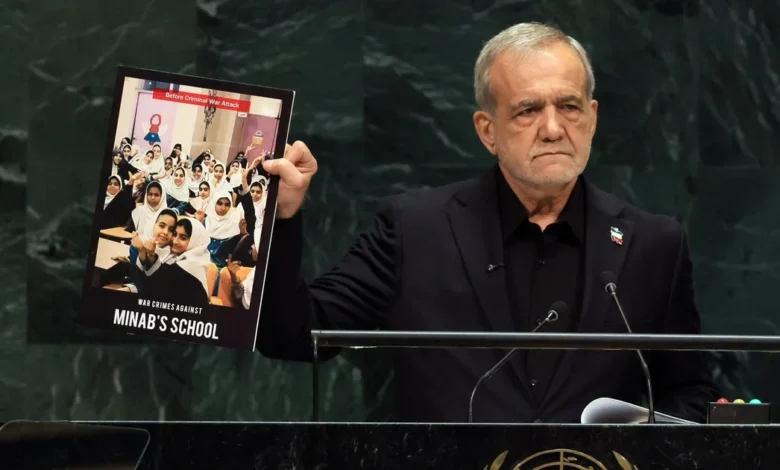
- September 23: President Pezeshkian addresses the UN General Assembly, displaying photos of schools bombed during the conflict.
- September 24: Israeli PM Benjamin Netanyahu addresses the UN, sparking mass walkouts from various delegations.
- September 25: Iran presents a 7-day de-escalation plan to U.S. mediators in New York.
- September 25: Saudi Arabia, Turkey, and Pakistan hold high-level defense consultations regarding Houthi threats.
- September 26: Iraq formally requests a U.S. exemption for Iranian airlines to resume humanitarian and religious flights.
Analysis: Implications for Regional Stability
The intersection of the U.S. naval blockade, the Houthi offensive in Yemen, and the aviation ban in Iraq illustrates the complex, multi-layered nature of the current Middle East conflict. The U.S. strategy of "maximum pressure" appears to be yielding results in terms of shipping control and economic leverage, but it is simultaneously creating humanitarian bottlenecks and pushing regional actors into tighter defensive alliances.
The proposal for a seven-day window to reopen the Strait of Hormuz represents a potential off-ramp, but the lack of trust between Washington and Tehran remains a formidable obstacle. Furthermore, the involvement of global powers like China—which President Trump warned against providing any aid to Iran—adds a layer of geopolitical friction that could complicate any future peace negotiations.
As Baghdad navigates its role in this conflict, the success of its plea for an aviation exemption will serve as a bellwether for the flexibility of U.S. sanctions policy. If the U.S. grants the request, it may signal a shift toward localized, humanitarian-focused diplomacy. If it refuses, the isolation of Iran will continue, likely forcing a recalibration of alliances across the region that could have long-lasting implications for global energy security and international relations.