‘The Life and Deaths of Wilson Shedd’ Review: Amanda Seyfried and Scoot McNairy Bring Raw Intensity to Tim Blake Nelson’s Death Row Drama

A Decade-Long Labor of Love
The production represents a 12-year development cycle for Nelson, a testament to his commitment to a narrative that refuses to offer easy catharsis. Based on actual events, the film is set against the backdrop of an Oklahoma maximum-security prison, utilizing a stark, rural American aesthetic bolstered by a delicate acoustic guitar score composed by Henry Nelson and Will Curry. This sonic choice serves to pivot the audience’s focus away from genre-driven action and toward the internal, often erratic, psychological states of the protagonists.
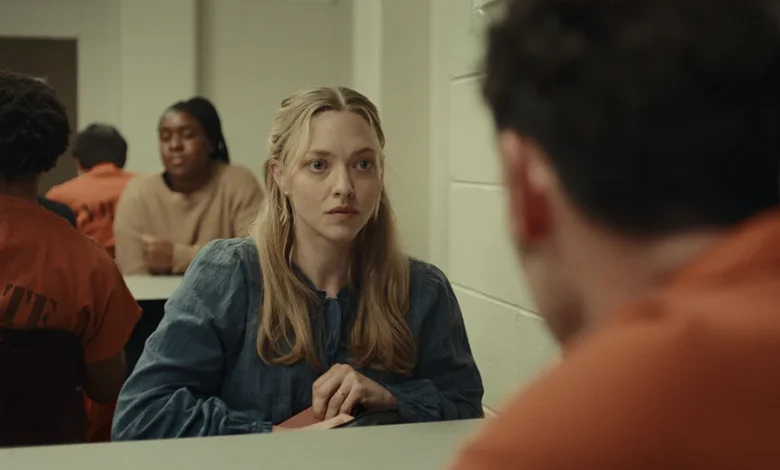
The film stars Scoot McNairy as Wilson Shedd, a death row inmate whose intelligence is as dangerous as it is profound, and Amanda Seyfried as Karen, an educator who begins teaching a writing course within the prison walls. The narrative is anchored by an ensemble cast that includes Missi Pyle, Elizabeth Marvel, William Jackson Harper, and Devyn Tyler, all of whom contribute to the film’s dense, authentic texture.
Narrative Structure and Chronological Complexity
Nelson utilizes an ambitious, tripartite timeline to weave together three distinct threads of the human experience. The first follows Karen’s classroom interactions, which provide her a momentary sanctuary from her abusive home life with her alcoholic husband, Kenneth, portrayed by Grant Harvey. The second timeline documents the visceral details of Wilson’s prison break, a sequence that escalates from incarceration to a series of violent, real-world encounters. The third timeline serves as a ticking-clock narrative, focusing on the administrative and emotional preparations for an upcoming execution by lethal injection, overseen by warden Joan Gardner (Missi Pyle).
This structural choice is as much a source of tension as it is a challenge for the viewer. By intercutting the domestic desperation of Karen’s life with the clinical finality of the state’s execution process, Nelson forces a juxtaposition between private cruelty and institutional violence. However, this fragmented approach occasionally disrupts the character arc of Karen, specifically regarding the rapid progression of her relationship with Wilson. While the script explores the well-documented phenomenon of individuals forming emotional bonds with inmates, the pacing of their transition from teacher-student to potential co-conspirators demands a significant leap of faith from the audience.
The Dynamics of Performance and Character
Scoot McNairy’s portrayal of Wilson Shedd is a study in calculated ambiguity. McNairy balances a soft-spoken, literary sensitivity—highlighted by his character’s prose about the complexities of childhood hunting—with a raw, volatile physicality. The film leaves the audience questioning the sincerity of Wilson’s connection to Karen: is he a man seeking genuine human connection, or is he a predator who identifies a vulnerable woman and methodically exploits her circumstances?
Amanda Seyfried delivers a grounded performance as Karen, a woman whose life is defined by the caretaking of her father, who suffers from dementia, and her navigation of a failing marriage. Her decision to enter the prison environment is born of economic necessity and a desire for purpose, yet her susceptibility to Wilson’s manipulation remains a point of contention in the film’s narrative logic. Critics have noted that while Seyfried effectively portrays the desperation of her character, the film’s condensed timeline makes her eventual complicity in Wilson’s escape plan feel accelerated.
The Reality of State-Sanctioned Violence
The film reaches its most harrowing emotional peak in its depiction of the impact of violence on innocent bystanders. The inclusion of William Jackson Harper and Devyn Tyler as John and Jane Lawson, a family caught in the crossfire of the prison escape, provides the film with its moral center. Their struggle to maintain faith in the face of absolute terror serves as a stark counterpoint to the bureaucratic coldness of the execution chamber.
Missi Pyle’s performance as Warden Joan Gardner offers a nuanced look at the toll of law enforcement. Her portrayal captures the exhaustion of a professional who can no longer reconcile the requirements of her duty with her personal humanity. The film’s inclusion of an execution sequence—filmed with unflinching, clinical precision—invites direct comparison to previous works like Dead Man Walking and Clemency. By documenting the mechanical, bureaucratic nature of lethal injection, Nelson forces the audience to consider the philosophical implications of the state’s role in taking a human life, questioning whether such actions are fundamentally distinct from the criminal violence the institution purports to punish.
Industry Implications and Audience Reception
The film is being positioned as a prestige drama, finding its home within the festival circuit before an expected rollout on streaming platforms. Its success hinges on the audience’s willingness to engage with material that is intentionally difficult and devoid of traditional moral alignment.
From a production standpoint, the film highlights a recurring issue in independent cinema: the underutilization of high-caliber talent in secondary roles. Wunmi Mosaku, an actress of immense range, is relegated to a supporting role as a friend to Karen, a narrative choice that leaves little room for her to contribute to the film’s deeper thematic weight. Despite this, the ensemble remains one of the most effective aspects of the production, grounding the film’s more surreal, thriller-adjacent elements in a reality that feels tangible and lived-in.
Analytical Context: The Cycle of Violence
The broader implication of The Life and Deaths of Wilson Shedd lies in its examination of the "cycle of violence." By tracing the origins of Wilson’s volatility to his past and contrasting it with the state’s cold, systematic approach to his death, Nelson suggests that the system is not a cure for violence but rather a reflection of it. The film does not provide a moral judgment on the characters; instead, it presents their choices as the result of a convergence of personal history, systemic neglect, and bad faith.
The film’s focus on the "epistolary" nature of the relationship between the teacher and the inmate underscores the power of narrative. Through writing, both characters attempt to rewrite their own histories—Karen to escape her domestic trauma, and Wilson to justify or explain his existence. This meta-narrative layer adds depth to the film, suggesting that in the absence of justice or mercy, storytelling becomes the only mechanism for human survival.
As the film moves toward a broader release, its reception will likely be split between those who find the structural fragmentation frustrating and those who appreciate the gravity and technical mastery of Nelson’s vision. For a director who has been a consistent, vital force in American independent film for over three decades, this project serves as a definitive statement on the limits of empathy and the persistence of cruelty in the human heart.
In summary, the film succeeds not because it provides answers, but because it refuses to let the viewer look away from the questions. By forcing an confrontation between the domestic abuse in a suburban home and the sterile, legalistic violence of a maximum-security execution, Nelson creates a chilling, coherent portrait of a society that has lost its way in the pursuit of retribution.
Related posts: