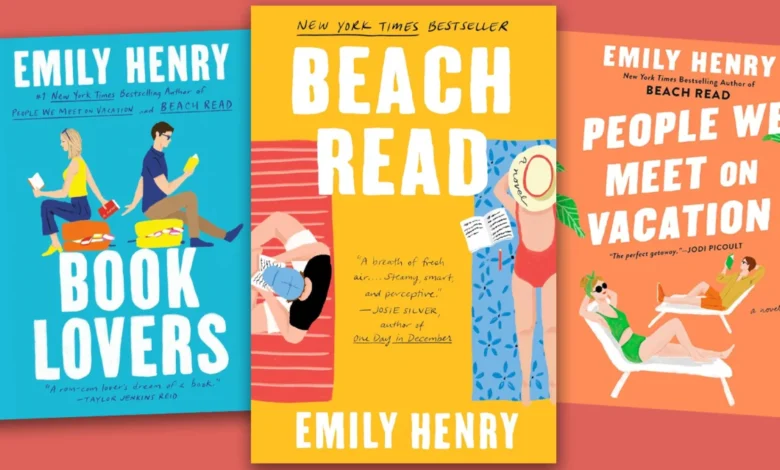
Romance author Emily Henry has solidified her status as a literary powerhouse, with an impressive five of her recent novels now slated for film adaptations. This remarkable cinematic trajectory began with her 2020 summer release, "Beach Read," marking the start of a prolific period where Henry has consistently delivered a new novel each year. Her subsequent bestsellers, "People We Meet on Vacation" (2021), "Book Lovers" (2022), "Happy Place" (2023), and "Funny Story" (2024), have all captured the hearts of readers and, now, the attention of Hollywood studios. The momentum for adapting her work gained significant traction in 2022, with multiple production companies securing optioning deals for her novels. The latest novel, "Great Big Beautiful Life," published in 2025, is also rumored to be in line for a potential adaptation, further underscoring Henry’s pervasive influence on contemporary popular fiction and its transition to visual media. This extensive slate of adaptations highlights a strategic embrace of Henry’s distinct brand of witty, emotionally resonant storytelling by the film industry, poised to bring her beloved characters and narratives to a wider global audience.
A Catalog of Cinematic Aspirations: From Page to Premiere
The phenomenon of Emily Henry’s novels transitioning to the big screen is a testament to the enduring appeal of well-crafted romantic comedies and the industry’s keen eye for commercially viable literary properties. The decision by various studios to invest in adapting her work reflects a broader trend of Hollywood seeking out bestselling authors whose narratives resonate deeply with contemporary audiences. Since 2022, a concentrated effort has been made to bring these stories to life, with several projects already in various stages of production and release.
People We Meet on Vacation: The First Wave of Adaptation
The journey of Emily Henry’s novels to film began in earnest with "People We Meet on Vacation." The adaptation, produced by 3000 Pictures, saw Brett Haley take the directorial reins, working from a screenplay adapted by Yulin Kuang. This project was notably the first of Henry’s novels to enter production and subsequently reach the screen.

The film premiered on Netflix on January 9, 2026, following the release of a teaser and a full trailer that generated considerable anticipation among fans. The production team included Marty Bowen, Wyck Godfrey, and Isaac Klausner from Temple Hill, with Laura Quicksilver overseeing the project for Temple Hill. Studio oversight was managed by Erin Siminoff and Sophie Kaplan.
"People We Meet on Vacation" centers on the dynamic between Alex and Poppy, two individuals with starkly contrasting personalities who forge an unlikely but enduring friendship. Poppy, characterized by her spontaneity and insatiable wanderlust, and Alex, who prefers the quietude of books and a more grounded lifestyle, find their lives intertwined since a pivotal car ride home from college. Despite living in different cities – Poppy in New York and Alex in their small hometown – they have maintained a cherished tradition: a week-long vacation together every summer for the past decade. This established narrative, rich with relatable character dynamics and the exploration of long-standing platonic bonds that potentially blossom into romance, provided fertile ground for a cinematic interpretation.
Director Brett Haley brings a wealth of experience in adapting young adult literature for the screen, having previously helmed Hulu’s "Looking for Alaska," based on John Green’s novel, and "All the Bright Places," adapted from Jennifer Niven’s work. Yulin Kuang, the screenwriter, has also carved a significant niche in film and television. Her feature adaptation of Maureen Goo’s "I Believe In a Thing Called Love" is slated for Netflix, and she has an original pitch, "Jade Palace," at New Line. In television, Kuang is adapting and directing a series based on "27 Dresses" for ABC Studios and developing a Jane Austen-inspired series, "Hopeless Romantics," for Paramount TV. Her involvement underscores a commitment to capturing the essence of Henry’s character-driven narratives.
Beach Read: A Genre-Bending Summer Romance
The anticipation for "Beach Read" has been building since its adaptation was announced by 20th Century Studios in April 2023, with Original Film producing. Yulin Kuang is set to write and direct this highly anticipated project, further cementing her connection to Emily Henry’s cinematic universe.

The casting news for "Beach Read" has been a significant point of interest. Deadline exclusively reported that Phoebe Dynevor has been cast as January Andrews, the female lead. Subsequently, Deadline also broke the news of Patrick Schwarzenegger’s casting as Augustus "Gus" Everett, the male lead. These casting choices signal a significant investment in bringing the novel’s central literary rivalry and burgeoning romance to life.
"Beach Read" delves into the lives of two authors, January and Augustus, who share a history from graduate school. Facing writer’s block and pressured by looming deadlines, they find themselves at adjacent beach houses on Lake Michigan for the summer. In a bid to overcome their creative slumps, they agree to swap literary genres – January attempting to write a serious, literary novel, and Augustus venturing into the world of romance. This premise, which explores the intersection of professional ambition, personal vulnerability, and the unexpected sparks that can fly between seemingly opposite personalities, offers a compelling narrative arc for a film adaptation.
Kuang’s own literary endeavors, including her debut novel "How to End a Love Story," a Reese Witherspoon’s Book Club pick, demonstrate her adeptness at crafting emotionally complex relationships. Her experience in adapting and directing suggests a nuanced understanding of how to translate literary themes into compelling visual storytelling.
Book Lovers: A Celebration of Literary Worlds
In March 2023, Tango announced its intention to adapt Emily Henry’s "Book Lovers," a novel that resonated deeply with readers for its meta-commentary on romance tropes and its sharp, witty dialogue. Sarah Heyward has been attached to write the script for the feature film, a project produced by the same entity behind critically acclaimed films such as "Shortcomings," "Aftersun," "Never Rarely Sometimes Always," and "Spaceman."

"Book Lovers" follows Nora, a formidable literary agent, who, at her sister’s urging, spends a holiday in Sunshine Falls, North Carolina. There, she repeatedly encounters Charlie, a reserved and brooding editor from the city. Their repeated, and decidedly un-cute, meetings create a dynamic ripe for cinematic exploration. The novel playfully subverts classic meet-cute scenarios, acknowledging that Nora and Charlie have a history and that their initial interactions are far from idyllic. Both characters are acutely aware of their own imperfections and the roles they play in their lives, yet their repeated encounters, orchestrated by a series of coincidences, suggest a deeper narrative unfolding beneath the surface of their carefully constructed personas. The story promises a deconstruction of self-imposed narratives and the potential for unexpected romance to bloom in the most unlikely circumstances.
Sarah Heyward’s writing credits include significant work on HBO’s Emmy-winning series "Girls," for which she received a WGA Award. She also contributed to Amazon’s Emmy-nominated series "Modern Love" and "SKAM Austin." Her background in character-driven narratives and critically acclaimed television projects suggests a strong ability to translate the sophisticated humor and emotional depth of "Book Lovers" to the screen.
Happy Place: Navigating the Complexities of Love and Friendship
The adaptation of "Happy Place" has taken an interesting turn, evolving from a planned television series to a feature film. Initially, Jennifer Lopez’s Nuyorican Productions optioned the novel for a television series at Netflix, leveraging their multi-year first-look deal with the streamer. Leila Cohan, a co-executive producer on Netflix’s "Bridgerton," was announced as the showrunner for the series.
However, in January 2026, a strategic shift occurred, with both Netflix and Emily Henry deciding to develop "Happy Place" as a feature film. Notably, Henry herself has committed to writing the screenplay for this adaptation, a move that underscores her deep connection to the story and her desire to shape its cinematic future.

"Happy Place" explores the story of Harriet and Wyn, a couple who, since their college days, have been perceived as the quintessential perfect match. However, their relationship has recently dissolved, a fact they have kept secret from their close-knit group of friends. When their friends gather for an emergency vacation at their traditional summer retreat in Maine, Harriet and Wyn find themselves attending, and more significantly, sharing a bedroom in the familiar beach house. The narrative centers on their efforts to maintain the facade of their relationship for the sake of their friends, creating a dynamic filled with humor, tension, and the exploration of underlying unresolved emotions. The novel delves into the complexities of long-term relationships, the challenges of unspoken truths, and the profound impact of shared history.
The involvement of Jennifer Lopez’s Nuyorican Productions, known for its commitment to diverse storytelling, and Emily Henry’s direct involvement in the screenplay writing process suggest a faithful and emotionally resonant adaptation that captures the nuances of the novel’s themes.
Funny Story: A Tale of Revenge and Rekindled Romance
Emily Henry’s most recent novel, "Funny Story," is also set to be adapted into a feature film, with Henry herself penning the script. The adaptation is being developed by Lyrical Media and Ryder Picture Company. The news broke in January 2026, coinciding with the release of "People We Meet on Vacation," confirming that this adaptation will also find its home on Netflix.
The plot of "Funny Story" revolves around Daphne, a children’s librarian whose fiancé, Peter, abruptly leaves her for his childhood best friend, Petra. Displaced and reeling from the breakup, Daphne finds herself seeking refuge with Miles, Petra’s ex-boyfriend. United by their shared predicament and a desire for their exes to experience jealousy, Daphne and Miles hatch a plan to fake a relationship. However, as is often the case with such schemes, their pursuit of revenge may very well ignite an unexpected flame of genuine connection between them. The story promises a witty exploration of heartbreak, the complexities of modern dating, and the potential for love to emerge from the ashes of betrayal.

The film is being produced by Alexander Black and Natalie Sellers for Lyrical Media, and Aaron Ryder and Andrew Swett for Ryder Picture Company. Jon Rosenberg and Emily Henry are attached as executive producers, with Emma Rappold of RPC serving as co-producer. While a director has yet to be attached, the involvement of Henry in the writing process suggests a strong creative vision for the adaptation.
The Emily Henry Phenomenon: A Cultural Impact
The sheer volume of Emily Henry’s novels being adapted into films and series speaks volumes about her significant impact on contemporary literature and popular culture. Her ability to craft stories that are both commercially successful and critically acclaimed has made her a coveted author for Hollywood. Her novels consistently top bestseller lists, demonstrating a broad and dedicated readership that translates into a built-in audience for any screen adaptation.
This wave of adaptations signifies a broader trend in the entertainment industry: the increasing reliance on pre-existing intellectual property with established fan bases. Emily Henry’s work, with its blend of humor, heartfelt emotion, and relatable characters, offers a blueprint for the kind of escapist, feel-good content that resonates with a wide demographic. The success of previous book-to-screen adaptations in the romance and contemporary fiction genres has paved the way for Henry’s stories to be embraced by studios eager to tap into this lucrative market.
The strategic decision by major studios and streaming platforms to invest in multiple adaptations of her work suggests a long-term commitment to leveraging her literary brand. This not only benefits Emily Henry as an author but also signals a growing demand for diverse and engaging romantic narratives in visual media. The continued success of these adaptations could further solidify the romantic comedy genre’s place in the cinematic landscape and inspire more authors to explore similar themes, knowing there is a viable pathway from the page to the screen. The Emily Henry phenomenon is, therefore, more than just a series of book-to-movie deals; it is a reflection of evolving audience tastes and a testament to the power of a skilled storyteller to capture the zeitgeist.
Related posts: