Stargazer’s Guide: Planetary Alignments, Supermoons, and Comet Flybys Highlight the November Night Sky

As the northern hemisphere transitions deeper into autumn, shifting atmospheric conditions and earlier nights present optimal viewing windows for amateur and professional astronomers alike. The month of November brings a remarkable convergence of celestial phenomena, ranging from rare planetary alignments and close conjunctions to a historic meteor shower and an icy visitor from the outer reaches of the solar system. For those equipped with patience, dark skies, and basic optical aids, the upcoming weeks offer an unprecedented opportunity to observe the dynamic mechanics of our solar system in real time.
Main Facts and Upcoming Cosmic Calendar
The celestial calendar for November is exceptionally dense, featuring five major astronomical events packed into a three-week window. According to observational data compiled by planetary scientists and astronomical organizations, the month kicks off with a four-planet morning alignment before shifting focus to a tight planetary dance between Mars and Jupiter. Mid-month brings the annual peak of the Leonids meteor shower, followed closely by the first in a trio of winter supermoons. The month concludes with the perihelion passage of a periodic comet that completes an orbit around the sun only once every two decades.
To assist observers in planning their viewing sessions, the chronology of November’s key astronomical milestones is detailed below:
- November 12: A four-planet morning alignment featuring Mercury, Venus, Mars, and Jupiter.
- November 16: A close planetary conjunction between Mars and Jupiter, backdropped by the star Regulus.
- November 18: The predicted peak of the Leonids meteor shower.
- November 24: The arrival of the Full Beaver Supermoon, reaching peak illumination just before midday EST.
- November 27: Comet 161P/Hartley–IRAS reaches perihelion, its closest approach to the sun.
Chronology and Observational Windows: The November Planetary Parade
The planetary show begins in earnest around November 12, when the innermost planet, Mercury, emerges from the solar glare to join Venus, Mars, and Jupiter. While Venus, Mars, and Jupiter maintain their prominent positions throughout the predawn hours for the entirety of the month, Mercury’s swift orbit makes its visibility fleeting. Astronomers note that viewers should look low toward the southeastern horizon just before nautical twilight begins to catch Mercury before it is washed out by the rising sun.
Venus, acting as the morning "star," dominates the southeastern quadrant of the sky, shining with a magnitude that outshines all other stellar bodies except the sun and moon. Higher in the eastern sky, the reddish hue of Mars serves as a distinct marker, while Jupiter shines brightly lower down in the east.
This planetary tableau sets the stage for a much tighter interaction on November 16, when Mars and Jupiter reach a formal conjunction. During this event, the two planets will appear separated by a fraction of the sky, creating a visually striking pair in the constellation Cancer, closely watched over by Regulus, the brightest star in the constellation Leo. Astrophysicists emphasize that while these planets appear close from an Earth-bound perspective, they remain separated by hundreds of millions of miles in the vacuum of space. Observers are routinely cautioned to exercise extreme care when scanning the eastern horizon near sunrise, ensuring all optical equipment is capped or put away before the sun breaches the horizon to prevent permanent retinal damage.
Meteor Showers and Historic Outbursts: The Legacy of the Leonids
As the planetary conjunction disperses later in the month, the focus of the night sky shifts from the planets to interplanetary debris. The Leonids meteor shower, active throughout much of November, is projected to reach its maximum hourly rate on the night of November 18.
The Leonids originate from the orbital path of Comet 5P/Tempel-Tuttle, a periodic comet that sheds dust and rock particles along its trajectory. As Earth intersects this stream of cosmic detritus, the particles collide with the upper atmosphere at speeds exceeding 40 miles per second, vaporizing in flashes of light known as shooting stars. Under typical dark-sky conditions, observers can expect a modest yield of 10 to 15 meteors per hour, with the radiant point appearing to emanate from the sickle of the constellation Leo.
However, the Leonids are historically famous for their unpredictable behavior and potential for dramatic outbursts. Planetary science archives record that during the historic storm of November 1966, rates reached thousands of meteors per minute over North America, resembling a celestial fireworks display. While contemporary orbital models do not predict a storm of that magnitude for the current cycle, researchers emphasize that Earth occasionally encounters dense, uncharted filaments of comet debris, making vigilance essential for meteor enthusiasts.
Lunar Mechanics: The Science of the Beaver Supermoon
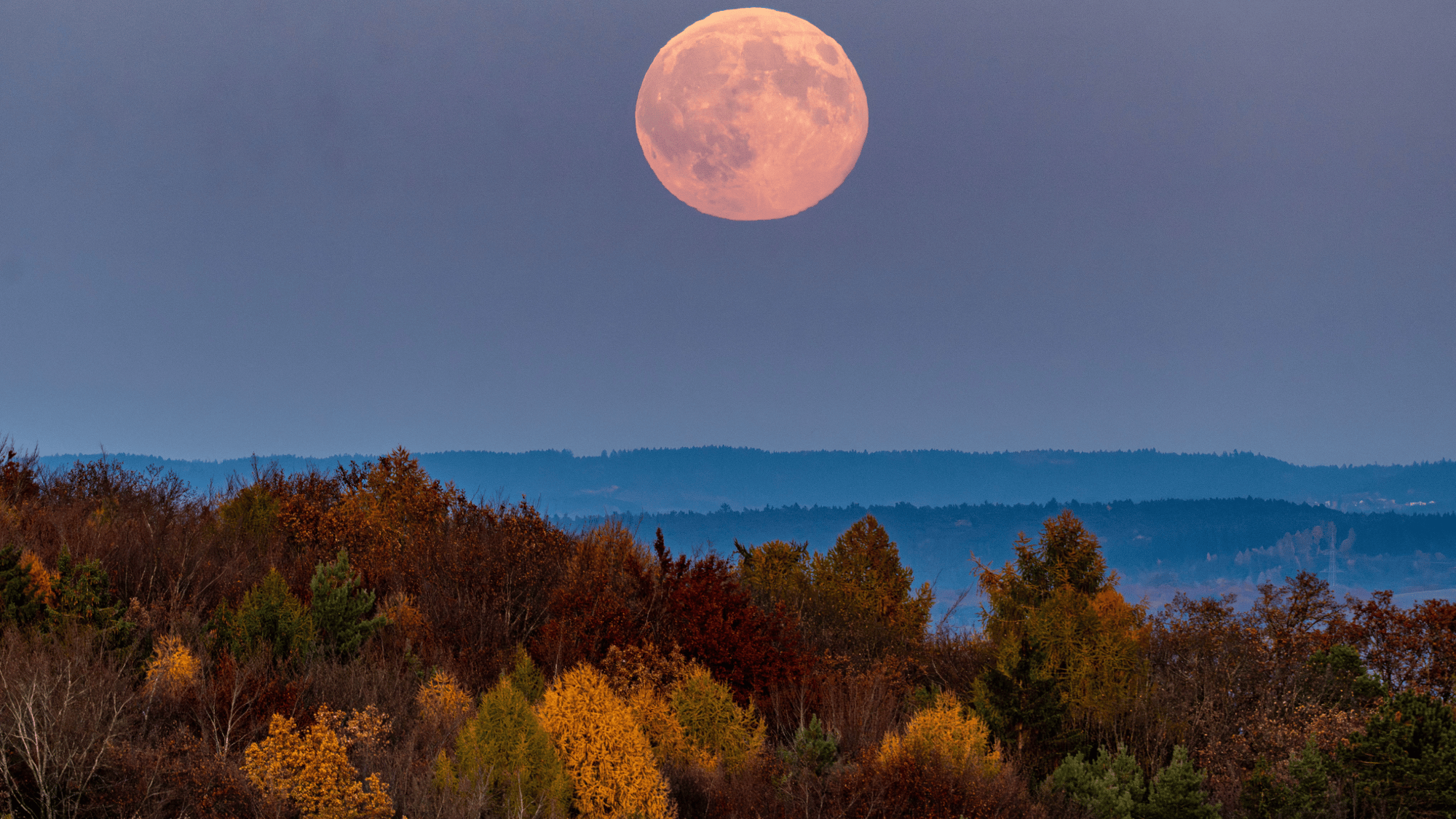
On November 24, the lunar cycle reaches its climax with the Full Beaver Supermoon. The term "supermoon" describes a full moon that coincides with perigee—the point in the elliptic orbit where the moon is closest to Earth. Because the lunar orbit is elliptical rather than a perfect circle, the distance between Earth and its natural satellite varies by about 30,000 miles over the course of a month.
At perigee, the moon appears roughly 14 percent larger and 30 percent brighter than a micromoon occurring at apogee (its farthest point). According to the U.S. Naval Observatory, the moon will reach exact peak illumination at 9:50 a.m. EST on November 24, rendering it technically below the horizon for North American observers during that specific minute. Nonetheless, the lunar disc will appear full, bright, and visually enlarged to the naked eye on the evenings immediately preceding and following the peak.
The moniker "Beaver Moon" derives from historical almanacs and traditional North American indigenous nomenclature, reflecting the seasonal behaviors of local fauna and flora. In November, North American beavers systematically reinforce their lodges and dams in preparation for the impending winter freeze. Concurrently, regional indigenous tribes, including the Tlingit, Algonquin, Dakota, and Lakota nations, maintained distinct seasonal calendars that noted ecological shifts, such as whitefish spawning or the annual deer rutting season, linking cultural traditions directly to lunar cycles.
Deep-Space Visitors: Comet 161P/Hartley–IRAS
Closing out the month on November 27, attention turns away from the solar system’s inner planets and toward a transient visitor: Comet 161P/Hartley–IRAS. The icy body will reach its perihelion—its closest approach to the sun—on this date, completing an orbit that takes approximately 21 years to traverse.
Discovered via space-based infrared observation techniques, periodic comets like 161P/Hartley–IRAS provide planetary scientists with valuable pristine material dating back to the formation of the solar system. As the comet nears the sun, solar radiation heats its volatile ice compounds, causing them to sublimate and release a coma and dust tail.
Unlike bright comets that occasionally grace the naked-eye visible spectrum, 161P/Hartley–IRAS will reach a magnitude of approximately 12 during this perihelion passage. Consequently, the comet will not be visible to the unaided eye. Professional astronomers and advanced amateur observers utilizing telescopes with an aperture of at least 7.8 inches (20 centimeters) will need to orient their equipment toward the east-northeast horizon just above the morning boundary to capture the faint, diffuse signature of the passing rock.
Broader Impact, Implications, and Observational Best Practices
The convergence of multiple astronomical events in November serves a dual purpose: advancing public engagement with science and providing observational opportunities for researchers studying meteor stream dynamics and space weather. Public science initiatives frequently leverage such high-visibility months to encourage data collection, such as citizen-science meteor counts coordinated by organizations like the American Meteor Society.
To maximize the scientific yield and personal enjoyment of these astronomical events, astronomers and dark-sky advocates emphasize foundational viewing protocols. Light pollution from urban and suburban centers remains the primary obstacle to amateur astronomy. Observers are advised to travel to designated dark-sky reserves or rural locations well away from municipal illumination.
Furthermore, human night vision requires approximately 20 to 30 minutes of complete darkness to fully adjust as rhodopsin regenerates in the retina. Observers are strongly discouraged from using white-light flashlights or mobile phone screens without red-light filters during viewing sessions, as sudden exposure to bright light resets the dark-adaptation process. By combining proper preparation, optical instrumentation where required, and an understanding of the underlying celestial mechanics, observers can fully appreciate the dynamic scope of November’s astronomical calendar.