A Culinary Odyssey Navigating the Essential Flavors and Cultural Heritage of Chinese Gastronomy

The vastness of China’s culinary landscape is such that any attempt to compile a definitive list of its "best" dishes is a task fraught with complexity. Spanning thousands of miles and encompassing a history that stretches back millennia, Chinese cuisine is not a singular entity but a mosaic of regional traditions, imperial legacies, and street-side innovations. For the international traveler or the budding gastronome, understanding this diversity requires more than a simple menu; it necessitates an appreciation of the cultural and historical forces that have shaped the flavors of the Middle Kingdom. From the refined banquets of the north to the spice-laden stalls of the southwest, the following exploration provides a comprehensive guide to the essential dishes that define the Chinese culinary experience.
The Imperial Legacy of the Roast Duck
The story of Chinese cuisine is inextricably linked to its imperial history, and perhaps no dish exemplifies this more than the roast duck. While the world predominantly recognizes Peking duck (Běijīng kǎoyā) as the pinnacle of Chinese poultry, its origins are found further south in Nanjing. During the 14th century, when Nanjing served as the seat of the Ming Dynasty, chefs perfected the art of roasting the bird. When the capital was relocated to Beijing in the 1400s, the imperial court brought these master chefs and their recipes with them.

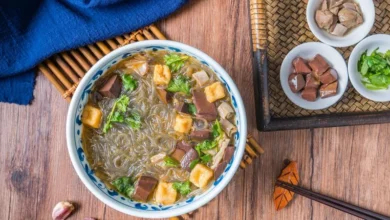
In Beijing, the dish evolved into the sophisticated ritual we recognize today. The process is meticulous: the duck is air-pumped to separate the skin from the fat, glazed with syrup, and roasted in a closed or hung oven until the skin reaches a glass-like crispness. It is served with delicate pancakes, spring onions, cucumbers, and a sweet bean sauce. However, in Nanjing, the "duck capital" of China, the obsession takes a different form. The local palate favors the "Vermicelli Soup with Duck Blood" (yā xuè fěn sī tāng). This street food staple utilizes every part of the bird, featuring duck bone broth, cubes of duck blood curd, and offal such as liver and gizzards. This contrast highlights a fundamental truth of Chinese cooking: the coexistence of imperial refinement and the resourceful ingenuity of the common people.
The Art of Steam and the Precision of Temperature
In the southern province of Guangdong, Cantonese cuisine emphasizes the preservation of the ingredient’s original flavor. This is best represented by Cantonese Steamed Fish (qīngzhēng yú). Though it appears deceptively simple, the dish is a test of a chef’s mastery over time and temperature. The fish—usually a whole sea bass or grouper—must be steamed for a duration determined by its weight and the intensity of the heat, often calculated down to the second.
Overcooking results in a loss of moisture and a tightening of the fibers, while undercooking prevents the flesh from cleanly detaching from the bone. Once perfectly timed, the fish is topped with julienned ginger and scallions, then finished with a splash of sizzling hot oil and a light, sweetened soy sauce. This technique underscores the Cantonese philosophy of "qing," or lightness, which seeks to elevate the freshness of the catch rather than mask it with heavy sauces.

Further inland, in the mountainous province of Hunan, steaming takes on a more aggressive character. Xiang cuisine, as it is known, is defined by its use of oil, salt, and fermented chilies. The signature dish, Steamed Fish Head with Chopped Salted Chili (duòjiāo yú tóu), uses the large head of a bighead carp, smothered in a vibrant blanket of duojiao. This relish is made by fermenting chopped chilies with salt, ginger, garlic, and baijiu (Chinese liquor). The resulting flavor is a complex harmony of salinity, acidity, and heat, often enjoyed with a side of noodles that are dipped into the spicy, savory juices left behind in the steamer.
Noodles as a Cultural Anchor
Noodles are a fundamental pillar of the Chinese diet, serving as a primary starch in the north and a beloved snack in the south. Dan Dan Noodles (dàndàn miàn) from Sichuan represent the quintessential street food. Named after the carrying poles (dandan) used by 19th-century street hawkers, the dish has evolved into various forms. Whether served as a dry mix or in a nutty, spicy broth, the soul of the dish lies in the rou saozi—finely chopped pork fried in lard until golden and crispy.
In the southwestern province of Yunnan, the "Cross-the-Bridge Rice Noodles" (guòqiáo mǐxiàn) offers a unique interactive dining experience. Legend tells of a scholar’s wife who discovered that a layer of chicken fat on top of a hot broth would act as insulation, keeping the liquid scalding during her journey across a bridge to her husband’s study island. Today, the dish is served as a deconstructed meal: a bowl of boiling-hot broth arrives at the table, followed by various raw ingredients—thinly sliced meats, vegetables, and rice noodles—which the diner cooks by submerging them into the soup. This method ensures that each component is cooked to the exact moment of tenderness.

The Global Influence of Stir-Fry and the Breath of the Wok
Perhaps no technique is more synonymous with Chinese cooking than stir-frying, and no dish is more internationally recognized than Kungpao Chicken (gōngbǎo jīdīng). The dish is named after Ding Baozeng, a late Qing Dynasty governor of Sichuan whose title was Gongbao. Legend suggests Ding combined the fried chicken techniques of his native Shandong with the bold spices of Sichuan. The result is a sophisticated balance of "lychee flavor" (sweet and sour) and "numbing heat" (from Sichuan peppercorns and dried chilies), punctuated by the crunch of deep-fried peanuts.
A critical element in any successful stir-fry is wok hei, often translated as the "breath of the wok." This refers to the complex charred aroma produced by the Maillard reaction and the partial combustion of oil at extremely high temperatures. This is most evident in Fried Rice (chǎofàn). Whether it is the classic Yangzhou style or a simple home-style version, the hallmark of quality is the "dancing grain"—each grain of rice should be distinct, coated in oil, and imbued with the smoky essence of the wok.
The Social Fabric of Dim Sum and Roast Meats
In the Cantonese-speaking regions of the south and Hong Kong, dining is a communal ritual. Dim Sum (diǎnxīn), meaning "to touch the heart," is less a specific dish and more a style of eating involving small plates shared among family and friends during yum cha (tea drinking). From the translucent pleats of prawn dumplings (har gow) to the savory-sweet richness of Siu Mai, dim sum represents a pinnacle of culinary craftsmanship.

Complementing the dim sum tradition is Siu Mei, the art of Cantonese roasting. Char Siu (barbecue pork), glazed with maltose and five-spice powder, and Cantonese Roast Goose are the stars of this category. The best roast goose is often cooked in wood-fired ovens using camphor or lychee wood to impart a subtle smokiness to the skin. The goal is a bird with skin that shatters like parchment, revealing a layer of rendered fat and succulent meat beneath.
Regional Diversity: From the "Chinese Burger" to Soup Buns
As one moves across China, the diversity of snacks reflects local history. In Xi’an, the gateway to the Silk Road, the Rou Jia Mo (meat sandwich) has been served for centuries. Often called the "Chinese burger," it consists of hand-pulled pork belly braised in a complex mixture of spices for over 12 hours, stuffed into a grilled flatbread called mo. A perfect mo must feature the "tiger’s back" and "chrysanthemum heart" patterns, indicating it has been toasted to the ideal level of crispness.
In the Yangtze River Delta, the Xiaolongbao (soup bun) represents a different kind of engineering. These delicate dumplings contain a sphere of pork and a concentrated broth that is solid at room temperature but melts into a rich soup when steamed. The suspense of moving a xiaolongbao from the basket to the spoon without breaking its thin skin is a shared experience among diners in Shanghai and beyond.

Health and Harmony: The Medicinal Aspect of Food
In Chinese culture, food is frequently viewed through the lens of Traditional Chinese Medicine (TCM). Cantonese slow-cooked soups (lǎohuǒ tāng) are prepared not just for taste but for their healing properties. Ingredients are chosen based on the season and the individual’s constitution. For instance, winter melon and barley are used to "clear heat" during the humid summer months, while snow fungus and lily petals are used to hydrate the body in the dry autumn.
This philosophy extends to staples like Congee (zhōu). This rice porridge is the ultimate comfort food and a digestive aid, served plain during illness or enriched with century eggs and lean pork for a hearty breakfast. It represents the nurturing side of Chinese gastronomy, focusing on balance and the restoration of qi.
Broader Impact and Global Implications
The global proliferation of Chinese cuisine has often led to the simplification of these complex dishes. However, as international travel to China has increased and the Chinese diaspora has brought regional specialties abroad, there is a growing global appreciation for the authenticity and diversity of the eight great culinary traditions (Lu, Chuan, Yue, Min, Su, Zhe, Xiang, and Hui).

Culinary tourism has become a significant economic driver for regions like Sichuan and Guangdong, prompting local governments to invest in the preservation of traditional techniques and the protection of geographical indications for ingredients like Pidu bean paste or Hanyuan peppercorns. UNESCO’s recognition of cities like Chengdu, Shunde, and Macao as "Cities of Gastronomy" further underscores the global cultural significance of China’s food heritage.
In conclusion, to eat in China is to consume its history. Every dish, from the humble jian bing (crepe) sold on a Tianjin street corner to the ornate slabs of Dongpo Pork served in Hangzhou, tells a story of migration, innovation, and the enduring importance of the communal table. For those willing to explore beyond the familiar, China offers a culinary journey that is as profound as it is delicious.