Defense Secretary Pete Hegseth Reprimanded by Arlington National Cemetery Sentinel During Veterans Day Ceremony

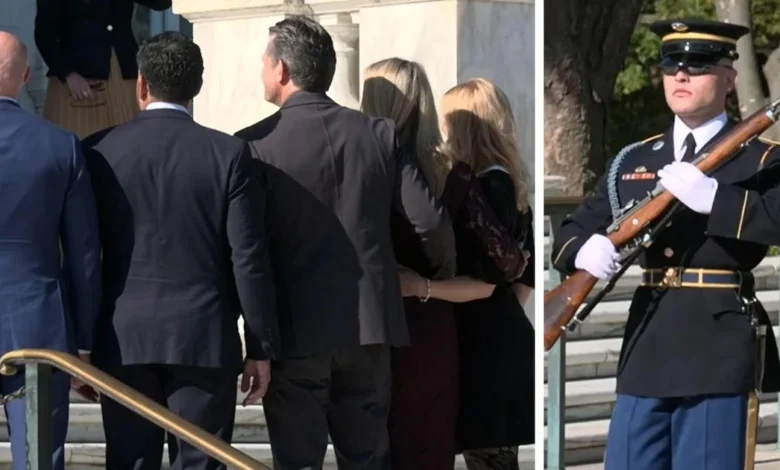
The solemn atmosphere at Arlington National Cemetery’s Tomb of the Unknown Soldier was briefly interrupted on Veterans Day, November 11, 2026, when a U.S. Army sentinel issued a sharp, public reprimand to a group of individuals that included Defense Secretary Pete Hegseth. The incident occurred shortly after a formal wreath-laying ceremony attended by high-ranking officials, including President Donald Trump and First Lady Melania Trump. While the event was intended to honor the nation’s fallen, the breach of decorum served as a stark reminder of the rigid protocols maintained at one of the most sacred sites in the United States.
Chronology of the Incident
The sequence of events began on the morning of Veterans Day, a day designated for reflection and national gratitude. Following the conclusion of the official wreath-laying ceremony at the tomb, the Secretary of Defense and his delegation—which included his wife and senior staff members, among them Chief of Staff Ricky Buria—moved to a designated area for a commemorative photograph.
Witnesses and video footage captured the group posing for the photo. As the delegation finished the session and began to walk away from the immediate vicinity of the tomb, an audible laugh broke the silence of the plaza. The response from the on-duty sentinel was instantaneous and practiced. Utilizing the standard, booming command voice expected of soldiers tasked with guarding the Tomb of the Unknowns, the sentinel declared: "All visitors will maintain an atmosphere of silence and respect at all times."
The sudden intervention caused the group to pause momentarily before continuing their departure. While it remains unclear exactly which individual initiated the laughter or whether the Defense Secretary himself was the source of the noise, the incident quickly gained attention due to the high-profile nature of the visitors involved.
The Sacred Protocol of the Tomb
To understand the gravity of the sentinel’s command, one must consider the historical and cultural significance of the Tomb of the Unknown Soldier. Dedicated in 1921, the site serves as the final resting place for unidentified service members from World War I, World War II, the Korean War, and the Vietnam War. It is considered the pinnacle of military reverence in the United States.
The sentinels, members of the 3rd U.S. Infantry Regiment—the "Old Guard"—undergo an exhaustive selection and training process to earn the right to stand watch. They maintain a 24-hour vigil, 365 days a year, regardless of weather conditions. Their movements are precise, silent, and steeped in ritual. Because the tomb is not merely a monument but a symbolic grave, visitors are strictly required to remain silent and avoid any behavior that could be construed as disrespectful.
Army Staff Sgt. Chadwick Winget, in a 2022 interview regarding the rigors of the post, noted that sentinels are trained to manage crowds proactively. According to internal Army reports, sentinels may issue verbal corrections to visitors—ranging from tourists to public officials—two or three times per day. These corrections are not personal; they are an extension of the sentinels’ primary mission: to protect the dignity of the fallen.
Official Responses and Internal Repercussions
In the immediate aftermath of the event, the Pentagon moved to address the situation with a statement intended to quell speculation regarding the Secretary’s intent. Chief Pentagon Spokesman Sean Parnell issued a formal response to media inquiries, stating, "The Secretary and the entire Department have always honored—and will always honor—the sacrifices our military men and women have made to keep America safe. While commemorating this solemn day, a soldier correctly and respectfully reminded everyone to maintain decorum."
By framing the interaction as a routine enforcement of cemetery policy rather than a targeted political rebuke, the Department of Defense sought to normalize the event. Observers note that this is a standard public relations strategy for the executive branch when high-ranking officials are involved in minor protocol breaches. No disciplinary action was reported against the members of the delegation, and the ceremony proceeded as scheduled at the nearby Memorial Auditorium without further disruption.
Historical Precedent and Public Expectation
The incident involving Secretary Hegseth is not the first time high-profile figures have encountered the strict rules of the Tomb. Arlington National Cemetery has seen a surge in visitors in recent years, leading to increased pressure on the guard force to maintain order.
Public expectation for decorum at the site is exceptionally high. Throughout the 20th and 21st centuries, the tomb has remained one of the few places in Washington, D.C., where partisan politics are expected to be set aside in favor of national unity. When a breach occurs, it often generates significant public interest because it touches upon the intersection of civilian leadership and military tradition.
Analysts suggest that the "Old Guard" maintains a posture of total neutrality. Whether a tourist, a veteran, or a Cabinet member is present, the protocol remains identical. This egalitarian enforcement is exactly what gives the Tomb its reputation for integrity. The fact that a sentinel would issue a correction to the Defense Secretary is, in many ways, a testament to the effectiveness of the Army’s training, which prioritizes the sanctity of the memorial over the rank of the visitor.
Implications for the Department of Defense
The incident at the Tomb of the Unknown Soldier carries nuanced implications for the current administration. As the leader of the Department of Defense, Secretary Hegseth occupies a position that is uniquely sensitive to military culture. While the laughter was likely an inadvertent lapse in judgment during a high-stress, high-visibility event, the optics of the situation are scrutinized by the rank-and-file military personnel who view the Tomb with profound reverence.
Critics may argue that the incident reflects a lack of focus or situational awareness during a major national holiday. However, supporters of the Secretary emphasize the human element of the error and the subsequent prompt compliance with the guard’s directive. The incident serves as a modern-day reminder that even at the highest levels of government, the "Old Guard" remains the final authority on the grounds of Arlington.
Looking Ahead
The 2026 Veterans Day incident will likely be categorized as a minor administrative footnote, yet it highlights the enduring power of the sentinels. The interaction remains a viral point of discussion on social media platforms, with much of the public commentary focusing on the professionalism of the soldier who issued the command.
For Arlington National Cemetery, the incident underscores the continued importance of the educational programs they offer to visitors regarding appropriate conduct. As the cemetery continues to evolve as a site of both historical education and active burial, the balance between public access and military solemnity will remain a core challenge.
Ultimately, the event at the Tomb of the Unknown Soldier reinforces the status of the sentinels as the ultimate guardians of American military tradition. In a world of shifting political tides, their commitment to the "atmosphere of silence and respect" remains an unmoving constant, ensuring that the unidentified heroes interred at Arlington receive the dignity their sacrifices deserve, regardless of who happens to be standing on the plaza.