Caleb Williams Injury Update: Chicago Bears Quarterback Sidelined with Grade 2 Hamstring Strain

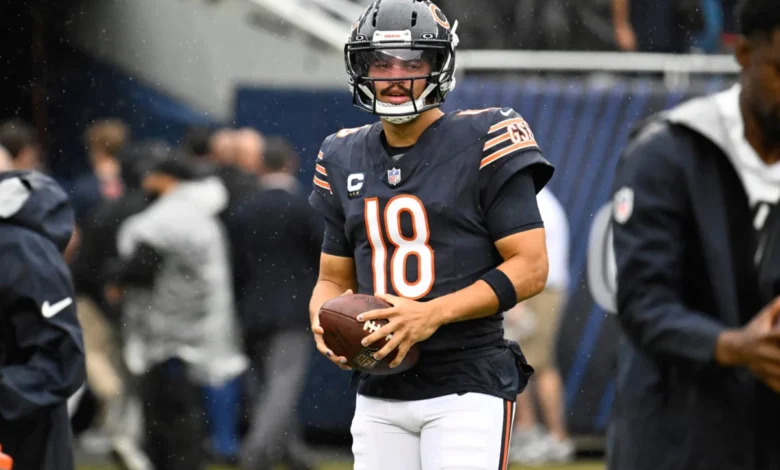
The Chicago Bears have received a clearer, albeit concerning, diagnosis regarding the health of franchise quarterback Caleb Williams, who is projected to miss multiple weeks of regular-season action. According to league sources, medical evaluations confirmed that the second-year signal-caller suffered a Grade 2 right hamstring strain during a recent divisional matchup. While initial fears inside Soldier Field pointed toward a catastrophic, season-ending lower-body trauma, subsequent magnetic resonance imaging (MRI) and clinical examinations revealed that Williams successfully avoided the worst-case scenario. Nevertheless, medical experts project a standard recovery timeline of three to four weeks, leaving the Bears’ offense in a precarious position as they navigate a critical stretch of the autumn schedule.

The injury initially occurred during the second half of a hard-fought, low-scoring contest against the Minnesota Vikings at Soldier Field. Mid-play, without any direct physical contact from an opposing defender, Williams suddenly pulled up and collapsed to the turf in visible distress. The non-contact nature of the incident immediately heightened concern among teammates, coaching staff, and the medical personnel who rushed to his side. As Williams remained down on the field, medical carts were deployed, and the young quarterback was eventually escorted to the locker room with a towel draped over his head, visibly emotional over the sudden setback. The bleak visual immediately circulated across sports media platforms, sparking widespread speculation that the Bears’ offensive anchor might face a lengthy, if not season-ending, absence.
In the immediate aftermath of the contest, head coach Ben Johnson addressed the media with cautious optimism, classifying his starting quarterback as week-to-week while emphasizing that diagnostic test results were encouraging. During a midweek press conference, Johnson pushed back against strict recovery windows, highlighting Williams’ unique physical resilience and history of rapid healing. "Here’s what I know," Johnson told reporters. "This guy’s a little bit different than the average human being. I said that last night, I’ll double down on that. He gets back—he has in the past—a lot faster than what people can anticipate, and so I’m not putting a timeline on this. We’re going to say week-to-week. He’s going to attack this with everything that he knows." Despite the head coach’s public vote of confidence, football operations and training staff are expected to exercise extreme caution with their prized asset, particularly given that Williams dealt with a strain in the same right hamstring during his collegiate career.

The immediate casualty of the injury is Williams’ availability for the Bears’ high-profile Monday Night Football appearance against the Philadelphia Eagles. Team officials formally ruled him out days prior to kickoff, forcing the coaching staff to scramble for viable alternatives under center. Complicating matters further, the instability extends deep into the Chicago quarterback room. Primary backup Tyson Bagent entered the league’s mandatory concussion protocol following a separate team activity, creating intense uncertainty regarding his status. Although Bagent managed limited participation in Saturday’s walkthrough sessions and was officially designated as questionable ahead of the Monday night showdown, his availability remains a game-time decision. Should Bagent fail to clear final neurological evaluations, the responsibility of leading the Chicago offense will fall squarely on veteran third-string quarterback Case Keenum, who would be thrust into immediate starting duty against a formidable Eagles defense.
The timing of Williams’ absence deals a significant blow to a Chicago offense that has struggled to find consistent rhythm during the early weeks of the campaign. Through the opening games of the season, Williams had experienced both the expected growing pains of a young professional and flashes of elite playmaking capability. His ability to extend plays outside the pocket, make off-schedule throws, and accurately distribute the football to his receiving corps forms the foundation of the Bears’ offensive scheme. Losing him for a projected minimum of three weeks forces offensive coordinators to fundamentally alter their play-calling philosophy, relying more heavily on a conservative ground game and quick-pass orchestration to protect an unstable quarterback depth chart.

From a broader strategic standpoint, a three-to-four-week absence means Williams could potentially miss crucial matchups against top-tier conference opponents, a stretch that could heavily influence the NFC playoff picture before the calendar turns to November. In the ultra-competitive landscape of the National Football Conference, falling behind early in the standings due to prolonged injuries at the game’s most important position is a luxury few franchises can afford. Analysts note that while avoiding surgery or a severe tendon tear represents a massive victory for the long-term outlook of the organization, managing the immediate aftermath without dropping multiple games will require flawless execution from the remainder of the roster.
As rehabilitation gets underway at the team’s practice facility, all eyes will remain fixed on Williams’ recovery trajectory. The training staff plans to employ a phased rehabilitation program focusing first on reducing inflammation and restoring full range of motion before advancing to functional movement, light throwing, and eventually sprinting drills. While the official prognosis points toward a mid-October return, the fluid nature of soft-tissue injuries means that the final decision will rest entirely on functional testing rather than a rigid calendar date. For now, the Chicago Bears must weather the storm, lean on their defensive unit, and hope that their franchise cornerstone can defy expectations once again on his road to recovery.