‘The Assassin(s)’ Review: A Riveting South Korean Popcorn Thriller About a Real Assassination

Historical Context: The 1974 Liberation Day Assassination Attempt
The film centers on the events of August 15, 1974, at the National Theater of Korea in Seoul. During a ceremony commemorating the 29th anniversary of Korea’s liberation from Japanese colonial rule, Prime Minister Park Chung-hee was delivering a speech when an assailant, later identified as Mun Se-gwang, opened fire. The assassination attempt failed to claim the life of the President, but it resulted in the tragic death of First Lady Yuk Young-soo. A young bystander was also killed in the crossfire.
Historical records indicate that Mun Se-gwang was a Japanese-born ethnic Korean (Zainichi) who had ties to radical anti-Park factions. The official investigation concluded that the assassination was orchestrated by North Korean agents operating through Japan. However, the rapidity of the investigation and the subsequent geopolitical fallout led to lingering skepticism among the South Korean public. Hur Jin-ho’s film acts as an imaginative vessel for these decades-old doubts, positing that the security failures that allowed an armed man to approach the podium were not merely the result of negligence, but of orchestrated collusion by the Korean Central Intelligence Agency (KCIA).
Chronology of a Political Thriller
The narrative follows three primary protagonists navigating the suffocating atmosphere of 1970s authoritarian South Korea, a period defined by the Yushin Constitution and extreme press censorship.
- The Inception: The film opens with the staff of the Dong-sung Daily struggling under the weight of KCIA intimidation. Journalists are frequently summoned, harassed, or arrested for reporting on stories that deviate from the state-sanctioned narrative.
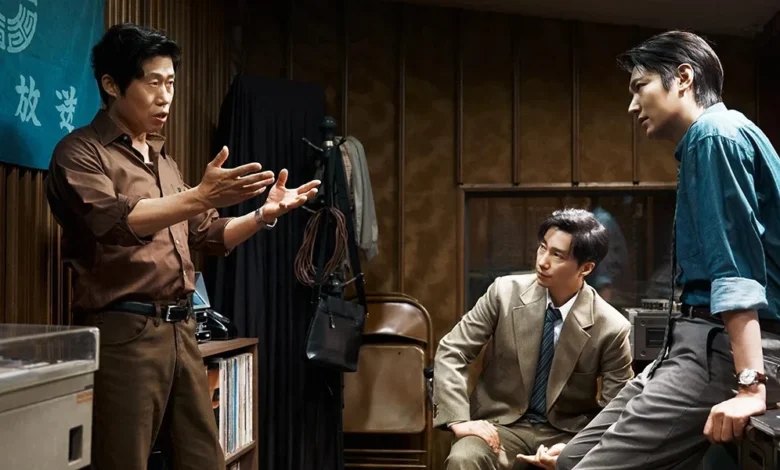
- The Incident: Rookie reporter Young-il (Lee Min-ho), the younger brother of a government official, is assigned to the Liberation Day speech. His proximity to the event allows him to witness the shooting firsthand, sparking a realization that the official sequence of events does not align with the physical reality of the scene.
- The Investigation: Jae-hwan (Park Hae-il), the world-weary head of the City Desk, initiates an unauthorized probe into the security protocols at the National Theater. He leverages his connection with a diligent detective, Cheol-goo (Yoo Hai-jin), who provides an internal perspective on how the security perimeter was compromised.
- The Discovery: The narrative reaches a crescendo as the journalists uncover evidence suggesting that local law enforcement officers, including Cheol-goo, were specifically ordered to stand down or redirect their attention, effectively clearing a path for the assailant.
The Mechanics of State Suppression
Central to the film’s tension is the portrayal of the KCIA, the primary instrument of state control during the Park administration. The film depicts the agency not just as a law enforcement body, but as an omnipotent force capable of manipulating media outlets and coercing editors. Bae Seong-woo’s character, the editor of the Dong-sung Daily, embodies the moral struggle of the era: the choice between maintaining professional integrity and protecting the lives of his staff from the reach of the KCIA.
The film argues that the "official" version of history is often a construct built to maintain the stability of the ruling power. By focusing on the "process" of journalism—the tedious collection of documents, the reliance on anonymous sources, and the physical danger of asking questions—Hur highlights how the investigative spirit was the only check against absolute power during this period.
Supporting Data and Political Implications
The real-world implications of the 1974 assassination attempt were profound. The incident significantly strained relations between South Korea and Japan, as Tokyo was accused of failing to adequately monitor the activities of Zainichi individuals associated with the pro-North Korean General Association of Korean Residents in Japan (Chongryon).
Statistically, the Park Chung-hee era saw a marked increase in both economic growth and civil rights suppression. Data from the period reflects a high frequency of "security-related" detentions, with press freedom indices—had they existed in their modern form—reaching historical lows. The film’s focus on the "Zainichi" angle serves to emphasize the international dimensions of domestic South Korean political violence, reflecting the complex, often fraught, triangular relationship between South Korea, North Korea, and Japan during the Cold War.
Official Responses and Public Sentiment
While the film includes a disclaimer acknowledging its status as a work of fiction, its emotional resonance is rooted in a genuine national sentiment of frustration. The 1974 incident remains a "missing piece" in the collective memory of the South Korean public. For many, the unanswered questions regarding the security lapse serve as a metaphor for the opacity of the authoritarian era.
The film premiered at the Toronto International Film Festival, where it received significant acclaim, finishing as the second runner-up for the International People’s Choice Award. This reception suggests that the themes of anti-authoritarianism and the struggle for truth are not merely local interests but possess universal appeal. By presenting a "what-if" scenario that feels grounded in plausible bureaucratic reality, Hur taps into a specific type of political cynicism—a skepticism that the truth is often hidden in plain sight, obscured by layers of administrative procedure and state-sanctioned silence.
Analysis of Cinematic Craft
Hur Jin-ho, known primarily for his romantic dramas, pivots effectively into the genre of political noir. His direction is characterized by a "show, don’t tell" approach to investigative procedure. The cinematography mirrors the claustrophobia of the era, using muted color palettes and tight framing to emphasize the characters’ vulnerability.
The supporting cast, featuring a "murderer’s row" of talent, provides the film with the gravity required to make its speculative elements feel grounded. Park Hoon’s portrayal of a vicious KCIA operative provides a terrifying physical presence that underscores the stakes for the journalists, while Yoo Hai-jin’s performance as the embattled detective adds a layer of human cost to the broader political maneuvering.
Conclusion: The Legacy of Truth-Seeking
The Assassin(s) is more than a standard historical thriller; it is a tribute to the role of the press as a democratic safeguard. By romanticizing the investigative process—the late-night document reviews, the secret meetings in dark alleys, and the confrontation with insurmountable odds—the film celebrates the act of "speaking truth to power."
While historians may point to the film’s inaccuracies regarding the specific details of the 1974 event, its value lies in its portrayal of the feeling of living under a regime where the truth was a commodity to be managed. As a piece of mass entertainment, it succeeds in being both a gripping procedural and a poignant reflection on a traumatic chapter of South Korean history. It reminds audiences that regardless of the era, the preservation of an honest historical record is a perilous but essential endeavor. The film does not provide the "answer" to the assassination mystery, but it successfully poses the right questions, ensuring that the legacy of those who dared to question the status quo remains at the forefront of the public consciousness.