Rocket Lab protests NASA selection of Blue Origin for 700 million dollar Mars Telecommunications Network contract

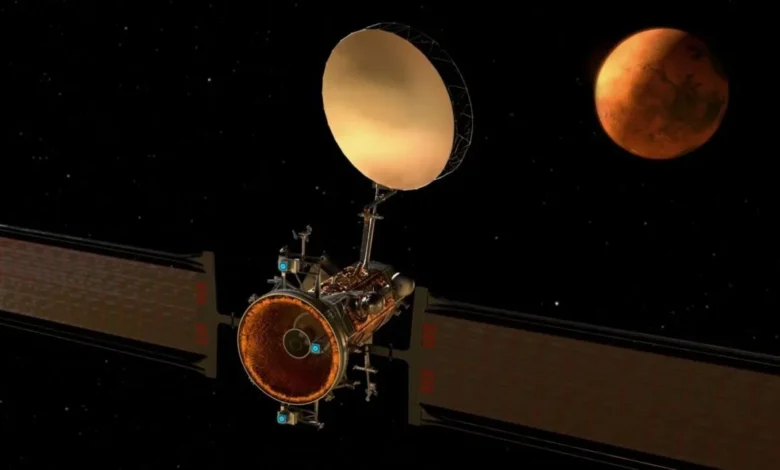
In theory, developing a spacecraft that will fly to Mars, insert itself into orbit around the red planet, and relay high-bandwidth data transmissions back and forth to massive Deep Space Network satellite dishes on Earth is a relatively straightforward proposition, but in the high-stakes world of aerospace procurement, the reality is far more complex. NASA’s recent endeavor to procure a dedicated Mars Telecommunications Network (MTN) spacecraft has devolved into one of the most contentious administrative dramas of the year, pitting two of the industry’s most ambitious private space firms against one another in a legal battle that threatens to reshape the agency’s future deep-space infrastructure.
Earlier this month, NASA formally selected Blue Origin, the aerospace company founded by Jeff Bezos, to design, launch, and operate a $700 million spacecraft destined for Martian orbit. The mission is designed to provide critical data relay services for future robotic and potentially human explorers, acting as a high-speed orbital bridge to bridge the communications gap between Mars and Earth. However, the decision was met with immediate hostility from the project’s primary runner-up, Rocket Lab. On Friday, the California-based launch and space systems provider filed a formal protest with the U.S. Government Accountability Office (GAO), effectively halting the project’s momentum and placing the 2028 launch timeline in jeopardy.
The Heart of the Dispute: Eligibility and Technical Evaluation
The core of Rocket Lab’s grievance centers on what the company describes as a failure by NASA to adhere to congressional mandates regarding eligibility criteria. In a statement released on the social media platform X, Rocket Lab asserted that the agency’s selection process was fundamentally flawed. "NASA’s award decision appears to be inconsistent with the eligibility criteria mandated by Congress," the company stated. "In addition, the agency’s punitive review of Rocket Lab’s technical volume was inconsistent, making incorrect assertions and conclusions."
While Rocket Lab has not yet publicly released the specific details of its internal legal argument, industry analysts suggest the dispute likely hinges on the interpretation of "commercial off-the-shelf" (COTS) requirements or specific provisions within the NASA Authorization Act regarding the procurement of planetary communications services. Rocket Lab, which has successfully executed numerous missions for both government and commercial clients, prides itself on its vertically integrated production model. The company likely feels that its proposal was either unfairly penalized for its technical approach or that Blue Origin failed to meet specific regulatory hurdles that Congress intended to be a barrier for entry for the MTN program.
A Chronology of the Mars Telecommunications Network Program
The trajectory of the MTN program has been marked by a transition from traditional NASA-led development to a commercial-service model. For decades, NASA has relied on its own fleet of orbiters—such as the Mars Reconnaissance Orbiter (MRO) and the Mars Odyssey spacecraft—to act as relay nodes. These aging assets are nearing the end of their operational lives, creating an urgent "communications cliff" that NASA sought to address through the private sector.
- Early 2023: NASA begins drafting the requirements for the Mars Telecommunications Network, shifting from a hardware-purchase model to a "communications-as-a-service" procurement strategy.
- Late 2023: The formal Request for Proposals (RFP) is issued to industry participants, seeking a high-throughput, orbit-capable spacecraft.
- Mid-2024: Multiple aerospace firms submit bids, including teams led by Blue Origin and Rocket Lab, each offering distinct architectural approaches to interplanetary data relay.
- October 2024: NASA announces its selection of Blue Origin for the $700 million contract.
- Late October 2024: Rocket Lab files a formal protest with the GAO, citing irregularities in the evaluation process and concerns over congressional eligibility standards.
Technical Requirements and the Stakes for 2028
The Mars Telecommunications Network is not merely an optional upgrade; it is a fundamental requirement for the next decade of Mars exploration. The planned spacecraft must be capable of autonomous orbit insertion, solar-powered operation in the harsh radiation environment of Mars, and the ability to maintain high-frequency radio and optical communication links with Earth.
Data relay is the bottleneck for Martian science. Currently, surface rovers like Perseverance and Curiosity must wait for an orbiter to pass overhead to upload their data to Earth. The limited "window" of visibility for these orbiters significantly constrains the volume of scientific data—such as high-resolution imagery and complex atmospheric readings—that can be transmitted. The MTN mission aims to increase this bandwidth by an order of magnitude.
The 2028 launch window is not a suggestion; it is a celestial necessity. Due to the relative positions of Earth and Mars, energy-efficient transfer orbits occur only every 26 months. Missing the 2028 window would mean pushing the mission into 2030 or beyond, significantly increasing costs and potentially leaving future Mars landers without a reliable communications backbone.
Official Responses and Corporate Positioning
Blue Origin, in its defense, has signaled that it intends to move forward with the program as planned, while warning of the risks inherent in the protest process. "We remain confident in the strength of our proposal, in NASA’s rigorous selection process, and in Congress’s clear intent to support competition for the Mars Telecommunications Network program," a Blue Origin spokesperson stated. The company emphasized the urgency of the mission, noting that "with limited Mars launch windows, any delay will greatly risk the timely deployment of this critical communications capability."
NASA, for its part, has maintained a policy of silence regarding ongoing bid protests. Under GAO regulations, the agency is required to pause performance on the contract while the protest is under investigation, unless the agency head determines that an urgent and compelling need exists to override the stay. Given the bureaucratic nature of the GAO, a decision is likely to take up to 100 days, meaning a resolution is expected in early 2025.
Broader Implications for Commercial Space Procurement
The protest highlights a growing tension within the "New Space" era. As NASA shifts more of its mission-critical infrastructure to private contractors, the lines between government oversight and corporate autonomy are increasingly blurred. This is not the first time a major NASA contract has been contested; the HLS (Human Landing System) procurement, which also involved Blue Origin, was the subject of a lengthy legal battle against SpaceX.
Analysts note that these protests are a symptom of a maturing industry. With multi-hundred-million-dollar contracts on the line, companies are more willing than ever to utilize the GAO protest process to hold the government accountable for its procurement decisions. While this ensures a level of transparency, it also creates significant administrative friction.
The implications of this specific dispute are threefold:
- Project Risk: The 2028 launch window remains the most significant risk. If the GAO finds in favor of Rocket Lab, NASA will be forced to re-evaluate the proposals, a process that could consume months and render the 2028 window unattainable.
- Industry Consolidation: Should the protest be denied, it cements Blue Origin’s status as a primary partner for deep-space infrastructure, further solidifying the company’s position as a competitor not just for launch, but for end-to-end space mission services.
- Policy Precedent: The specific mention of "eligibility criteria mandated by Congress" suggests that the legal outcome could influence how future NASA procurements are structured, particularly regarding the involvement of smaller aerospace firms in major planetary science missions.
As the industry waits for the GAO’s findings, the broader question remains whether the current procurement model is robust enough to handle the pressures of deep-space exploration. The Mars Telecommunications Network is designed to be the backbone of future human presence on Mars, but before it can relay the first byte of data from the red planet, it must first survive the terrestrial reality of federal contracting and the intense competitive pressures of the modern space economy. For now, the mission to connect Earth and Mars is grounded in a legal holding pattern, awaiting the resolution of a battle that will determine which firm earns the right to serve as the voice of humanity in the Martian void.