Essential Flavors of the Middle Kingdom A Comprehensive Guide to Chinas Culinary Heritage and Regional Masterpieces

The culinary landscape of China represents one of the world’s most sophisticated and diverse food cultures, evolved over millennia through imperial patronage, regional migration, and geographic necessity. To understand the "best" Chinese dishes is to embark on a journey across a vast continental expanse, where the flavors of the spicy southwest contrast sharply with the delicate, ingredient-focused traditions of the southern coast. While compiling a definitive list is an impossible task given the thousands of regional variations, industry experts and culinary historians point to a core group of essential eats that provide a well-rounded perspective on the nation’s gastronomic identity. These dishes, ranging from the imperial banquet halls of Beijing to the bustling street stalls of Xi’an and the tea houses of Guangzhou, serve as the primary ambassadors of Chinese culture to the rest of the world.
The Imperial Legacy and the Evolution of Roast Poultry
The narrative of Chinese cuisine often begins with its imperial history, where chefs to the emperors developed techniques that are still celebrated today. Peking Duck (Beijing Kaoya) remains the most iconic of these exports. Its history is a testament to the movement of China’s political center; while now synonymous with the capital, the tradition of roasting duck began over 1,500 years ago in Nanjing during the Southern Dynasties. When the Ming Dynasty relocated the capital to Beijing in the 1400s, the imperial chefs brought their recipes with them, eventually refining the process into the current iteration: a mountain of crispy skin and succulent meat served with thin pancakes, scallions, cucumbers, and sweet bean sauce.

However, residents of Nanjing continue to contest Beijing’s title as the "duck capital." In Nanjing, the bird is utilized in its entirety, reflecting a zero-waste culinary philosophy. The most popular manifestation of this is Duck Blood Vermicelli Soup. This street food staple utilizes a duck-bone broth enriched with duck blood curds and offal, such as liver and gizzards. This contrast—between the high-end refinement of Peking Duck and the rustic, intense flavors of Nanjing’s soup—highlights the depth of China’s poultry traditions. Similarly, in the south, Cantonese Woodfire Roasted Goose offers a different sensory experience. Utilizing camphor or lychee wood for smoking, Cantonese chefs produce a bird with a glass-like skin and a layer of rendered fat that melts upon contact, a technique that has become a benchmark for roasting globally.
The Sichuanese Influence and the Science of Spice
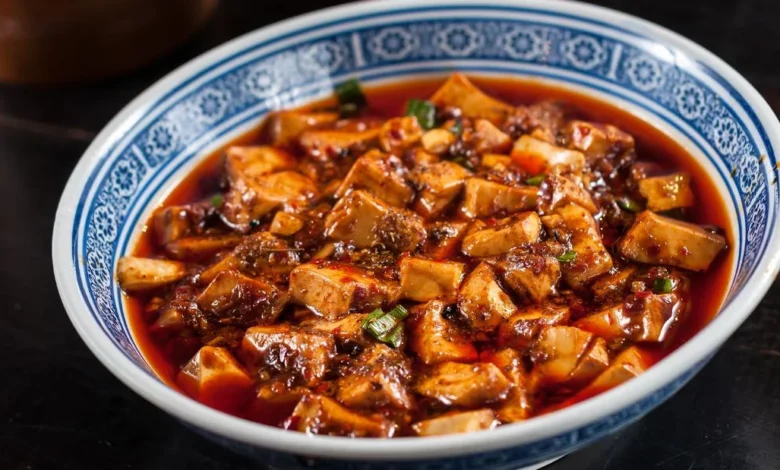
If Cantonese food is defined by freshness, Sichuan cuisine is defined by "Mala"—the combination of numbing (ma) and spicy (la) sensations. This flavor profile is best exemplified by Mapo Tofu and Dan Dan Noodles. Mapo Tofu, a dish of soft bean curd set in a spicy, oily sauce with minced meat, relies heavily on the quality of fermented broad bean paste (doubanjiang) from the Pidu district and the specific numbing peppercorns of Hanyuan.
Dan Dan Noodles, named after the "dan dan" carrying poles used by 19th-century street hawkers, represent the soul of Sichuan comfort food. The dish has evolved into two primary versions: a dry-tossed noodle and a soup-based variety. Both, however, prioritize the "rou saozi"—finely chopped pork fried in lard until golden and crispy. The global popularity of these dishes has led to a surge in "Sichuan tourism," where international travelers visit Chengdu, a UNESCO City of Gastronomy, specifically to experience the authentic heat of the region.

The Sichuanese technique of "Shui Zhu" (water boiling) further demonstrates the region’s innovation. Despite the name, the technique involves poaching proteins like beef or fish in a hot, spicy chili oil broth rather than plain water. This method ensures the meat remains incredibly tender while absorbing the complex aromatics of the spices, a sharp contrast to the stir-frying methods common in Westernized Chinese food.
Southern Traditions: Freshness, Dim Sum, and Healing Soups
In the coastal provinces of Guangdong and Fujian, the culinary focus shifts toward the preservation of "Umami" and the natural flavors of the ingredients. Cantonese Steamed Fish is perhaps the ultimate test of a chef’s skill. The dish requires precise timing—often measured in seconds—to ensure the flesh is flaky and moist without becoming tough. Served with only a light sweetened soy sauce and scallions, it represents the minimalist peak of Chinese cooking.
Guangdong is also the birthplace of Dim Sum, a meal format rather than a single dish. This culture of "touching the heart" (the literal translation of dim sum) involves a parade of small plates, from translucent prawn dumplings (har gow) to barbecue pork buns (char siu bao). Related to this is the art of Char Siu itself—Cantonese barbecue pork. The perfect Char Siu requires a balance of maltose sweetness and savory soy, with a slightly charred exterior. It is a versatile ingredient that appears in everything from breakfast macaroni to high-end banquet platters.

Furthermore, the Cantonese obsession with health is manifested in their tradition of slow-simmered herbal soups. These are not merely starters but therapeutic tonics designed to balance the body’s "internal heat." Using seasonal ingredients like snow fungus, winter melon, or dried tangerine peel, these soups are a staple of domestic life, reflecting a deep-seated belief in the medicinal properties of food.
Regional Specialties and the Silk Road Connection
Moving inland to Xi’an, the capital of Shaanxi province, the food begins to reflect the city’s history as the eastern terminus of the Silk Road. Rou Jia Mo, often called the "Chinese hamburger," features shredded pork belly braised for hours in a complex mix of star anise, cinnamon, and cloves, stuffed into a grilled flatbread known as "mo." The quality of the dish is judged by the "chrysanthemum" pattern on the toasted bread, a sign of perfect heat distribution.
In the southern province of Yunnan, the famous Cross-the-Bridge Rice Noodles (Guoqiao Mixian) tell a story of regional ingenuity. Legend says a wife invented the dish to keep her husband’s lunch warm as she crossed a bridge to his study island. By using a layer of chicken oil to insulate a scalding broth, she could cook raw ingredients on the spot. Today, this dish is a symbol of Yunnan’s diverse ethnic influences and its unique agricultural output.

The northern city of Tianjin offers another essential street food: Jian Bing Guozi. This savory crepe made from mung bean flour and eggs, stuffed with deep-fried crisps and savory bean paste, has become one of China’s most popular breakfast items, even gaining a cult following in cities like New York and London.
The Global Impact and Socio-Economic Significance
The international proliferation of Chinese cuisine has transitioned from "takeout" staples to high-end culinary art. According to data from the World Federation of Chinese Catering Industry, there are now over 600,000 Chinese restaurants outside of China. This global footprint has allowed dishes like Xiaolongbao (soup dumplings) to become international sensations. Originally from the Jiangnan region (around Shanghai and Suzhou), these dumplings require immense precision to ensure the thin wrapper can hold the hot broth without breaking before it reaches the diner’s mouth.
The socio-economic impact of these culinary traditions is significant. Food tourism is a major driver of the Chinese economy, with provinces like Sichuan and Guangdong seeing billions of yuan in revenue from "gastronomy travelers." Furthermore, the Chinese government has increasingly used food as a tool of "soft power," promoting the "Eight Great Cuisines" through cultural exchange programs and international festivals.

Chronology of Development and Modern Adaptation
The timeline of Chinese culinary evolution shows a clear trajectory from necessity to artistry:
- Ancient Era (Pre-Tang): Development of fermentation and the use of grains like millet and rice.
- Imperial Golden Age (Tang-Song): Refinement of tea culture and the birth of regional styles.
- Ming-Qing Era: The migration of chefs and the formalization of "Imperial" recipes like Peking Duck.
- 20th Century: The global diaspora spreads Cantonese and Sichuanese flavors worldwide.
- 21st Century: A focus on "Authenticity" and the preservation of Intangible Cultural Heritage, such as the hand-beaten beef balls of Chaozhou or the specific yam-based taro paste of Fujian.
As China continues to modernize, its food culture remains a bridge between its ancient past and its globalized future. Whether it is the humble bowl of congee (rice porridge) that nourishes the sick or the elaborate "breath of the wok" (wok hei) found in a perfect plate of fried rice, these dishes are more than just sustenance. They are the living history of a civilization, meticulously preserved in every bite of crispy skin, every numbing peppercorn, and every drop of slow-simmered broth. For the traveler and the gourmand alike, understanding these essential eats is the key to understanding the heart of China itself.