The Essential Guide to Chinese Gastronomy Regional Identities and the Evolution of a Global Culinary Powerhouse

The culinary landscape of China is not merely a collection of recipes but a vast, living archive of the nation’s history, geography, and social evolution. With a territory spanning nearly 9.6 million square kilometers and a history involving dozens of imperial dynasties, China has developed one of the world’s most sophisticated and diverse food cultures. To understand Chinese cuisine is to recognize that it is not a monolith; rather, it is a tapestry of regional "Great Traditions"—traditionally categorized into eight major schools—that reflect the unique climate and resources of each province. For the international traveler or the resident epicurean, navigating this landscape requires an introductory framework of essential dishes that represent the pinnacle of these regional identities.
The Imperial Legacy and Northern Traditions
The history of Chinese cuisine is inextricably linked to the movement of the imperial court. One of the most prominent examples of this historical migration is the Peking Duck (Beijing Kaoya). While now synonymous with the capital, the origins of roasted duck can be traced back over 1,500 years to Nanjing, which served as the seat of several ancient regimes. When the Ming Dynasty relocated the capital to Beijing in the early 15th century, the imperial chefs brought their specialized roasting techniques with them.

The dish is celebrated for its meticulous preparation: the duck is air-pumped to separate the skin from the fat, glazed with syrup, and roasted in a closed or hung oven using fruitwood, such as pear or date, to impart a subtle fragrance. The resulting texture—a mountain of crispy skin and succulent meat—is traditionally served with thin pancakes, scallions, cucumbers, and sweet bean sauce. This dish represents more than a meal; it is a symbol of Chinese "soft power," frequently featured in state banquets for visiting foreign dignitaries.
Further west in Shaanxi province, the city of Xi’an offers a different historical perspective through the Rou Jia Mo, often described as the "Chinese hamburger." Dating back to the Qin Dynasty (221–206 BC), the dish consists of shredded pork belly braised for hours in a complex "master stock" of star anise, cinnamon, and ginger, tucked into a grilled flatbread known as a mo. In Shaanxi culture, the quality of the mo is judged by the "chrysanthemum heart" pattern on its surface, a result of precise toasting.
The Spicy Heart of China: Sichuan and Hunan
In the southern and southwestern interior, the provinces of Sichuan and Hunan have gained international fame for their bold use of chilies, though their flavor profiles are distinct. Sichuan cuisine is defined by "Ma La," a combination of numbing (ma) and spicy (la) sensations. The numbing effect is produced by the Sichuan peppercorn, which contains hydroxy-alpha-sanshool, a compound that causes a vibrating sensation on the tongue.

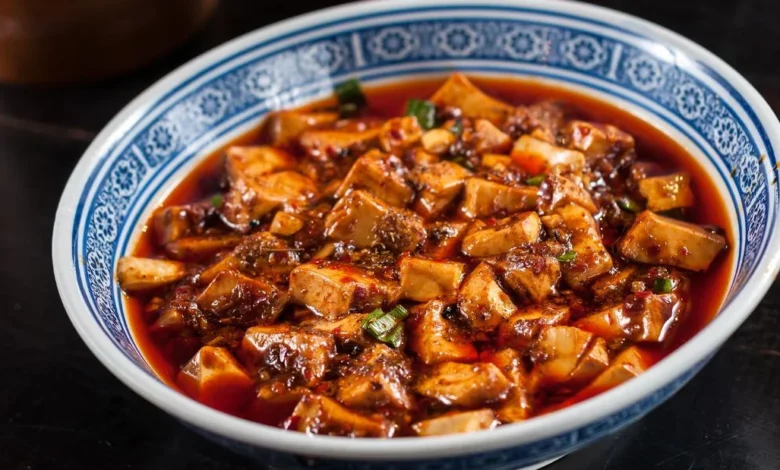
Mapo Tofu is the quintessential Sichuan dish, balancing soft tofu with minced meat in a fermented broad bean paste (doubanjiang) and chili oil. For the most authentic experience, gourmets point to Hanyuan peppercorns and Pidu district bean paste as the essential ingredients. Another Sichuan staple, Dan Dan Noodles, reflects the region’s street food history. Named after the carrying poles (dan dan) used by 19th-century vendors, the dish features a spicy, nutty sauce topped with "rou saozi"—finely chopped pork fried in lard until golden.
Hunan cuisine (Xiang cuisine), by contrast, focuses on "Gan La" (dry spicy) or "Duo La" (salty spicy). The region’s signature dish, Steamed Fish Head with Chopped Salted Chilies (Duo Jiao Yu Tou), utilizes fermented chilies that have been aged in jars with salt and ginger for at least a week. This method provides a sharp, acidic heat that cuts through the richness of the fish. According to local folk songs, a meal in Hunan is considered incomplete without the presence of chili, reflecting the province’s mountainous, humid climate where spicy food is believed to expel internal dampness.
The Art of Freshness: Cantonese and Chaozhou Schools
Guangdong province, particularly the Pearl River Delta, is the birthplace of Cantonese cuisine, arguably the most globally recognized form of Chinese food. The Cantonese philosophy prioritizes the "original flavor" (yuan zhi yuan wei) of ingredients, leading to a mastery of steaming and roasting.

Cantonese Steamed Fish is a test of a chef’s precision. The timing is calculated down to the second based on the fish’s weight and the stove’s heat; a perfectly steamed fish must have flesh that barely detaches from the bone, preserving its moisture and flakiness. This dedication to ingredient integrity is also evident in Dim Sum culture—a meal composed of numerous small plates like prawn dumplings (har gow) and siu mai. Dim sum is not just a meal but a social ritual, often accompanied by tea in a practice known as "yum cha."
In the coastal region of Chaozhou, the focus on freshness is even more pronounced. Chaozhou-style Cold Crab or Fish involves lightly salting the seafood before steaming and then serving it at room temperature to maximize the natural umami. Chaozhou is also famous for its Beef Balls, which are hand-beaten with heavy iron rods until the meat reaches a springy, bouncy texture that is a source of intense local pride.
The Huaiyang Tradition and the Yangtze Delta
The region surrounding Shanghai and the Yangtze River, known as the Jiangnan area, is home to Huaiyang cuisine, one of the four traditional pillars of Chinese gastronomy. This school is characterized by its delicate knife skills and slightly sweet flavor profiles.

Xiaolongbao, or soup dumplings, are the crown jewel of this region. These dumplings contain a pork filling and a gelatinized broth that melts into a hot soup when steamed. The engineering of a xiaolongbao—balancing a thin, translucent wrapper with a heavy liquid center—is considered a high art form. Similarly, Dongpo Pork, named after the Song Dynasty poet Su Dongpo, showcases the region’s expertise in "red braising." The pork belly is simmered with rock sugar, soy sauce, and Shaoxing wine until it becomes a richly glazed, melt-in-the-mouth delicacy.
Historical Chronology and Culinary Evolution
The evolution of these dishes follows a clear historical timeline:
- Ancient Foundations (Pre-Qin to Han): Development of fermentation and the use of "master stocks" for braising (Origins of Rou Jia Mo).
- Imperial Migration (1400s): The shift of the capital from Nanjing to Beijing, establishing the northern roasting tradition (Peking Duck).
- The Columbian Exchange (16th-17th Century): The introduction of the chili pepper from the Americas, which revolutionized the palates of Sichuan and Hunan.
- Modern Globalization (20th Century): The spread of Cantonese roast meats (Char Siu) and Hainanese chicken rice (inspired by Wenchang chicken) across Southeast Asia and the West.
Economic Impact and Official Recognition
The culinary sector is a massive driver of the Chinese economy. According to data from the National Bureau of Statistics of China, the catering industry’s revenue reached over 4.6 trillion RMB (approximately $650 billion USD) in the years leading up to 2020. This economic power is supported by official efforts to preserve culinary heritage.

The Chinese government, through the Ministry of Culture and Tourism, has successfully lobbied for several cities to be recognized by UNESCO’s Creative Cities Network. Chengdu and Shunde were among the first in Asia to be named "Cities of Gastronomy." Furthermore, techniques such as the traditional roasting of Peking Duck and the making of Xuanwei ham have been listed as Intangible Cultural Heritage at the national level.
Broader Impact and Global Implications
The global proliferation of Chinese food has acted as a primary vehicle for cultural exchange. However, culinary historians note a significant shift in recent years. While "Westernized" Chinese food (such as General Tso’s Chicken) dominated the 20th century, there is now a growing demand for authentic regional experiences.
This trend is driven by China’s increasing economic influence and the sophisticated palates of the global diaspora. The rise of specialized restaurants focusing on specific sub-cuisines—such as Shaanxi noodles or Chongqing hot pot—indicates a move away from the generic "Chinese restaurant" model toward a more nuanced appreciation of China’s regional diversity.

In conclusion, the essential dishes of China—from the refined Peking Duck to the humble bowl of congee—serve as a gateway to understanding the nation’s complex identity. As China continues to urbanize, the preservation of these regional traditions remains a vital link to its ancestral past, ensuring that the "breath of the wok" (wok hei) continues to resonate in both domestic kitchens and international dining rooms. For the global observer, these dishes are not just food; they are a narrative of a civilization that has, for millennia, placed the art of the table at the very center of human experience.