The Legal Battle Over Alligator Alcatraz and the Protection of the Florida Everglades

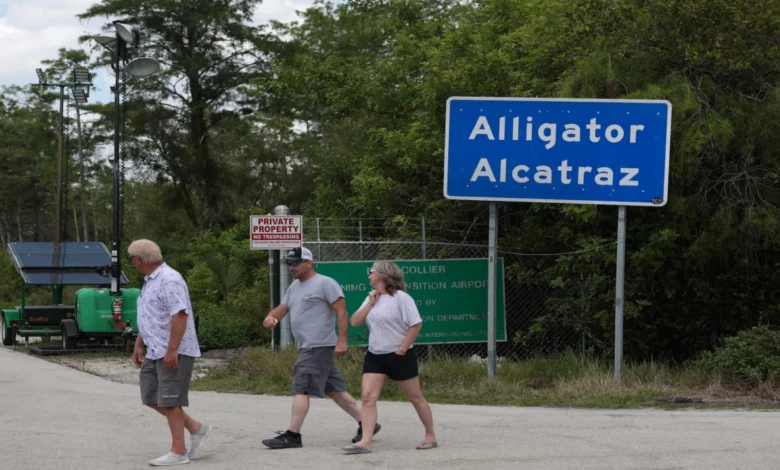
The 11th U.S. Circuit Court of Appeals has issued a pivotal ruling allowing the controversial migrant detention facility known as Alligator Alcatraz to remain operational, effectively overturning a lower court’s injunction that would have seen the site shuttered. Located deep within the ecologically sensitive Florida Everglades, the facility has become a flashpoint for legal battles involving tribal sovereignty, environmental preservation, and the jurisdictional boundaries of federal immigration enforcement. The decision marks a significant setback for the Miccosukee Tribe and a coalition of environmental advocacy groups who argue that the facility’s existence poses an "irreparable harm" to one of the world’s most unique and fragile ecosystems.
The appellate court’s 2-1 decision, delivered last week, invalidated a preliminary injunction issued in August by District Judge Kathleen Williams. Judge Williams had previously ordered a phased winding down of the facility, citing concerns over the lack of federal environmental reviews. However, the appeals court ruled that the plaintiffs—the Miccosukee Tribe, the Center for Biological Diversity, and Friends of the Everglades—failed to sufficiently prove that the federal government exercised direct control over the site. This distinction is critical, as federal control would trigger mandatory reviews under the National Environmental Policy Act (NEPA).
The Jurisdictional Dispute: Federal Oversight vs. State Operation
At the heart of the litigation is a complex debate over whether Alligator Alcatraz is a state or federal entity. The facility was established last summer as part of a broader immigration crackdown initiated by the Trump administration. While the site is used to detain thousands of undocumented migrants under the authority of the Department of Homeland Security (DHS) and U.S. Immigration and Customs Enforcement (ICE), the government maintains that the facility is state-operated.
Judges William Pryor and Andrew Brasher, writing for the majority, argued that the mere fact that the facility adheres to federal immigration standards does not transform it into a federal project. They drew a comparison to private office buildings that must comply with the Americans with Disabilities Act (ADA), noting that such compliance does not make the building a federal property. Consequently, they argued that the statutory prohibition on enjoining immigration enforcement must take precedence.
However, the ruling was met with a sharp dissent from Judge Nancy Abudu. She characterized the relationship between the state and federal governments as one where Florida acts as a "deputy" of the federal government. Judge Abudu argued that the facility’s sole purpose is to serve federal interests—specifically the housing of detainees under ICE control—and that the state would have no legal authority to hold these individuals without federal partnership. She went as far as to suggest that without this federal framework, the state’s actions could be viewed as "akin to kidnapping."
Environmental Impact and the National Environmental Policy Act
The plaintiffs’ primary legal strategy rests on the National Environmental Policy Act (NEPA), a cornerstone of American environmental law. NEPA requires federal agencies to assess the environmental effects of their proposed actions prior to making decisions. The Miccosukee Tribe and environmental groups contend that because the facility was "rushed to completion" without these reviews, the government bypassed critical safeguards intended to protect the Everglades.
The Everglades is not merely a swamp; it is a "river of grass" that serves as the primary source of drinking water for more than eight million Florida residents. The region is currently the subject of a $27 billion restoration effort, the largest and most expensive ecosystem restoration project in human history. Critics of Alligator Alcatraz argue that placing a massive detention center in this area undermines decades of conservation work.
Elise Bennett, the Florida and Caribbean director for the Center for Biological Diversity, highlighted the specific biological risks. The facility’s operation involves light pollution, noise, and potential water contamination that threaten endangered species, including the Florida panther and the Florida bonneted bat. "We know that there is irreparable harm ongoing in the Everglades," Bennett stated, emphasizing that the legal team remains "reinvigorated" to continue the fight despite the appellate setback.
Cultural and Religious Infringement on Miccosukee Lands
For the Miccosukee Tribe, the battle is as much about religious freedom as it is about environmental protection. The Everglades served as a sanctuary for the tribe during the First and Second Seminole Wars in the 19th century, saving them from forced removal and annihilation. Today, the tribe holds these lands as sacred, utilizing the remote wilderness for traditional ceremonies, including the annual corn dance season.
Curtis Osceola, the tribe’s chief operating officer, explained that the facility’s massive light footprint has a direct impact on their religious practices. The orientation of the stars is a fundamental component of Miccosukee theology, and the artificial glow from the detention center—visible for miles—obscures the night sky. Osceola likened the construction of the facility to razing a church to build a prison.
"It’s hard to explain, and not everyone will understand our relationship with the land," Osceola said. "This is our place of worship. This is a sacred place." The proximity of the facility to tribal life is stark: there are 10 Miccosukee villages within a three-mile radius of Alligator Alcatraz, with one village located just 1,000 feet from the site.
A Chronology of the Alligator Alcatraz Controversy
The timeline of the facility’s development and the subsequent legal challenges reveals a rapid escalation of tensions between the state of Florida, the federal government, and local stakeholders:
- June 2023: Friends of the Everglades and the Center for Biological Diversity file a lawsuit in the U.S. District Court for the Southern District of Florida. They allege that the construction of the migrant detention facility violates NEPA and other environmental statutes.
- July 2023: The facility, colloquially named "Alligator Alcatraz" due to its remote and secure location, begins operations. Thousands of migrants are processed and detained at the site.
- August 2023: District Judge Kathleen Williams issues a preliminary injunction. She finds merit in the plaintiffs’ claims regarding the lack of environmental review and orders a gradual winding down of operations.
- Late 2023: The Miccosukee Tribe officially joins the litigation as a plaintiff, citing cultural and religious impacts.
- April 2024: Public records obtained through separate litigation reveal that the Federal Emergency Management Agency (FEMA) promised hundreds of millions of dollars to the state of Florida to facilitate the construction and operation of the site, further complicating the "state vs. federal" jurisdictional argument.
- May 2024: The 11th U.S. Circuit Court of Appeals vacates the preliminary injunction, allowing the facility to remain open while the broader case proceeds.
Financial Underpinnings and Official Responses
While the government agencies involved—including the Florida Division of Emergency Management and Miami-Dade County—have been hesitant to provide detailed comments on the ongoing litigation, the financial trail provides significant context. Documents obtained by Friends of the Everglades suggest that while the state manages the day-to-day operations, the financial burden is heavily subsidized by federal taxpayers through FEMA grants.
This financial arrangement is a key pillar of the plaintiffs’ argument. They contend that the hundreds of millions of dollars in federal funding constitute a "major federal action," which by law requires a NEPA review. The defendants, however, argue that providing funding does not equate to operational control, a distinction that the appellate court currently supports.
The Miami-Dade County government, which owns the property where the facility sits, has found itself caught between federal immigration mandates and local environmental concerns. The county has yet to take a definitive stance that would oppose the facility, citing the legal complexities of the lease and the overarching authority of state and federal emergency management agencies.
Broader Implications and Future Litigation
The ruling by the 11th Circuit does not end the case; rather, it shifts the battleground back to the District Court. Judge Kathleen Williams will now preside over the discovery phase and eventually a full trial on the merits of the case. The outcome will likely set a major legal precedent regarding how the federal government can use state partnerships to bypass environmental regulations.
Beyond the legal technicalities, the case highlights a growing tension in American policy: the intersection of border security and environmental conservation. As the effects of climate change make the Everglades restoration more urgent, the placement of high-intensity infrastructure like Alligator Alcatraz raises questions about the long-term viability of the ecosystem.
For the Miccosukee Tribe, the stakes are existential. Their survival as a people is inextricably linked to the health of the "river of grass." As the legal process continues, the tribe and its allies are calling for a more transparent accounting of the facility’s impact. The ongoing litigation will determine whether the "sanctuary" that saved the Miccosukee two centuries ago will itself be protected from the modern machinery of the state.
Related posts: