Chasing the Sun: How a Norwegian Mountain Town Defeated Six Months of Winter Darkness with Giant Mirrors

Nestled deep within a steep-sided mountain valley in southern Norway, the industrial town of Rjukan has spent most of its existence living in perpetual winter shadow. For approximately six months out of every year—specifically between the months of September and March—the towering peaks surrounding the municipality block out direct sunlight entirely, leaving its roughly 3,000 residents to navigate the dark, freezing months bathed only in cold, ambient daylight. Today, however, that architectural and geographical misfortune has been dramatically mitigated through an ingenious combination of engineering, computer automation, and high-altitude reflective hardware known as the Solspeilet.
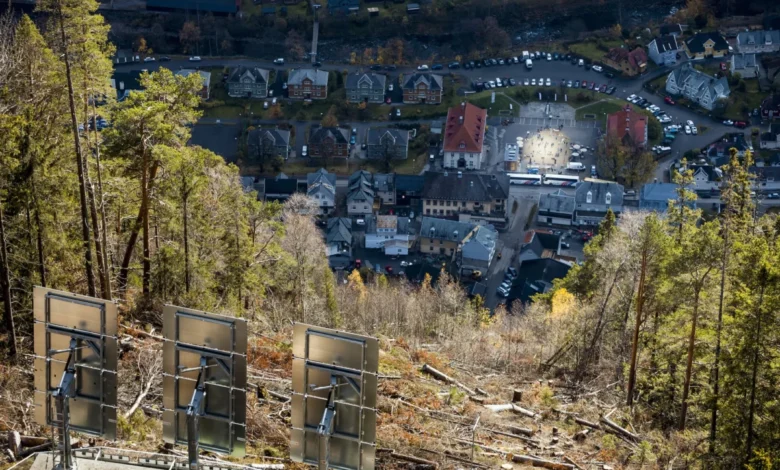
Located roughly a three-hour drive west of Norway’s capital city of Oslo, Rjukan is internationally recognized not only for its striking natural landscapes and historic waterfalls, which have drawn tourists since the late 19th century, but also for a pioneering technological installation that fundamentally reshaped winter living in polar-adjacent valleys. Perched 450 meters—or roughly 1,476 feet—above the town square on a sheer cliffside are three massive, computerized sun mirrors. Each reflector is roughly the size of a standard parking space, measuring 17 square meters (183 square feet). Together, they capture available sunlight from the southern peaks and redirect it directly down into the valley, bathing a targeted patch of the municipal market square roughly the size of three tennis courts in warm, natural rays.
This bold intervention into the natural environment has turned what was once a geographic curse into a celebrated modern marvel, attracting global media attention from outlets including the BBC, NPR, National Geographic, and the Associated Press since its official inauguration in late October 2013. Yet, while the current mirror array has successfully brought localized solar warmth to sun-starved residents, the realization of this vision is the culmination of a century-long struggle against both nature and local skepticism.
A Century-Old Vision Finally Realized
The concept of artificially illuminating Rjukan’s shadowed town square is far from a recent innovation. The idea was first formally proposed back in 1913 by industrialist and visionary Sam Eyde, the very founder of the town. Eyde established Rjukan as a company town to house workers for Norsk Hydro, drawn to the area by the immense energy potential of the Rjukan Falls. Recognizing the psychological and physiological toll that months of total shadow took on his workforce, Eyde envisioned a system of mirrors to beam light into the valley.
At the dawn of the 20th century, however, the technology required to make such a system viable—particularly automated tracking mechanisms and lightweight, durable reflective materials—simply did not exist or was cost-prohibitive. As an interim solution to combat the lack of sunlight, the town constructed a cable car in 1928, known as the Krossobanen, which allowed residents to ascend the steep mountain slopes to access natural sunlight during the dark winter months. The Krossobanen remains Europe’s oldest continuously running two-car aerial tramway, but it offered only a temporary escape rather than a permanent solution to the valley’s deep gloom.
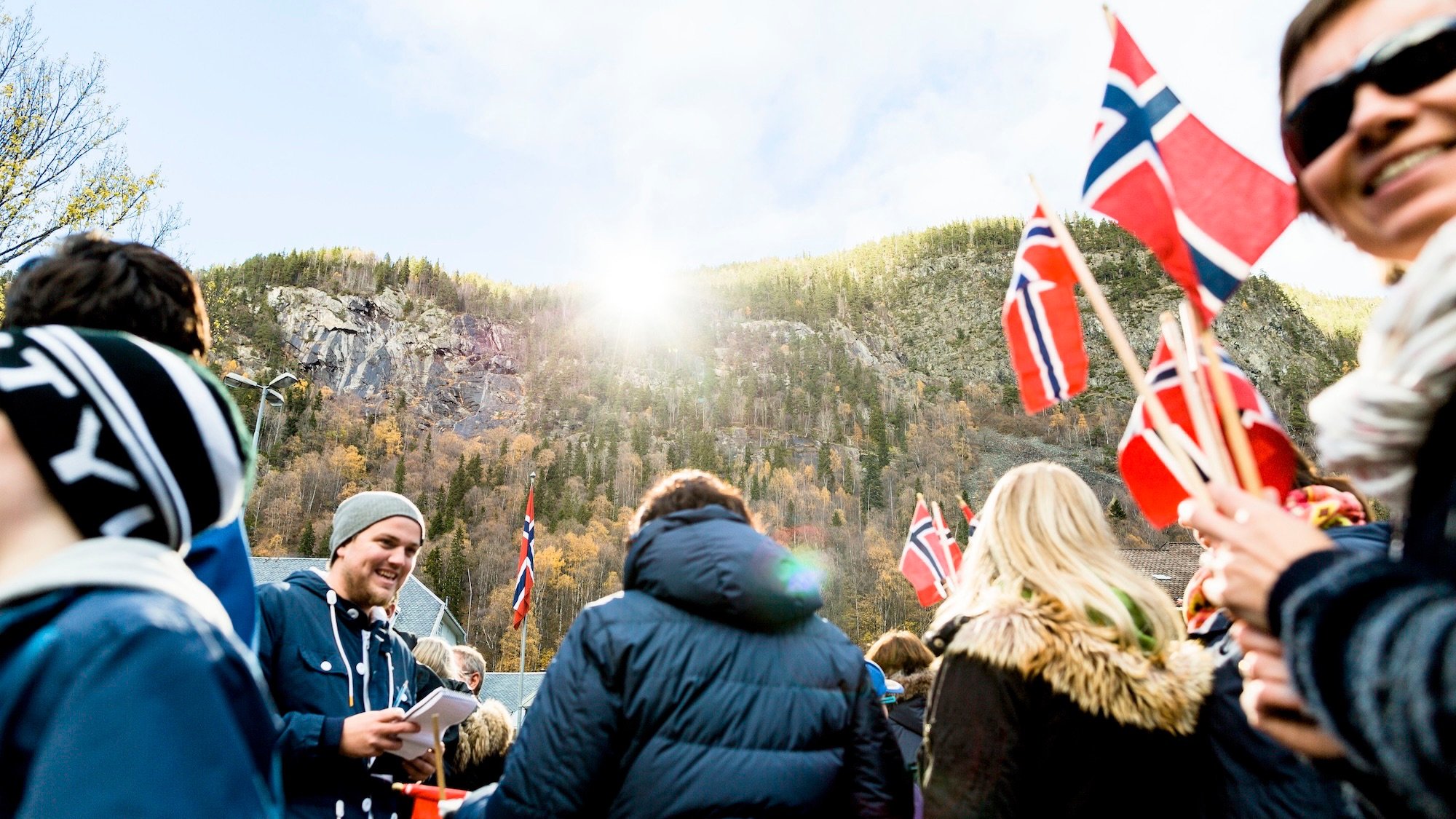
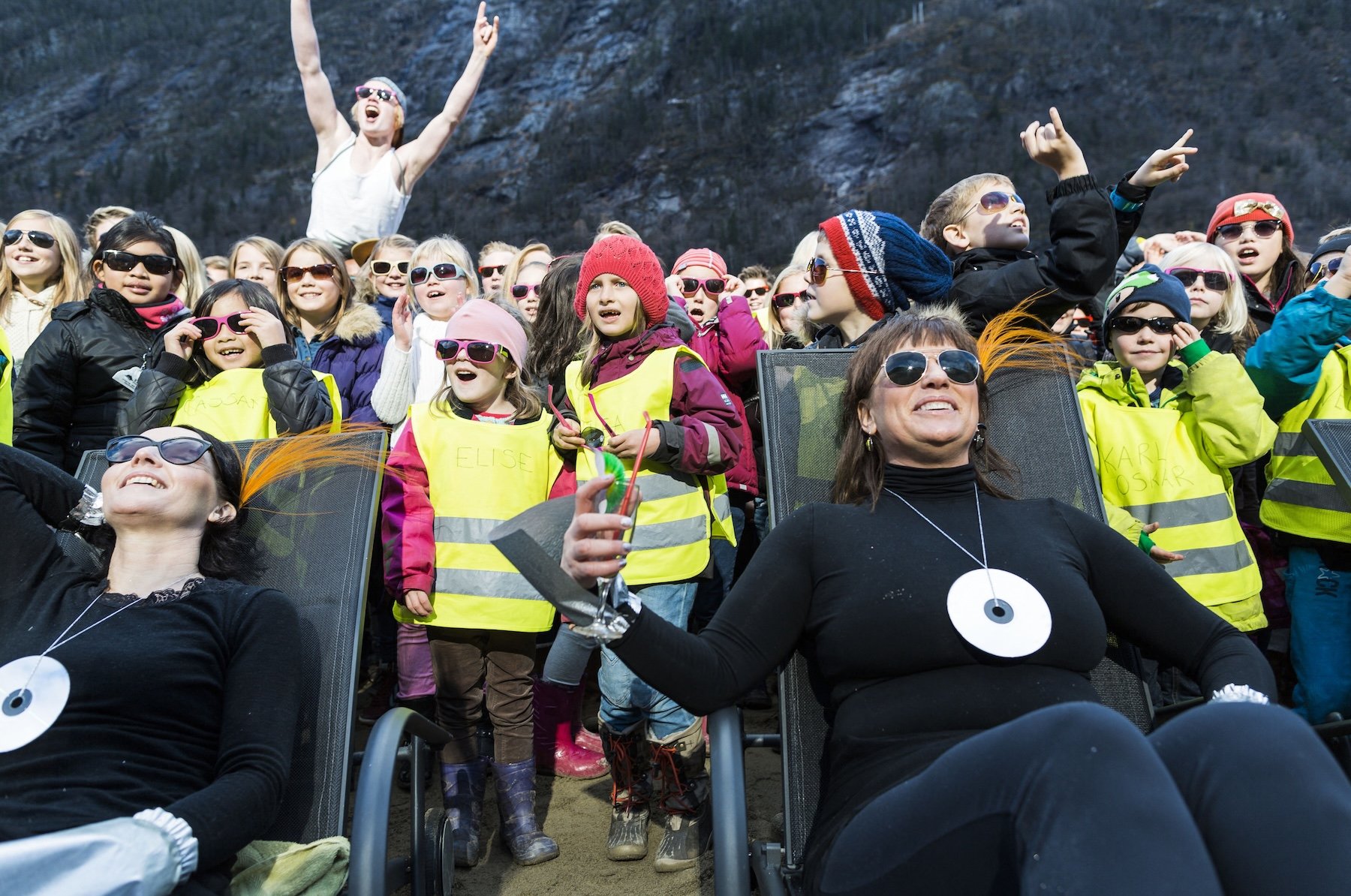
It took precisely 100 years from Eyde’s initial proposal for technology and local ambition to finally align. Spearheaded by local artist Martin Andersen, who revived the project in the modern era, a dedicated group of planners, engineers, and municipal authorities brought the Solspeilet to life. On October 30, 2013, the mirrors were activated for the first time, washing the historic town square in golden light and drawing cheering crowds of local residents and international journalists to witness the historic transformation.
Engineering Challenges and Upgrades in Extreme Terrain
Maintaining a high-tech optical array on a precipitous, wind-swept Norwegian cliffside is an extraordinary logistical undertaking. Initially, the 2013 mirror installation operated entirely off-grid, relying on a combination of localized solar panels and a backup diesel generator to power the electronic motors that tilt and rotate the glass plates. Because the mirrors sit nearly 500 meters above the valley floor with no connecting access roads, servicing the equipment required maintenance crews to hike up the steep incline carrying replacement parts and tools entirely in backpacks.
The vulnerability of this remote, off-grid setup was exposed in 2022 when the original mirror system suffered a catastrophic mechanical breakdown. The failure left the town without reflected sunlight for nearly a year, underscoring the fragility of the pioneering installation. Rather than abandoning the project, municipal authorities committed to a comprehensive and costly overhaul, initiating a full replacement of the system to coincide with the project’s 10-year anniversary in late 2023.
The 2023 renovation cost approximately 3 million Norwegian kroner—equivalent to just over $310,000 USD—a significant fiscal commitment for a small municipality. However, the investment yielded substantial engineering improvements. Crews successfully installed a dedicated power line up the mountain face, providing the mirrors with a stable, weather-resistant energy source. Furthermore, the analog-heavy control mechanisms were replaced with an advanced, internet-based digital infrastructure.
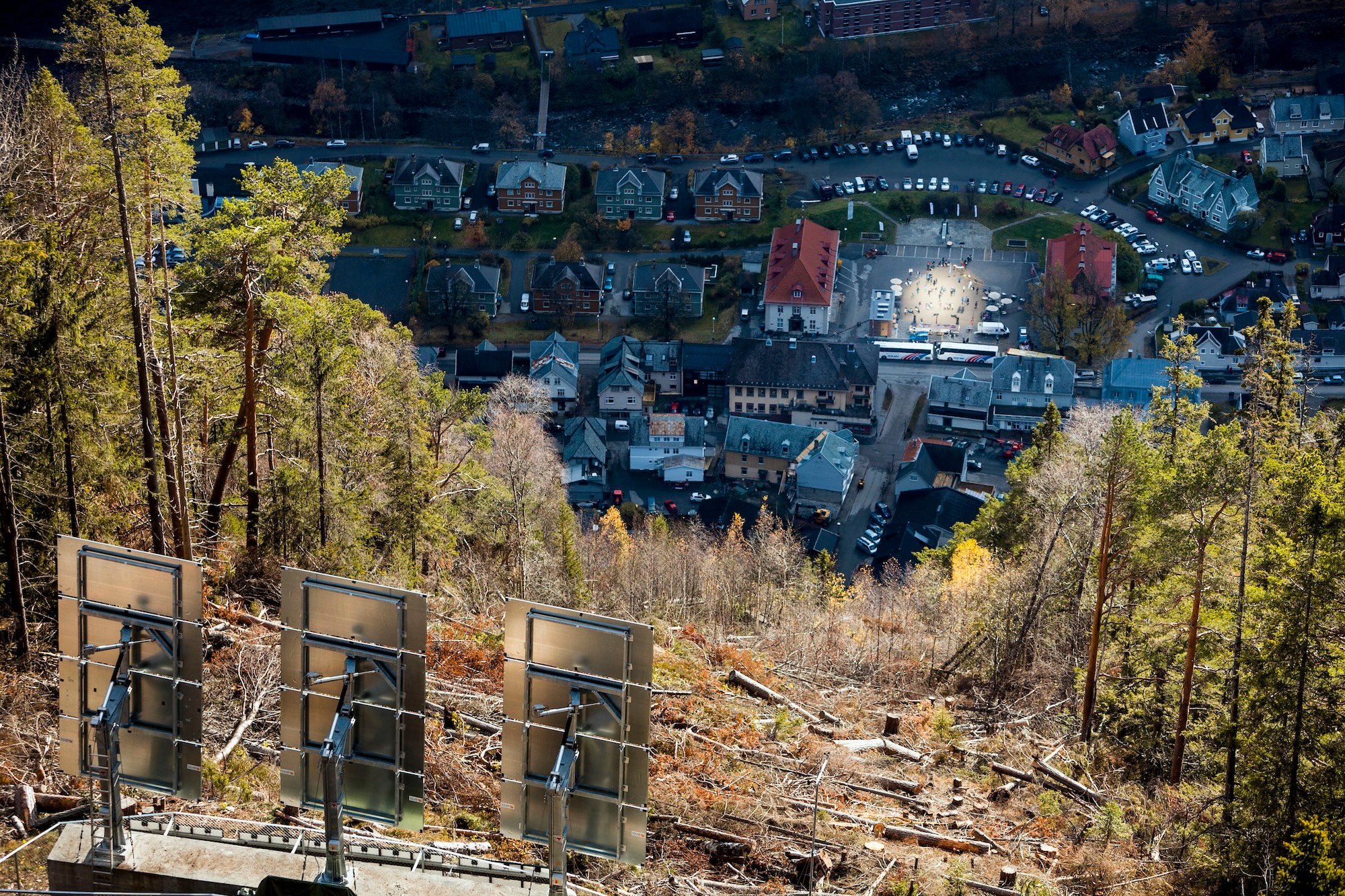
This modern control system allows municipal operators to manage the heliostat array remotely. Crucially, the upgraded software possesses the flexibility to pivot the reflected light beams beyond the traditional boundaries of the market square, directing precious rays to other public gathering spaces such as the local ice-skating rink, thereby maximizing the social and recreational benefits of the installation.
Overcoming Local Skepticism and Controversy
Despite the romantic appeal of bringing sunlight to a dark valley, the path to constructing the Solspeilet was not universally embraced by the community. When the project was first seriously debated and proposed in the early 2010s, it faced notable pushback from a segment of the local population. More than 1,000 residents signed formal petitions opposing the initial construction—a remarkably high figure of dissent within a tight-knit community of only 3,000 people.
Critics of the project raised various concerns, questioning whether spending millions of kroner on decorative mirrors was a responsible allocation of public funds, particularly when basic municipal infrastructure required constant investment. Others expressed aesthetic and environmental anxieties, arguing that industrial structures perched high on the pristine mountain slopes would mar the natural beauty of the landscape. A few skeptics even questioned whether the artificial beam of light would feel unnatural or invasive.
Over time, however, the overwhelming success of the initiative largely dissolved local opposition. As families, children, and elderly residents began gathering in the illuminated town square during the depths of January to feel warmth on their faces, the cultural atmosphere shifted. Furthermore, the economic dividends of the project quickly became apparent. The mirrors transformed Rjukan into a winter tourism hotspot, drawing travelers from across the globe during the off-season to witness the engineering marvel firsthand. The international media coverage generated by the launch and subsequent repairs provided the town with priceless global marketing, boosting local businesses, hotels, and restaurants during a period of the year when tourism would otherwise stall.
Broader Implications: Innovation in Extreme Environments
Rjukan’s successful deployment of heliostats offers a fascinating case study in human adaptation to extreme geographical environments. As urban planners and architects increasingly look for innovative ways to improve public health, mental well-being, and energy efficiency in challenging climates, projects like the Solspeilet demonstrate how creative engineering can overcome deep-seated natural limitations.
The psychological impact of seasonal darkness—often associated with Seasonal Affective Disorder (SAD) and diminished vitamin D synthesis among high-latitude populations—is a well-documented public health challenge across Scandinavian nations and other polar regions. While artificial indoor light therapy and vitamin supplementation remain standard medical interventions, the ability to step outside into actual, natural solar radiation during the dead of winter provides an invaluable psychological boost to an isolated community.
Furthermore, the technology utilized in Rjukan—heliostats that track the sun’s trajectory across the horizon to concentrate or redirect light—shares underlying engineering principles with large-scale concentrated solar power (CSP) plants used for renewable energy generation. By proving that such systems can be maintained under harsh winter conditions, high winds, and remote mountain access constraints, Rjukan has inadvertently served as a small-scale laboratory for optical engineering in extreme weather.
As climate patterns shift and remote communities seek sustainable ways to enhance livability without expanding fossil fuel dependency, Rjukan stands as a testament to human ingenuity. What began as an unfulfilled 1913 daydream by industrial pioneer Sam Eyde has evolved into a permanent fixture of community life, proving that with enough mathematical precision, technical ambition, and glass, even the deepest shadows can be pierced by the light.
Related posts: