The History of Concrete: John Wilson’s Cinematic Investigation into the Infrastructure of Our Modern Collapse

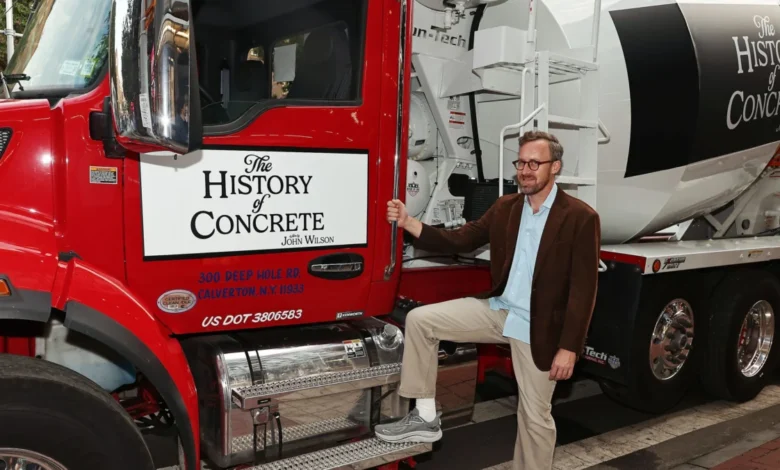
Concrete is the silent protagonist of the Anthropocene, the literal foundation upon which modern civilization rests, and increasingly, the substance of its potential undoing. It is the second-most consumed material on Earth, trailing only water, with global production exceeding 50 billion tons annually. Yet, beneath its ubiquitous, grey, and seemingly permanent veneer lies a volatile reality of environmental degradation, structural instability, and a looming resource crisis. Filmmaker John Wilson, renowned for his observational style in the HBO series How To with John Wilson, turns his lens toward this paradox in his new feature-length documentary, The History of Concrete, offering a sobering meditation on the fragility of the world we have built.
The Anatomy of an Environmental Crisis
While the documentary adopts the aesthetic trappings of a lighthearted Hallmark feature, its core thesis is grounded in urgent environmental science. Concrete is a significant contributor to the climate crisis, responsible for approximately 8% of global carbon dioxide emissions. The production process, specifically the manufacture of cement—the binding agent in concrete—requires the heating of limestone to extreme temperatures, a process that releases vast quantities of greenhouse gases.
Beyond its atmospheric footprint, the material is fundamentally linked to a critical shortage of natural resources. Sand, the primary aggregate in concrete, is vanishing at an unsustainable rate. As global urbanization demands more housing, bridges, and highways, the extraction of sand from riverbeds and coastal regions has led to severe erosion, the destruction of aquatic habitats, and the destabilization of coastlines. Experts have long warned that the global sand crisis is no longer a localized issue but a systemic threat to international supply chains and environmental security.
Chronology of a Crumbling Infrastructure
The impetus for Wilson’s investigation began with a mundane, personal frustration: a persistent flooding issue in the basement of his Queens apartment. His repeated attempts to repair the leaks with off-the-shelf concrete mixes provided a microcosm of a larger municipal struggle. As climate change accelerates, New York City and other global metropolises are facing increased frequency and intensity of extreme rainfall.
The chronological deterioration of these structures is well-documented by urban planners and engineers:
- Mid-20th Century: A period of unprecedented concrete-based expansion in major urban centers, relying on engineering standards that did not anticipate the severity of current climate-induced flooding or the acceleration of material degradation.
- Early 2010s: Rising awareness among structural engineers regarding the "hidden" lifespans of critical infrastructure. Projects like the Brooklyn Promenade, constructed as a multi-layered artery, began showing significant signs of fatigue.
- 2025: The closure of a high-profile concrete recycling facility near the Brooklyn marine terminal following intense community protests. Residents reported dangerous levels of airborne particulate matter, highlighting the local health impacts of the infrastructure maintenance cycle.
- Present Day: Ongoing debates in urban planning circles regarding the necessity of "climate-resilient" materials versus the entrenched, carbon-intensive reliance on traditional concrete.
Structural Hazards and the Urban Heat Island
The film underscores a chilling reality: the built environment is not as permanent as it appears. Interviews with former NYC traffic commissioner Sam Schwartz reveal that key infrastructure, such as the Brooklyn Promenade, is operating well past its intended design life. Patchwork repairs have become the standard, but as structures age and environmental stressors—such as saltwater intrusion and extreme temperature fluctuations—intensify, the margin for error narrows.
Furthermore, concrete exacerbates the "urban heat island" effect. By absorbing and radiating solar heat, vast swathes of concrete pavement can reach temperatures as high as 140 degrees Fahrenheit. This not only threatens public health—contributing to hundreds of heat-related deaths annually in regions like Arizona—but also accelerates the thermal expansion and subsequent cracking of the concrete itself, creating a vicious cycle of decay.
Industry and Regulatory Perspectives
The reliance on concrete is not merely a design choice; it is an economic and logistical necessity. Contractors and developers often argue that, despite the environmental costs, there is no currently viable, mass-scale alternative that provides the same durability, fire resistance, and cost-efficiency. "We would be up a creek without concrete," one contractor notes in the film.
However, regulatory bodies are beginning to face pressure to rethink urban development. The failure of concrete recycling facilities, which were intended to be a circular economy solution, suggests that the industry is struggling to innovate without creating new public health externalities. The closure of the Brooklyn plant serves as a case study in the tension between the need for sustainable material management and the immediate right of residents to clean air.
The Socio-Economic Implications of the Built Environment
The documentary challenges the prevailing narrative that high-density urban living is inherently the most sustainable lifestyle. While city dwellers often have lower per-capita carbon footprints due to reduced transportation emissions, these metrics frequently omit the "embodied carbon" of the massive concrete structures that support urban life. When the lifespan of these structures is short, the carbon "debt" incurred during construction is never fully paid off by the energy efficiencies of urban density.
Wilson’s film posits that our dependency on concrete is as much a psychological state as a physical one. Once a society is built upon a specific material foundation, it becomes difficult to imagine—or fund—an alternative. The film suggests that the "external pressure" of climate change may be the only force capable of altering this lifestyle, though such transitions are historically slow and fraught with systemic resistance.
Observations on a Concrete World
The narrative power of The History of Concrete lies in its ability to synthesize these heavy, abstract concepts into observable moments. Wilson’s camera captures the absurdity of a society that spends millions of dollars on temporary patches for critical infrastructure while simultaneously ignoring the long-term depletion of the natural world. From a tattoo-preservation mortuary to the spiritual runners of Queens, the film uses these vignettes to illustrate how humans exist within a cocoon of their own making—one that is, quite literally, cracking under pressure.
As viewers leave the theater and return to the streets, the film leaves them with a heightened awareness of their environment. A pothole is no longer just a nuisance; it is a symptom of a global material crisis. A towering skyscraper is no longer just a feat of engineering; it is a massive store of embodied carbon with a finite lifespan. By forcing the viewer to look at the ground beneath their feet, John Wilson reveals that the most critical story of our time is one that has been hiding in plain sight, cast in grey, and waiting to be noticed. The challenge ahead is not merely to find a substitute for concrete, but to fundamentally redefine the relationship between our ambition and the physical limits of our planet.
Related posts: