Rising Tides and Political Currents: The Battle for Virginia’s Second District and the Future of Naval Readiness

As early voting draws to a close this Saturday in Virginia’s Second Congressional District, the race between Republican incumbent Jennifer Kiggans and Democratic challenger Elaine Luria has crystallized into a bellwether for the 2027 legislative session. With the Cook Political Report shifting the district from a “toss up” to “lean Democrat,” the contest has transcended local partisan bickering, emerging as a critical inflection point for the future of U.S. military infrastructure and climate resilience policy. The outcome of this election will not merely dictate regional representation; it will determine whether the nation’s largest naval installation can successfully navigate the existential threat of a changing climate under an administration openly hostile to environmental mitigation efforts.
The Geography of Vulnerability
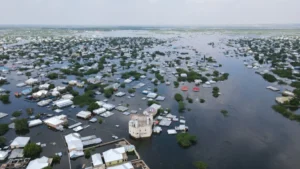
The Second Congressional District, which encompasses the sprawling metropolitan landscape of Hampton Roads and the coastal expanse of Virginia Beach, is uniquely positioned at the intersection of American military might and environmental fragility. Naval Station Norfolk, the world’s largest naval base, serves as the heartbeat of the regional economy and a linchpin of global naval power. However, for more than a decade, the region has been ground zero for the acceleration of sea-level rise.
The geological reality of the area is compounding the threat. As the land in coastal Virginia continues to subside—a process known as land subsidence—the encroaching Atlantic Ocean creates a dual-threat environment. Residents and base personnel alike have become accustomed to "sunny-day flooding," where high tides infiltrate streets and residential neighborhoods even in the absence of storm events. According to researchers at Old Dominion University, advanced machine learning models have begun to predict the exact timing and severity of these floods with alarming accuracy, painting a picture of a region that is becoming increasingly difficult to traverse.
A Chronology of Policy and Neglect
The tension between the Department of Defense’s operational requirements and the political climate in Washington has evolved significantly over the last several years.
- 2022: A coalition of Democratic representatives, including then-incumbent Elaine Luria, formally petitioned the Biden administration to establish a dedicated interagency coordinator for Hampton Roads, citing the urgent need for a unified resilience strategy for the base and surrounding communities.
- 2023: In a significant acknowledgment of the threat, Naval Station Norfolk was designated as the first pilot site for a comprehensive federal climate resilience program, intended to serve as a national model for military base adaptation.
- January 2026: Representative Jennifer Kiggans voted in favor of the FY 2026 appropriations package, emphasizing its role in securing military readiness. However, this period also marked a shift in political discourse as the new administration under President Donald Trump took office.
- Early 2026: The Trump administration initiated a series of policy reversals, including an attempt to halt the Coastal Virginia Offshore Wind (CVOW) project. This prompted a rare moment of bipartisan friction, as Kiggans signed a letter alongside other officials to protest the delay.
- Mid-2026: The climate resilience pilot program at the naval base fell into a state of stagnation. Official records and climate-related initiatives were systematically scrubbed from federal websites, and the Department of Defense, under Secretary Pete Hegseth, signaled a move away from environmental risk assessment.
The Conflict of Priorities
The candidates’ platforms highlight a complex paradox in the district’s politics. Elaine Luria, a Navy veteran, has framed her campaign around the necessity of environmental preservation as a matter of national security. Her supporters argue that her tenure represents a proactive stance on the economic and strategic fallout of sea-level rise. She has consistently championed the integration of the Coastal Virginia Offshore Wind project, viewing renewable energy not just as a climate solution, but as a catalyst for regional economic growth and energy independence.
Conversely, Jennifer Kiggans has attempted to strike a balance between traditional Republican defense orthodoxy and the specific needs of her coastal constituency. While she has advocated for infrastructure funding that bolsters base readiness, her legislative record has drawn criticism from environmental advocates. Her vote to repeal certain clean energy tax credits in 2026, despite her earlier support for the offshore wind project, has been labeled by groups like the Chesapeake Climate Action Network as a "stab in the back" to the district’s long-term sustainability goals.
Military Readiness and Environmental Risk
The debate over climate change in the Second District is not merely ideological; it is operational. Retired Rear Admiral Jonathan White, a former director of the U.S. Navy’s Climate Change Task Force, has been a vocal critic of the current administration’s approach to environmental threats.
"Naval Station Norfolk is probably one of the most at-risk large Navy or military installations when we look at climate change," White noted. "It is not just about the ships; it is about the entire ecosystem of support. If the machinists, the welders, and the logistics personnel cannot get to work because their neighborhoods are flooded, or if the base infrastructure itself is degraded by saltwater intrusion, we are looking at a failure of readiness."
White’s concerns are supported by data from the Yale Climate Opinions Map, which indicates that a majority of residents in the district—roughly 55 to 57 percent—acknowledge the connection between global warming and the flooding issues plaguing their daily lives. Despite the prevalence of "climate hushing," where political figures avoid the subject to prevent alienating core bases, the reality of the district’s topography makes the issue impossible to ignore entirely.
Broader Implications for National Security
The standoff at the base level reflects a broader national trend. As the Trump administration moves to remove climate change from the lexicon of the federal government, military leaders are left to grapple with the consequences of ignoring what they characterize as a "threat multiplier."
For the civilian workforce and the families of the 88,000 veterans residing in the district, the stakes are tangible. Quentin Scott of the Chesapeake Climate Action Network points out that the current state of affairs is unsustainable. "People are driving boats through the middle of the neighborhood," Scott said. "There is a ‘No Wake Zone’ sign in the middle of a school playground. These are the everyday experiences that people are adapting to."
The strategic implications are severe. If the United States continues to treat climate-induced infrastructure damage as a secondary concern, the ability to project power from its primary Atlantic port may be compromised. Critics argue that the current administration’s refusal to engage with the reality of sea-level rise creates a dangerous vulnerability. If a base is rendered partially inoperable during a critical deployment window due to environmental factors, the repercussions will be felt far beyond the borders of Virginia.
Analysis: A Test of Voter Awareness
As voters head to the polls, the central question is whether the electorate will prioritize long-term resilience over immediate partisan alignments. The race in the Second District demonstrates that climate change has become a structural issue that defies simple political categorization. Whether voters identify primarily as "national security" advocates or "climate" advocates, they are increasingly finding that the two interests are inextricably linked.
The data suggest that the next Congress will be under intense pressure to reconcile these realities. If the incoming representative ignores the environmental degradation of the Hampton Roads area, they risk the economic and strategic vitality of their district. If they embrace a strategy of resilience, they may find themselves at odds with an administration that views environmental action as a political liability.
In the final analysis, the Second District race serves as a mirror for the nation. It reflects a society grappling with the consequences of an changing environment while attempting to maintain its status as a global superpower. Regardless of who secures the seat, the reality of the rising tide in Norfolk will remain, waiting for a government that is willing to acknowledge the changing landscape of national security. As the polls close this Saturday, the result will not just mark the end of a campaign, but the beginning of a new chapter in the fight to define the future of America’s defense in an age of climate uncertainty.