Warriors Survive Late-Game Collapse against Timberwolves to Secure 119-114 Victory and Improve to 2-3

The Golden State Warriors narrowly avoided a historic fourth-quarter collapse on Wednesday night, holding off a fierce second-half charge by the Minnesota Timberwolves to secure a 119-114 victory at the Target Center in Minneapolis. Despite establishing a commanding 24-point lead in the early stages of the second half, the veteran-laden Warriors permitted Minnesota to claw back into contention, exposing persistent vulnerabilities in late-game execution that have characterized the opening stretch of their 2026-2027 NBA campaign.
The win elevates Golden State’s record to 2-3, concluding a turbulent three-game road trip with a 2-1 mark. Meanwhile, the Timberwolves—playing without star guard Anthony Edwards—fell short of orchestrating a miraculous comeback reminiscent of the one executed just days prior by the Memphis Grizzlies, who erased a 12-point deficit with under four minutes remaining to stun the Warriors. Although head coach Steve Kerr and his squad avoided a catastrophic defeat, the manner in which their double-digit advantage evaporated has intensified internal scrutiny regarding the team’s ability to navigate high-pressure situations during the twilight of their championship window.
A Game of Two Halves: From Dominance to Desperation
The contest began as an offensive masterclass for the visiting Warriors, who capitalized on unorganized defensive rotations by a shorthanded Minnesota squad. Golden State methodically built its advantage through crisp ball movement, disciplined half-court sets, and aggressive attacks on the rim that repeatedly put the Timberwolves in foul trouble.
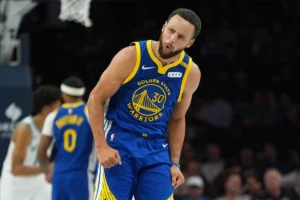
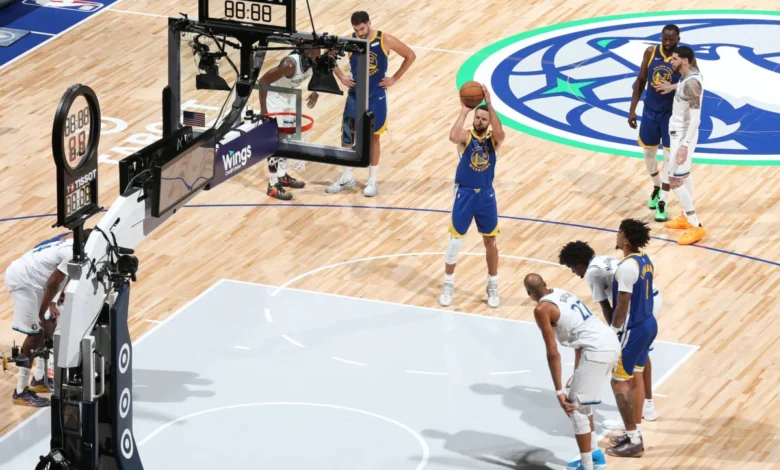
By intermission, the Warriors had established firm control of the tempo, outworking Minnesota on both ends of the floor. The momentum culminated with just under three minutes elapsed in the third quarter when Stephen Curry converted a pair of free throws—part of his 16-point performance from the charity stripe—to cap a blistering sequence that pushed the Golden State lead to 73-50. At that juncture, the outcome appeared all but decided, and the possibility of a blowout victory seemed increasingly likely.

However, the game’s complexion shifted abruptly within a dizzying two-minute window. A combination of careless ball-handling and uncharacteristic sloppiness allowed Minnesota to inject life into an otherwise dormant arena. Draymond Green committed an unforced turnover, newcomer Yaxel Lendeborg was stripped on consecutive possessions, and Curry stepped out of bounds along the baseline, highlighting a sudden lapse in offensive discipline.
Capitalizing on the live-ball turnovers, Timberwolves guard TJ Shannon sparked a quick transition sequence, culminating in a three-pointer that trimmed the deficit to 73-53 and forced an immediate timeout from Kerr. Rather than maintaining tactical patience to stretch the margin toward 30 points, the Warriors’ offense degenerated into forced isolation plays and rushed perimeter attempts, giving the younger, more athletic Minnesota roster precisely the open-court environment it required to mount a comeback.
Chronology of the Collapse
The erosion of Golden State’s lead was not confined to a single catastrophic quarter but rather occurred in distinct, escalating waves. Following the mid-third-quarter timeout, the Warriors struggled to reestablish offensive rhythm. Minnesota, sensing vulnerability, intensified its defensive pressure and began converting transition opportunities with high efficiency.
As the game bled into the fourth quarter, the Timberwolves systematically chipped away at the deficit. Golden State’s offense grew stagnant, heavily reliant on individual brilliance rather than the systemic ball movement that defined their championship eras. The tension peaked in the final minute of regulation following a broken offensive possession that ended in a missed perimeter shot by Curry. The ensuing long rebound allowed Jonathan Kuminga to advance the ball quickly, setting up Ayo Dosunmu for a transition three-pointer that sliced the Warriors’ lead to 116-112 with precisely 45 seconds remaining on the game clock.
Ultimately, Golden State managed to sink critical free throws down the stretch to stave off the upset, but the sequence underscored a recurring structural flaw. The Timberwolves outscored the Warriors 64-110 over the final iterations of the game, fueled largely by a stark disparity in perimeter shooting during the second half, where Minnesota drained 10 three-pointers compared to just one for Golden State.

Context, Supporting Data, and Historical Trends
To fully evaluate the implications of Wednesday’s contest, analysts must examine the broader trajectory of the Warriors’ early season. Following a dismal 0-3 start—the franchise’s worst opening stretch since the 2007-08 season—Golden State has labored to find consistency on both sides of the ball. The primary concern is not merely the losses themselves, but the manner in which late-game leads have dissipated.
In five games this season, the Warriors have held double-digit leads in the fourth quarter on three separate occasions. Their inability to cleanly close out these contests has raised red flags regarding stamina, defensive rebounding, and offensive stagnation when opponents deploy aggressive full-court pressure. This trend was painfully evident on the preceding Friday against the Memphis Grizzlies, where Golden State surrendered a 17-0 run over the final 3:41 of regulation to forfeit a 106-94 lead.
Statistical indicators further illustrate the team’s dichotomy. While the Warriors remain one of the most experienced rosters in the National Basketball Association—boasting a wealth of veteran savvy designed to close out tight games—they are simultaneously integrating structural tweaks to their offensive scheme and assimilating new role players into the rotation. This transitionary phase has frequently resulted in periods of disjointed play, wherein the team abandons half-court discipline in favor of erratic, high-tempo possessions that disproportionately favor younger, more athletic opponents.
Postgame Reactions and Technical Analysis
In the immediate aftermath of the victory, members of the Golden State organization offered measured assessments that balanced relief with clear-eyed recognition of ongoing deficiencies.

"We didn’t do a good job closing, but… I kind of liked what happened," Steve Kerr told reporters during his postgame press conference. "Because we need to learn from it. We smelled blood in the water. We thought we needed to make great plays, spectacular plays, in order to extend it to 30, instead of just making solid plays."
Kerr emphasized that the turning point occurred when the team abandoned its tactical discipline while holding a 23-point cushion in the third quarter. By attempting to force high-risk plays rather than executing fundamental basketball, the Warriors invited chaos into an environment where control was paramount.
Stephen Curry echoed his head coach’s sentiments, acknowledging the psychological relief of securing a victory on the road while maintaining a pragmatic view of the team’s current developmental stage.
"There’s a slight bit of relief," Curry remarked regarding the team’s ascent to a 2-3 record. "But there’s still an understanding that the Memphis game in the second half, tonight mostly in the fourth quarter, we know we can play better… We let them off the hook when we were up 73-50 with all those turnovers. The whole game changed right then at that point. That’s when it got wild and crazy."
Curry also dissected the team’s offensive vulnerabilities when facing defensive pressure, noting that the veteran unit occasionally falls into the trap of playing on its heels. "I think a lot of it is just getting organized offensively where you’re using the other team’s desperation and pressure against them," Curry explained. "It seems like we kind of get playing on our heels a little bit. Then you’re just kind of hoping and wishing shots go in."
Broader Implications for the Season

As the Golden State Warriors return home to prepare for the remainder of their rigorous early-season schedule, the implications of their narrow escape in Minneapolis extend well beyond a single box score.
On one hand, securing a 2-1 record on a three-legged road trip represents a tangible step forward for a franchise that opened the year searching for an identity. Veteran leadership and late-game free-throw shooting ultimately preserved the outcome, preventing a disastrous 1-5 start that could have derailed team morale early in the autumn schedule.
Conversely, the recurring nature of fourth-quarter lapses suggests that fundamental adjustments are required if Golden State intends to contend in the fiercely competitive Western Conference. Opponents have recognized that applying sustained defensive pressure and pushing the pace can disrupt the Warriors’ offensive flow, exposing vulnerabilities in transition defense and ball security.
For Kerr and his coaching staff, the primary objective moving forward will be bridging the gap between dominant stretches of play and sustained execution over a full 48 minutes. While the integration of new personnel and tactical modifications naturally breeds inconsistency during the opening month of the season, the margin for error in the modern NBA leaves little room for recurring late-game collapses. As the Warriors continue their campaign, the lessons extracted from both the Memphis defeat and the Minneapolis near-miss will serve as critical litmus tests for whether this veteran roster can successfully reclaim its status among the league’s elite elite.