Oregon Paves the Way as State-Level Universal Healthcare Push Gains Momentum Ahead of Crucial 2026 Proposal Deadline

While federal lawmakers and congressional candidates focus their midterm ambitions on incremental adjustments to the nation’s healthcare landscape—such as bolstering Affordable Care Act (ACA) subsidies, pushing back against Medicaid rollbacks, and lowering the baseline age for Medicare eligibility—a more radical transformation is quietly brewing at the state level. In progressive strongholds across the country, including New York, Washington, California, and Oregon, policymakers are laying the groundwork for complete single-payer, universal healthcare systems designed to bypass the gridlock of Washington, D.C.
No state is currently closer to realizing this ambitious goal than Oregon. Pursuant to a mandate passed by the state legislature in 2023, the nine-person Universal Health Plan Governance Board is finalizing a comprehensive blueprint for a universal healthcare system. Scheduled for formal submission to state lawmakers by December 1, the proposal envisions a cradle-to-grave system providing robust medical, vision, dental, and mental health benefits to every single Oregon resident starting in 2032. Under the draft framework, patients would experience zero premiums, deductibles, or copayments at the point of service.
The path from a board proposal to legislative reality could move quickly. Oregon lawmakers have the option to debate and vote on the plan during the 2027 legislative session, or they could choose to refer the sweeping measure directly to voters via a statewide ballot initiative in 2028. Should the proposal clear these hurdles, Oregon would become the first state in modern American history to successfully design and implement a true single-payer health coverage ecosystem, potentially serving as a blueprint for other states and the federal government.
Historical Context and the State-Level Laboratory
The pursuit of single-payer healthcare has historically faced immense structural and political barriers in the United States. While national movements like Medicare for All command passionate progressive support, policy analysts note that federal implementation remains politically untenable in the near term. Consequently, proponents have increasingly looked to state governments to act as policy laboratories—a historical precedent that has yielded transformative results before.
The Affordable Care Act itself was heavily modeled after Massachusetts’ pioneering state-level healthcare reform signed into law by Republican Governor Mitt Romney in 2006, which instituted an individual mandate and state-backed insurance exchanges after statewide single-payer efforts stalled. Similarly, Canada’s celebrated universal healthcare system originated as a provincial experiment launched in Saskatchewan in 1947 before expanding nationwide decades later.
"In the short to medium term, there is no chance that Medicare for All can be passed at the national level," said Jonathan Oberlander, a health policy professor at the University of North Carolina. "That’s where the states come in. A state like Oregon provides a more hospitable political environment and a more realistic path to single-payer reform."
Despite these opportunities, history serves as a cautionary tale for universal healthcare advocates. In 2011, the Vermont Legislature voted to establish a state-based universal healthcare system, only for Democratic Governor Peter Shumlin to abandon the effort three years later, citing the risk of severe economic disruption and unmanageable payroll tax hikes. Ballot measures aimed at enacting single-payer systems have fared even worse when taken directly to voters, failing by wide margins in California in 1994, Oregon in 2002, and Colorado in 2016.
Financial Architecture: Shifting the Burden of Healthcare Spending
Oregon’s emerging proposal attempts to circumvent past financial pitfalls by reimagining how healthcare is funded. Rather than injecting billions in new spending from scratch, the plan aims to capture and consolidate existing healthcare expenditures currently paid by federal and state governments, private businesses, and individual consumers.
Under the board’s framework, revenue from private insurance premiums and out-of-pocket costs would be replaced by a combination of new personal and corporate tax structures. These funds would be pooled into a single, centralized state fund used to pay hospitals, physicians, and medical practitioners directly. Board officials argue that eliminating the administrative overhead, waste, and profit margins of private insurance companies will generate substantial savings.
To demonstrate the financial impact on everyday citizens, the board highlighted consumer focus group data. For example, a 30-year-old Oregon resident earning an annual salary of $55,000 who currently purchases a benchmark silver-level ACA plan pays approximately $5,478 annually in premiums. Under the proposed single-payer framework, that same worker’s contribution could drop to roughly $2,331 via a dedicated state tax. Similarly, an employee making $55,000 with employer-sponsored coverage who currently pays $3,063 in combined premiums and out-of-pocket expenses could potentially access healthcare services entirely free of charge while retaining the freedom to choose any doctor in the state.
Businesses that currently shoulder the burden of employee health insurance would see their responsibilities codified through a corporate payroll tax applied to companies with payrolls exceeding $500,000. Employees would receive partial tax credits for contributions made on their behalf. According to board estimates, between 31% and 60% of Oregonians would pay nothing directly for their health benefits, though more affluent residents would likely face higher tax burdens depending on final legislative thresholds.
"What we are proposing is something very different," said Miriam McDonell, executive director of the Oregon board. "Everyone contributes based on the amount that they are able to contribute and not based on utilization."
Stakeholder Friction: Hospitals, Physicians, and Insurers Weigh In
Despite the potential benefits for consumers, the proposal has ignited fierce pushback from major healthcare stakeholders who argue the model is structurally flawed and financially risky.
Proponents insist that hospitals and medical systems will ultimately benefit from the transition by shedding the astronomical administrative costs associated with processing claims across dozens of different private and public insurers, each with distinct billing rules. Furthermore, proponents argue that rural hospitals—which frequently struggle to stay afloat due to high concentrations of uninsured patients or low-reimbursement Medicaid recipients—would achieve newfound financial stability under a guaranteed, single-payer reimbursement model.
Hospitals and medical associations remain deeply skeptical. Becky Hultberg, president and CEO of the Hospital Association of Oregon, criticized the plan sharply, stating that it preserves fundamental inefficiencies while introducing unmanageable fiscal burdens.

"The universal health plan proposal preserves much of the broken, fragmented status quo and adds new taxes and complexity that Oregonians can’t afford," Hultberg said. "With federal policy changes looming, we are entering a period of tremendous upheaval. This proposal could destabilize a system that is already struggling."
Physicians and medical groups are similarly divided. Under the proposed framework, practitioner compensation would be pegged somewhere between lower Medicare reimbursement rates and higher private insurance rates. While overall provider revenue would remain constant, the payment structure would be negotiated to reallocate funds away from specialized medical services and toward primary care.
Courtni Dresser, vice president of government relations for the Oregon Medical Association, noted that while her organization shares the board’s goals of expanding access and reducing administrative red tape, the group has withheld formal endorsement. Rebecca Schoon, an associate health policy professor at Pacific University who is scheduled to join the governance board in January, acknowledged the immense difficulty of balancing stakeholder interests.
"There’s always winners and losers in designing something like this, and so how to distribute those is the hardest part," Schoon said. "But the second-hardest part is, I think, messaging this."
Meanwhile, the private health insurance industry—which encompasses nine Fortune 500 companies—faces an existential threat from any system that effectively locks private plans out of the state market. While major health insurers have not yet formally weighed in on the Oregon text, advocates and industry watchdogs expect a massive public relations and lobbying blitz.
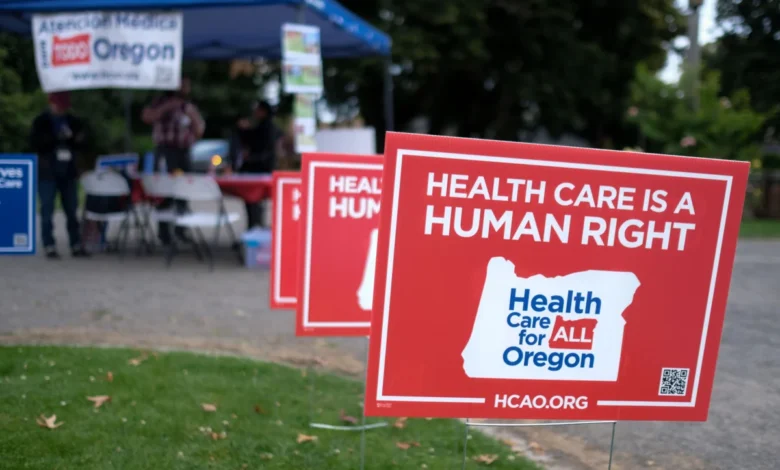
"We expect insurance companies to put every ounce of money they can against this idea because our system is broken and they profit from it," said Collin Stackhouse, communications coordinator for Health Care for All Oregon.
Wendell Potter, a former health insurance executive turned industry whistleblower, warned that opponents will likely weaponize public anxiety surrounding change, framing the proposal as an expensive leap toward "socialized medicine."
"Most people go year to year without testing the limits of their health insurance policy," Potter said. "And so, they’re easily scared into thinking that something valuable will be taken away from them, and that they will have something that’s inferior in its place."

Conversely, major insurance trade groups defend the private market’s current role in shielding consumers from volatile medical costs. Chris Bond, a spokesperson for the industry trade group AHIP, emphasized that Americans express high levels of satisfaction with their existing coverage, pointing to the 180 million workers covered through employers and the 36 million seniors enrolled in Medicare Advantage. "Policy solutions are needed to rein in the ever-higher prices charged by hospitals and drugmakers and make care more affordable for everyone," Bond argued.
Federal Hurdles and Regional Momentum
A major hurdle for Oregon’s plan lies at the federal level. To fully fund a universal state system, Oregon must secure federal waivers allowing the state to redirect massive pools of Medicare and Medicaid funding into its single-payer apparatus. While current political realities under the federal administration make immediate approval unlikely, board backers note that the timeline gives the state years to build political capital, with hopes that the 2028 presidential election could yield a more receptive federal administration. If federal waivers are denied, the state could theoretically proceed in stages, beginning with non-Medicare populations.
Despite these hurdles, Oregon is not acting in isolation. Democratic gubernatorial candidates in California are actively debating different pathways to single-payer implementation, New York lawmakers continue to press for the passage of the comprehensive New York Health Act, and Washington state has established its own commission to design a companion universal healthcare plan.
The governance boards in Oregon, California, and Washington have maintained regular lines of communication, sharing policy research and exploring cross-state collaboration. Dr. Richard Bruno, an Oregon family physician and member of Physicians for a National Health Program, suggested that a coordinated West Coast coalition could emulate successful multi-state alliances previously formed to counter federal public health directives.
"If our four states could do it," Bruno said, "that would be the momentum we would need to get it nationally."