Hannah Einbinder and other high-profile figures arrested during protests against Benjamin Netanyahu in New York City

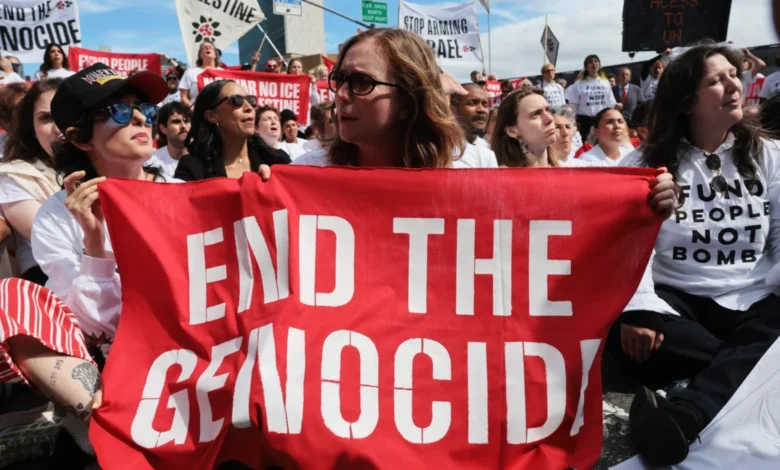
The arrest of Hacks star Hannah Einbinder, Academy Award-winning actress Susan Sarandon, and comedian Caleb Hearon during a demonstration against Israeli Prime Minister Benjamin Netanyahu’s visit to New York City has ignited a broader conversation regarding the intersection of celebrity activism and geopolitical advocacy. The incident, which occurred on Thursday ahead of Netanyahu’s address to the United Nations General Assembly, resulted in the detainment of approximately 100 protesters who had gathered to voice opposition to the ongoing war in Gaza and the widening regional conflict involving Southern Lebanon.
The Chronology of the Demonstration
The protest, organized by groups advocating for a ceasefire and the cessation of U.S. military aid to Israel, centered on the streets surrounding the UN headquarters and areas frequented by the Israeli delegation. According to witnesses and reports from the New York City Police Department (NYPD), the gathering began as an "unscheduled demonstration." Participants moved to block major intersections, effectively disrupting traffic flow in Midtown Manhattan as world leaders convened for the General Assembly’s high-level week.
NYPD officials stated that the Community Affairs Bureau issued multiple warnings to the protesters, advising them that their presence in the intersection was unlawful and that they were required to disperse. When a segment of the group failed to comply with these dispersal orders, officers transitioned from monitoring the situation to taking individuals into custody. Among those arrested were high-profile entertainment figures, including Einbinder, Sarandon, and Hearon. Other notable figures, including actress Cynthia Nixon and Saturday Night Live cast member Sarah Sherman, were observed at the scene, with images circulating on social media showing Einbinder alongside Sherman during the event.
Statements from the Detained
Following her release from police custody, Hannah Einbinder utilized her social media platform to address the motivations behind her participation. In a detailed statement posted to her Instagram Stories, the actress reframed the media focus away from the spectacle of the arrests and toward the humanitarian crisis in the Middle East.
"If the pictures of my friends and me getting arrested in protest of Netanyahu’s shameful visit to New York draw attention to anything, let it be to the devastating genocidal war Israel is waging against people of Palestine and Southern Lebanon," Einbinder wrote. She emphasized that her actions were intended to highlight settler violence, the demolition of civilian infrastructure, and the scale of casualties in Gaza, which she argued have been largely underreported by mainstream international outlets.
Einbinder’s statement also levied significant criticism against the United States government, characterizing the administration’s diplomatic reception of the Israeli Prime Minister as a failure of moral leadership. She further argued that the lack of internal dissent within the U.S. political establishment—spanning both major parties—contributes to the continuation of the conflict. "The fact that the orchestrator of all this bloodshed is roaming freely in our cities is an indictment of both Republicans and Democrats who enable and protect architects of genocide," she concluded.
Official Responses and Legal Context
The NYPD’s response to the demonstration reflects a broader challenge faced by law enforcement in New York City throughout the 2024 and 2025 UN General Assembly sessions. Managing the balance between the constitutional right to protest and the necessity of maintaining public order in a high-security environment has become a point of friction.
A spokesperson for the NYPD confirmed to The Guardian that the arrests were predicated on the refusal to clear the intersection. In legal terms, such arrests typically result in summonses for disorderly conduct or obstruction of governmental administration. While the NYPD has not released specific details regarding the charges against each individual arrested, the procedural standard for such public order offenses usually involves processing and subsequent release with a court appearance ticket.
Historical Context of Celebrity Activism
Hannah Einbinder’s arrest marks a continuation of her public commitment to Palestinian rights, which she has integrated into her professional life and public appearances. During her acceptance speech for Outstanding Supporting Actress in a Comedy Series at the 2025 Emmy Awards, Einbinder concluded her remarks with a pointed reference to the conflict, stating, "Go birds, fuck ICE and free Palestine."
This activism aligns with a growing trend among Hollywood figures who are increasingly willing to risk professional and legal repercussions to advocate for humanitarian causes. Susan Sarandon, a long-time political activist, has similarly been a vocal critic of Israeli policy, often participating in protests and public forums that challenge the status quo of U.S.-Israel relations. The involvement of figures like Caleb Hearon and Sarah Sherman underscores a generational shift in the entertainment industry, where younger performers are utilizing their visibility to advocate for international human rights issues.
Broader Impact and Geopolitical Implications
The protests occurring in New York coincide with a particularly volatile period in the Middle East. Data from international aid organizations and UN agencies indicate that the humanitarian situation in Gaza has reached critical levels, with significant portions of the civilian population displaced and facing food insecurity. The expansion of the conflict into Southern Lebanon has further complicated diplomatic efforts to reach a ceasefire.
The protest at the UN is part of a larger, global wave of anti-war demonstrations. These events serve to apply public pressure on the UN General Assembly to take stronger action. However, the diplomatic reality remains complex; while the UN General Assembly serves as a platform for global dialogue, its resolutions are non-binding. The ultimate authority for international enforcement resides with the UN Security Council, where the United States—a key ally of Israel—maintains veto power.
The implications of these high-profile arrests are twofold. First, they amplify the visibility of the protest movement, ensuring that the issue remains a prominent topic in both digital media and traditional news cycles. Second, they highlight the deepening divide within the American public regarding the U.S. government’s unwavering support for the current Israeli administration.
Analytical Outlook
The arrest of high-profile entertainers acts as a catalyst for public engagement. By documenting their own detainment, individuals like Einbinder transform a localized police action into a national narrative. From a media studies perspective, this strategy is highly effective; it forces legacy media outlets to cover the underlying cause—the war in Gaza—under the banner of a "celebrity news" hook, thereby reaching a demographic that might otherwise avoid hard-news political reporting.
Furthermore, the critique leveled by these activists against the "bipartisan support" for the Israeli government reflects a shifting sentiment among the Democratic party’s younger base. As the conflict continues to unfold, the pressure on elected officials to reconcile their support for Israel with the demands of their constituents—who are increasingly identifying with the Palestinian humanitarian cause—is likely to intensify.
As of the current reporting, there have been no further comments from the representatives of the individuals involved. The demonstration serves as a reminder of the friction between international diplomatic protocols and the vocal, grassroots efforts of citizens and public figures seeking to influence global policy from the streets of the host city. Whether this surge in celebrity-led activism will result in tangible changes to foreign policy remains a matter of significant debate, but the events in New York demonstrate that the visibility of the conflict remains a central pillar of contemporary political discourse.
Related posts: