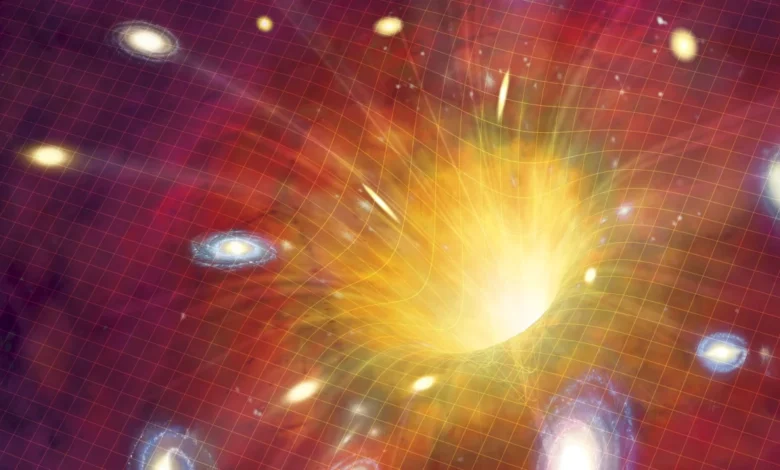
The fundamental nature of existence remains one of the most fiercely debated topics among the global scientific community, according to the results of the largest survey of physicists ever conducted. Released following an extensive multi-year data collection effort, the landmark questionnaire reveals stark divisions among researchers regarding the origins of the cosmos, the mechanics of quantum gravity, and the true meaning of the Big Bang. While popular culture frequently portrays modern physics as a monolith of absolute answers, this comprehensive poll paints a very different picture: a vibrant, deeply fractured frontier where some of the brightest minds on the planet fundamentally disagree on how the universe operates at its most basic level.
The findings, published in Physics Magazine following an open call launched in 2025, analyzed the anonymous responses of over 1,600 self-identified physicists from around the globe. Designed to map out the "Big Mysteries in Physics," the survey sought to capture where professional consensus lies on topics ranging from cosmology to quantum mechanics. Instead of finding unified theories, the survey’s authors discovered profound disagreements that challenge conventional public perceptions of theoretical physics and highlight the profound gaps remaining in our understanding of space and time.
The Big Bang Misconception: Did Time Have a Beginning?
Perhaps the most startling revelation from the survey centers on the widely accepted Big Bang theory, formally known in modern cosmology as the Lambda Cold Dark Matter (LCDM) model. When asked whether the Big Bang marks the absolute beginning of time itself, an overwhelming 68 percent of surveyed physicists responded in the negative.
To the general public, the Big Bang is frequently visualized as a cosmic explosion that detonated out of absolute nothingness, effectively acting as the starting pistol for time, space, and matter. However, professional physicists point out that this is a persistent misconception fueled by popular culture and media simplification. In technical terms, the Big Bang theory does not attempt to explain the creation of the universe out of nothing; rather, it mathematically describes how the universe rapidly expanded from an initial state of unimaginable heat and density.
Because the prevailing model only tracks the evolution of the cosmos from a pre-existing dense state forward, it leaves ample room for theoretical physicists to speculate about what—if anything—preceded that epoch. Many contemporary cosmological models, such as cyclic universe theories or pre-big-bang scenarios, suggest that our universe could be just one iteration in an eternal sequence of cosmic expansion and contraction, meaning time itself may stretch infinitely backward beyond our current observational horizon.
A Chronology of Uncertainty: From the 2025 Open Call to Publication
The journey to mapping these intellectual divides began in 2025, when a coalition of international researchers issued an open call for the Big Mysteries in Physics survey. The initiative was designed to move past anecdotal impressions of scientific consensus and gather hard data on what working physicists actually believe about unresolved anomalies in their fields.
- Early 2025: The survey is launched globally, inviting participants from academic institutions, national laboratories, and private research sectors to weigh in on foundational physics questions.
- Mid-2025 to Late 2025: The questionnaire closes after accumulating responses from more than 1,600 verified physicists. The dataset is filtered to isolate professional researchers from general enthusiasts.
- Early 2026: Authors of the study compile and analyze the data, revealing deep ideological rifts across multiple subfields.
- May 2026: The formal results are published in Physics Magazine, accompanied by open-access preprint papers detailing the statistical breakdown of the responses.
- September 2026: Broader academic reactions and press releases from institutions such as the University of Waterloo spark widespread discussions across the international scientific community regarding the health and direction of modern theoretical research.
Inflationary Debates and Cosmic Expansion
Beyond the origin of the Big Bang, the survey exposed deep fissures regarding the immediate aftermath of the cosmic birth. Cosmic inflation—the hypothesis that the universe underwent an exponential, incomprehensibly rapid burst of expansion within the first fraction of a second of its existence—has long been a cornerstone of modern inflationary cosmology. Yet, the survey revealed that only 51 percent of participating physicists agreed that inflation definitely occurred in the moments following the Big Bang.
While inflation neatly solves several persistent problems in astrophysics, such as the uniformity of the cosmic microwave background and the spatial flatness of the universe, it remains notoriously difficult to test directly. Skeptics within the physics community argue that alternative models, such as bouncing cosmologies or varying speed-of-light theories, can explain the observed data just as effectively without requiring an untestable period of hyper-expansion. This narrow 51 percent majority underscores that even concepts taught as textbook facts in undergraduate classrooms remain active battlegrounds of theoretical debate.
The Enigma of Dark Matter and the Quantum Chaos
The disagreements only deepen when venturing into the realms of dark matter and quantum gravity. Dark matter constitutes roughly 27 percent of the universe’s total mass-energy inventory, yet its actual physical composition remains completely undetected.
According to the survey data, only 17 percent of physicists believe dark matter is definitively comprised of a yet-undiscovered elementary particle, such as Weakly Interacting Massive Particles (WIMPs) or axions. Meanwhile, roughly 12 percent favor alternative gravitational models—such as Modified Newtonian Dynamics (MOND)—which propose that our understanding of gravity breaks down on galactic scales, rendering dark matter unnecessary. A meager 21 percent of respondents suggested that the answer likely involves a hybrid of multiple theories, while the remainder stood undecided or offered alternative hypotheses.
The integration of quantum mechanics with general relativity—the holy grail of modern theoretical physics—exhibits an even greater degree of fragmentation:
- 19 percent of respondents lean toward string theory as the most viable framework for unifying gravity with quantum mechanics.
- 18 percent suspect that gravity fundamentally cannot be quantized or integrated into the standard model of particle physics in this manner.
- 12 percent advocate for loop quantum gravity, an approach that treats space-time as a fabric woven from discrete, quantized loops rather than a smooth continuum.
Official Responses and Perspectives from the Frontier
Rather than viewing these profound disagreements as a sign of institutional failure or a crisis within the discipline, leading researchers have embraced the survey results as evidence of a healthy, dynamic scientific frontier.
Niayesh Afshordi, a theoretical physicist at the University of Waterloo and a co-author of the study, emphasized that scientific validity is never established by popular vote or majority consensus. Instead, truth in physics is forged strictly through empirical observation, rigorous mathematical modeling, and demonstrable evidence.

"Consensus, or its absence, tells us where the evidence feels settled and where researchers still see room for radically different ideas," Afshordi noted in a public statement discussing the findings. "In this sense, lack of consensus can be a clue. It marks places where better data, sharper theory, or new connections between subfields may be needed."
Afshordi added that the presence of such diverse and competing viewpoints should reassure the public that physics is not a stagnant dogma. "The interesting point is not that physicists are confused," he stated. "It is that the frontier is genuinely alive."
Broader Implications for the Future of Science
The implications of the Big Mysteries in Physics survey extend far beyond academic debates; they directly influence how research funding is allocated, how graduate students choose their specializations, and how scientific literacy is communicated to the public.
For decades, the public narrative surrounding physics has promised an imminent "Theory of Everything"—a single, elegant mathematical equation capable of explaining all physical forces in the universe. However, the deep divisions captured in this survey suggest that the scientific community is still a long way from consensus. As experimental facilities like the Large Hadron Collider continue to probe higher energy scales, and next-generation space telescopes peer deeper into the primordial cosmos, theorists will continue to test their models against new streams of empirical data.
Ultimately, the survey demonstrates that uncertainty is not the enemy of science, but its primary engine. As physicists continue to grapple with the mysteries of dark matter, the limits of the Big Bang, and the reconciliation of quantum mechanics with gravity, the willingness to entertain radical, divergent ideas will remain essential to unraveling the true nature of reality.