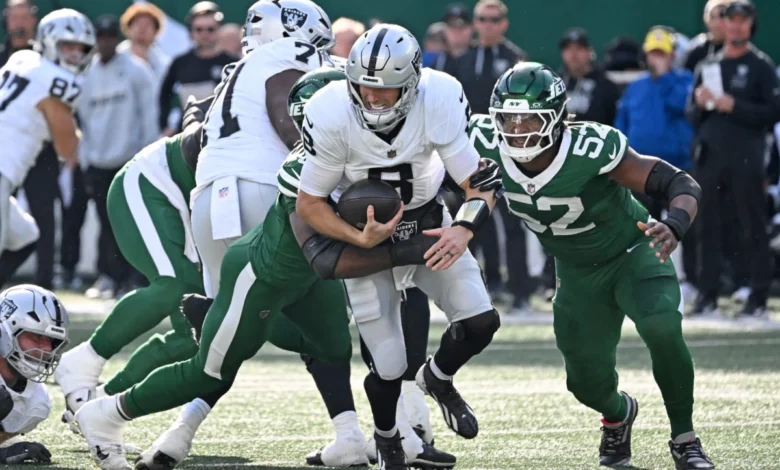
The atmosphere inside MetLife Stadium following the New York Jets’ devastating 33-31 loss to the Las Vegas Raiders was not merely somber; it was heavy with the familiar, grinding despair that has defined a generation of football in East Rutherford. For a franchise that has grown accustomed to finding inventive ways to lose, this defeat scraped a new bottom. On the field, on the scoreboard, and in the collective psyche of a famously tortured fanbase, the state of the Jets under first-year head coach Aaron Glenn has reached a critical juncture.
When Glenn was hired to helm the iconic franchise, he brought with him a sterling reputation as one of the National Football League’s most brilliant defensive minds. Having built a reputation during his successful coordinator stints as a fierce motivator and a master of schematic adjustment, expectations were that Glenn would instantly instill a brand of hard-nosed, resilient football. At the dawn of the season, optimism flickered. Even the most cynical observers could not have fathomed a scenario where a Jets offense—long the punchline of the league—would put up 33 points in a home game and somehow walk off the field with a loss.
Yet, that is precisely what transpired. Glenn’s supposed superpower, his defensive acumen, has utterly failed to materialize when his team has needed it most. At 2-6, the New York Jets’ season is effectively dead and buried, leaving the front office, the players, and a restless fan base to confront the harsh reality of a rebuilding project gone entirely off the rails.
The Anatomy of a Collapse: Game Day Breakdown
The matchup against the Las Vegas Raiders was billed as a winnable contest, a chance for the Jets to stabilize their ship and claw their way back toward respectability before the brutal midpoint of the NFL calendar. For three quarters, the Jets’ offense executed with a fluidity and explosiveness that has been entirely absent from the organization for years. Moving the chains, converting in the red zone, and sustaining drives, the offense held up its end of the bargain, putting an impressive 33 points on the board.
Under normal circumstances, scoring 33 points in the NFL translates to a winning percentage north of eighty percent. But normal rules do not apply to the 2026 New York Jets.
As the offense accumulated points, Aaron Glenn’s defense systematically unraveled. Communication breakdowns in the secondary, missed assignments in run defense, and an inability to generate pressure against a vulnerable Raiders offensive line turned what should have been a comfortable afternoon into a defensive catastrophe. Las Vegas sliced through the Jets’ scheme with alarming ease, exploiting soft zone coverages and capitalizing on crucial penalties at the most inopportune moments.
When the final whistle blew, the scoreboard read 33-31 in favor of the visitors. The offensive breakthrough, which should have been celebrated as a turning point for the franchise, was instantly overshadowed by a defensive meltdown that laid bare the widening fissures within the team.

The Chronology of a Lost Season
To understand how the Jets arrived at this dismal 2-6 record, one must trace the trajectory of a campaign that began with cautious optimism and rapidly descended into chaos.
The early weeks of the season offered brief glimpses of what ownership and the front office envisioned when they handed the keys to Glenn. There was competitive fire in the season opener, followed by a gritty road victory that briefly placed the Jets above .500 in the minds of hopeful supporters. However, underlying structural flaws were evident even in victory. The defense, which was supposed to be the undisputed anchor of the team, routinely surrendered chunk plays and struggled to close out tight games in the fourth quarter.
As the schedule hardened, the cracks widened into chasms. Consecutive losses exposed a lack of depth and exposed tactical rigidity. Injuries began to mount, testing the resilience of a roster that lacked the margin for error required to weather long-term absences. By mid-October, whispers of frustration within the locker room began to leak into the media landscape.
The defeat to Las Vegas served as the catastrophic crescendo of this first-half spiral. Dropping to 2-6 does not just mathematically compromise a playoff push; it effectively eliminates the margin for error for the remainder of the season and turns the final months of the schedule into an uncomfortable audition period for players and coaches alike.
Statistical Reality and Defensive Deficits
A deeper dive into the numbers reveals the alarming regression of a defense led by a head coach whose entire coaching pedigree is rooted on that side of the football.
Entering the game against Las Vegas, analytical models had already begun to question the efficiency of Glenn’s defensive unit. Third-down conversion rates allowed by the Jets ranked near the bottom of the league, and red-zone defensive stops had become increasingly rare. Against the Raiders, these trends were magnified. The defense surrendered explosive plays both through the air and on the ground, failing to force a single turnover that could have shifted momentum in a game of razor-thin margins.
On the other side of the ball, the offense’s 33-point explosion stands as an isolated statistical anomaly rather than a sustainable trend. While credit is due to the execution on that specific afternoon, the broader offensive metrics throughout the season highlight a unit still searching for an identity. The juxtaposition of a season-high offensive output resulting in a defensive defeat encapsulates the profound imbalance plaguing the organization.
The Front Office and Locker Room Response
In the immediate aftermath of the humiliating loss, the post-game press conferences carried a familiar, somber weight. Players spoke in hushed tones about execution, accountability, and the need to look in the mirror.

Aaron Glenn addressed the media with the stark realism of a coach fighting to keep his locker room intact. Refusing to deflect blame, Glenn acknowledged the systemic failures that led to the collapse.
"When you score 33 points in this league, you expect to win the football game," Glenn stated during his post-game address. "That falls squarely on my shoulders. As the head coach, and with my background, our defense simply has to be better. There are no excuses for the way we performed in critical situations today. We have to look at everything we are doing, from scheme to execution, because this is not the standard we established for ourselves."
Inside the locker room, veteran leaders echoed the sentiments of their head coach, emphasizing that pointing fingers would only accelerate the team’s downward spiral. Yet, beneath the diplomatic public statements, the frustration among players who performed at a high level only to watch the game slip away on the defensive side was palpable.
Broader Implications and Future Outlook
The broader implications of a 2-6 start under a first-year head coach stretch far beyond the immediate disappointment of a single lost Sunday. In the hyper-results-driven business of the National Football League, patience is a scarce commodity.
While ownership typically affords a first-year head coach and his staff a grace period to implement a new culture and roster philosophy, the manner of these defeats matters. When a defensive-minded coach presides over a unit that gives up 33 points to lose a game the offense fought valiantly to win, fundamental questions are inevitably raised regarding schematic compatibility and sideline leadership.
For the New York Jets organization, the immediate future will require hard evaluations. The front office must decide how to navigate the remainder of a lost season without completely alienating a locker room that still possesses young talent. Development of cornerstone pieces must take precedence over short-term band-aids, and the coaching staff must use the remaining games to demonstrate that they can construct a cohesive, competitive identity.
Meanwhile, the fanbase—weary of decades of unfulfilled promises, false dawns, and excruciating Sundays—is left to grapple with a familiar grief. The hope that accompanied Aaron Glenn’s arrival has been severely tested, replaced by the grim realization that the road to redemption for the New York Jets is far longer and steeper than anyone dared to imagine. As the calendar turns toward the bitter cold of late autumn, the 2-6 Jets are left searching for answers where, for now, there simply is no defense.