Rebel Democrats Defy Hakeem Jeffries in Procedural Move, Rescuing GOP Majority Ahead of Midterm Elections

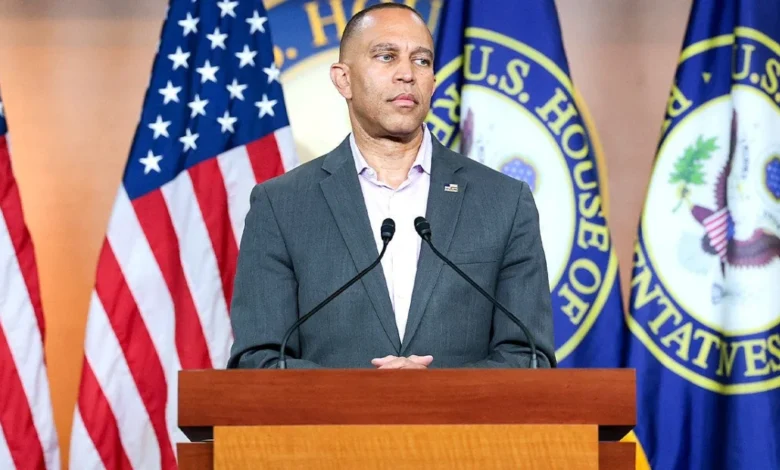
The delicate math of Capitol Hill floor strategy collided with intra-party discipline on a Tuesday afternoon, delivering a striking rebuke to House Minority Leader Hakeem Jeffries, D-N.Y. In an almost unprecedented breach of modern legislative protocol, two moderate House Democrats broke ranks with their party leadership to support a Republican procedural vote. This intervention rescued the GOP majority from an embarrassing legislative stall on the eve of the November midterm elections, while instantly injecting friction into the Democratic caucus.
Reps. Jared Golden of Maine and Marie Gluesenkamp Perez of Washington cast pivotal votes alongside House Republicans to secure the passage of a critical procedural hurdle known as a "rule vote." This maneuver unlocked the chamber’s calendar, enabling the House of Representatives to proceed with debating and voting on a diverse slate of scheduled legislation, most notably a high-profile package concerning Russian sanctions that had previously cleared the United States Senate with overwhelming bipartisan support.
The episode highlights the escalating tensions between pragmatic moderate Democrats representing competitive or red-leaning districts and a national leadership team striving to maintain uniform opposition to the Republican agenda. As both parties sprint toward the November midterms, the defiant floor maneuver has raised persistent questions regarding caucus cohesion, legislative strategy, and the mechanics of governing should the Democratic Party successfully recapture the House majority.
Anatomy of a Procedural Rebellion
To understand the magnitude of the rebellion led by Golden and Gluesenkamp Perez, one must examine the function of a rule vote in the modern House of Representatives. Unlike final passage votes on substantive legislation—where lawmakers frequently cross party lines based on personal ideology or constituent pressure—procedural votes on rules are traditionally treated as absolute tests of party loyalty.
Rules dictate the parameters of debate, including which amendments are permissible and whether the minority party will have any opportunity to shape the final text of a bill. Historically, it is practically unheard of for members of the minority party to assist the majority in passing a rule. Doing so surrenders leverage and signals a fracture in the minority’s coordinated opposition.
However, Golden and Gluesenkamp Perez faced a high-stakes legislative ultimatum. The procedural rule tied directly to a comprehensive Russia sanctions initiative championed by Senate hawks, which aimed to tighten economic penalties against Moscow and reinforce support for Ukraine. According to representatives for Golden, the Maine Democrat determined that allowing the procedural vote to fail would effectively kill the bipartisan sanctions package, subverting the will of the Senate and abandoning an ally.
"Congressman Golden has been a consistent supporter of America’s allies in Ukraine. He didn’t want to see the Russia sanctions bill die in a rule vote after passing with overwhelming bipartisan support in the Senate," a spokesman for Golden explained following the vote.
For Gluesenkamp Perez, who represents a rural and politically purple district in southwest Washington that favored Donald Trump in the 2024 presidential election, the vote aligns with a legislative brand defined by independence from national party orthodoxy.
A Pattern of Defiance and Leadership Backlash
This week’s floor showdown is not an isolated incident. Several weeks prior, Golden and Gluesenkamp Perez engaged in a nearly identical procedural rebellion, joining forces with the Republican majority to salvage a stalled rule vote. That earlier defection provoked intense fury among progressive and establishment Democrats alike, who argued that such actions undermine the collective bargaining power of the minority caucus.
Following the previous breach, Minority Leader Jeffries and his top leadership deputies issued a blistering joint statement condemning the actions of the two moderates.
"The decision by two of our colleagues to blindside the entire House Democratic Caucus and join with the Republican majority to pass a procedural rule on the brink of failing represents a significant breach of trust," Jeffries and his leadership team stated at the time. "It is an action that necessitates a serious response, and we have asked the Committee on Caucus Rules to take this up in short order."
While the immediate disciplinary consequences of that earlier warning remain opaque, the recurrence of the behavior suggests that moderate members operating in politically volatile environments are increasingly willing to absorb the wrath of leadership to deliver specific policy outcomes for their constituents.
The friction also highlights a structural dilemma for Jeffries. As he positions himself to potentially become the next Speaker of the House should Democrats flip the chamber in November, managing a diverse and ideologically polarized caucus will require delicate negotiation. Critics point to these procedural defections as evidence that maintaining discipline within a potentially razor-thin majority could prove exceptionally challenging.
Political Context and Electoral Pressures
The timing of the vote places both lawmakers at distinct crossroads in their respective political careers, magnifying the national attention surrounding their floor decisions.
Rep. Jared Golden is notably serving his final term in Congress, having announced that he will retire at the end of the current legislative cycle. Unbound by the immediate pressures of a grueling re-election campaign in a split-leaning district, Golden has increasingly leaned into an independent voting record that frequently places him at odds with the progressive wing of his party. Over his tenure, Golden has established a reputation as one of the most conservative Democrats in the chamber, frequently breaking with his party on issues related to gun control, environmental regulation, and federal spending.
Conversely, Rep. Marie Gluesenkamp Perez is currently navigating the most treacherous reelection battle of her congressional career. Representing Washington’s 3rd Congressional District, she is locked in a fierce contest against a formidable, Trump-backed Republican challenger. In a district where populist conservative sentiment runs high, demonstrating independence from national party leadership is viewed by political strategists as essential for her survival. By prioritizing legislative outcomes—such as foreign policy measures targeting Russia—over procedural solidarity, Gluesenkamp Perez is signaling to independent and moderate voters in her district that her allegiance rests with pragmatic governance rather than partisan conformity.
Broader Implications for the House of Representatives
As the 118th Congress winds down its legislative calendar, the actions of Golden and Gluesenkamp Perez serve as a microcosm of the broader challenges facing contemporary American politics. The increasing erosion of procedural norms, combined with the rising influence of moderate lawmakers trapped in competitive districts, complicates traditional models of party discipline.

For House Republicans, the rescue delivered by the two Democrats provided a temporary and welcome reprieve from the internal divisions that have frequently paralyzed their own narrow majority. By relying on bipartisan support to pass procedural hurdles, GOP leadership managed to advance key legislative items through a chamber often characterized by legislative gridlock.
At the same time, the incident leaves Democratic leadership grappling with a strategic dilemma. While party leaders must project unity to mount a credible challenge for the majority in November, they simultaneously must accommodate the unique political realities of members like Gluesenkamp Perez, whose survival in swing districts is vital to the party’s overarching numerical ambitions.
As the calendar ticks down toward the general election, the legislative floor will undoubtedly continue to serve as a stage where national political ambitions clash with local electoral survival, testing the limits of party leadership in an increasingly fragmented political landscape.