James Gray’s Paper Tiger debuts at the 2026 New York Film Festival as a study in domestic tension and the hazards of the American dream

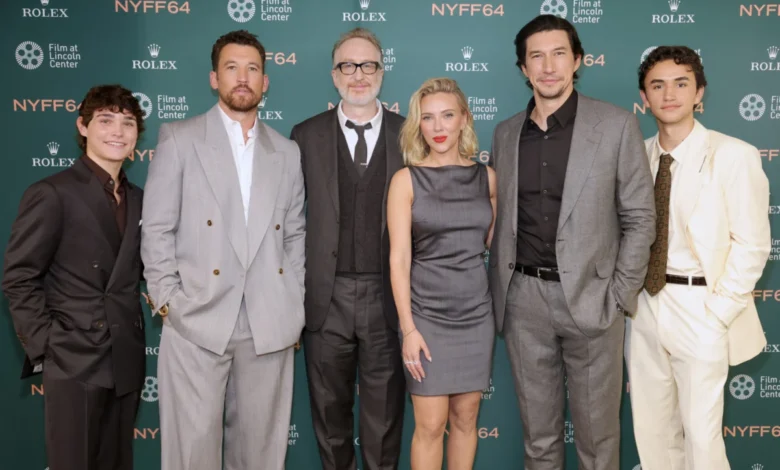
The 2026 New York Film Festival (NYFF) opened its highly anticipated slate this week with the North American premiere of James Gray’s latest feature, Paper Tiger. The film, which has already garnered significant attention for its powerhouse cast and tonal shift from the director’s previous work, serves as a gritty, suspense-filled examination of a Queens family in the 1980s. Starring Miles Teller, Adam Driver, and Scarlett Johansson, the movie explores the intersection of domestic fragility and criminal entanglement.
While the film marks a return to the thematic landscape of Gray’s upbringing, it deliberately breaks from the mold of his 2022 semi-autobiographical drama, Armageddon Time. Where that film functioned as a faithful reconstruction of his youth, Paper Tiger leans into a sharper, more volatile genre space.
A Narrative Shift Toward the Hitchcockian
The plot centers on a Queens patriarch, Irwin, played by Miles Teller, whose life is upended by a dubious financial proposal brought to him by his older brother, Gary, portrayed by Adam Driver. As the brothers delve deeper into a scheme involving the Russian mob, the film transitions from a domestic drama into a high-stakes crime thriller.
In a post-screening discussion at the festival, Gray addressed the creative pivot. “This one is much different,” Gray noted. “I think that one [Armageddon Time] was much more close to the facts of the case. There are many things that my brother, I’m sure, will recognize as from our life, but it’s not a documentary. And I didn’t think it was a sequel. I wanted to make something kind of a little bit… Hitchcockian. Pulpier is the wrong word, but a little bit more dramatically intense.”
This shift is significant for Gray’s filmography. Known for his methodical pacing and deeply intimate character studies, the director’s move toward “dramatically intense” narrative structures signals an evolution in his craft. By infusing the tension of a crime thriller into a grounded family story, Gray seeks to heighten the stakes of his protagonists’ moral compromises.
The Dynamics of a Troubled Household
At the heart of the conflict is the relationship between the brothers and their family unit, anchored by Hester, played by Scarlett Johansson. The film avoids the trap of glorifying the criminal element, instead focusing on the emotional toll that desperation takes on interpersonal connections.
“I was trying to make a film in which the personal connection is everything, that love is everything,” Gray stated during a press briefing preceding the premiere. “Through that, of course, you want people to feel suspense and intensity and things that we love in a good drama, you hope. But then in the end, dare I use the word catharsis, what connects us is what matters. It’s almost a cautionary tale.”
This focus on the internal life of the characters is reflected in the director’s guidance to younger cast members. Roman Engel, who plays the youngest of the brothers and acts as a narrative proxy for the director’s own perspective, described the collaborative atmosphere on set. “He would mostly just try to tell me to be myself on set and don’t try to live someone else’s experience,” Engel explained. This approach allowed the ensemble to ground their performances in emotional realism, even as the plot ventured into the perilous territory of organized crime.
Chronology of the Production and Release
The journey of Paper Tiger to the silver screen has been a meticulous process. Following the project’s development phase, production commenced in early 2025, taking advantage of authentic Queens locations to capture the period-specific aesthetic of the 1980s.
- Early 2025: Principal photography begins in New York City.
- Mid-2025: Post-production phase begins, with Gray emphasizing a focus on the film’s atmospheric score and period-accurate production design.
- May 2026: Early buzz builds following industry screenings at the Cannes Film Festival.
- September 2026: North American premiere at the 64th New York Film Festival.
- November 13, 2026: Scheduled limited release in U.S. theaters via Neon.
- November 20, 2026: Expansion to a wider theater circuit across the country.
The film’s selection as an anchor for the NYFF is indicative of its critical pedigree. The festival has long been a bastion for auteurs who balance commercial viability with uncompromising artistic vision, and Paper Tiger fits comfortably within that tradition.
The Art of the Open Ending
One of the most discussed aspects of the film is its refusal to provide a tidy resolution. The story concludes with the characters—Gary, Irwin, and Hester—grappling with their respective personal crises, unaware of how their paths will ultimately intersect or unravel.
During a Q&A session at the festival, Gray defended this narrative choice, noting that it reflects the inherent uncertainty of life. “I love the idea that the life of the movie goes on past the movie,” Gray remarked. “I love the open ending. I love the idea that the film exists past the boundaries of the screen and the time. With all of the characters, I wanted to make sure that there was a completion to their openness in a way, how open their characters were, and that nobody has the whole picture, because that’s like life, and it’s very untraditional actually for movies. Usually, in a movie somebody has the whole story.”
This choice serves as a commentary on the fragmentation of the human experience. In a world where audiences are often conditioned to expect linear, neatly packaged conclusions, Gray’s decision to leave his characters in a state of suspended animation challenges the viewer to contemplate the consequences of their actions long after the credits roll.
Implications for the 2026 Awards Season
As Paper Tiger heads into its wide release, industry analysts are closely watching its performance. Neon, the distributor behind the film, has successfully championed similarly complex, character-driven works in recent years. Given the film’s pedigree—featuring a trio of A-list stars and a director with a consistent track record of critical acclaim—it is widely considered a frontrunner for various accolades, particularly in the categories of directing, screenwriting, and lead acting.
Furthermore, the film’s 1980s setting serves as more than just a backdrop; it acts as a character in its own right. The decade was defined by economic volatility and a shifting social landscape in New York City, themes that Gray has explored throughout his career. By setting his latest thriller within this specific temporal framework, he invites comparisons to classic American cinema while maintaining a contemporary relevance regarding the lengths to which individuals will go to protect their families.
Cultural and Economic Context
The economic climate depicted in the film—a time of rising mob influence in outer-borough real estate and small business—adds a layer of historical authenticity that will likely resonate with both older audiences who recall the era and younger viewers intrigued by the period’s gritty aesthetic.
From a broader industrial perspective, the success of Paper Tiger could signal a continued resurgence of mid-budget, star-driven adult dramas. While the film industry has been dominated by large-scale franchise tentpoles for much of the 2020s, the consistent performance of films like those in the Gray catalog suggests a robust and hungry audience for stories that prioritize dialogue, tension, and character development over CGI-laden spectacle.
As the industry moves toward the final quarter of 2026, the reception of Paper Tiger will be a bellwether for the health of prestige cinema. With its release date set for mid-November, it is positioned to capture both the critical attention of the early awards circuit and the commercial interest of holiday-season moviegoers.
Ultimately, Paper Tiger stands as a testament to James Gray’s ability to evolve. By taking the familiar elements of his own life and filtering them through the lens of a suspense thriller, he has created a work that is simultaneously a personal reflection and an exercise in pure cinematic craft. As the characters navigate the moral gray zones of their existence, they invite the audience to do the same, proving that even in the most “paper-thin” situations, the weight of human connection remains the most potent force on screen.