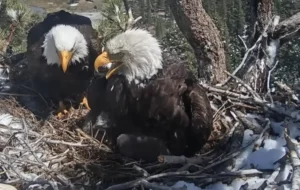
Jackie and Shadow’s 2026 eaglets are mastering essential survival skills as they grow, offering a captivating glimpse into bald eagle development.

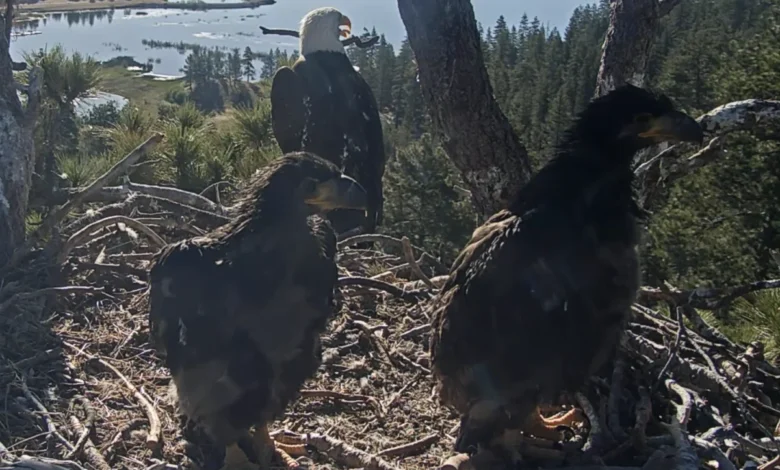
The eaglets, Sandy and Luna, born in early April to the renowned bald eagle pair Jackie and Shadow in Big Bear Valley, California, are rapidly progressing through critical developmental stages. Having recently sprouted new feathers and developed keen eyesight, the young birds are now actively practicing behaviors crucial for their future independence. These include vigorous wing-flapping sessions, which, while appearing somewhat uncoordinated at this age, are vital for strengthening their pectoral muscles and preparing them for flight.
Friends of Big Bear Valley (FOBVV), the non-profit organization responsible for the popular 24/7 livestream of the eagle nest, explains that these wing exercises are not only about muscle development but also about spatial awareness. "It helps them learn the ‘wingspan’ of their own bodies so they don’t hit the nest walls or their siblings," FOBVV noted in a recent report. Despite these impressive developmental leaps, Sandy and Luna are still some weeks away from fledging, the process of leaving the nest. Currently around six weeks old, they are expected to take their first flights between 10 to 14 weeks of age, a timeline consistent with previous years. For context, last year’s eaglets, Sunny and Gizmo, both fledged at approximately 13 weeks old.
Beyond wing exercises, the eaglets are also observed engaging in a behavior that might seem like playful stomping. However, this action is deeply rooted in their instincts as raptors, or birds of prey. According to FOBVV, this stomping is an innate behavior to "pin" prey down, a fundamental hunting technique. As the eaglets are top-heavy at this stage, this practice also aids them in developing their sense of balance and center of gravity as their legs grow longer and stronger. While occasional accidental stomps on siblings’ toes do occur, the underlying purpose is critical for their predatory development.
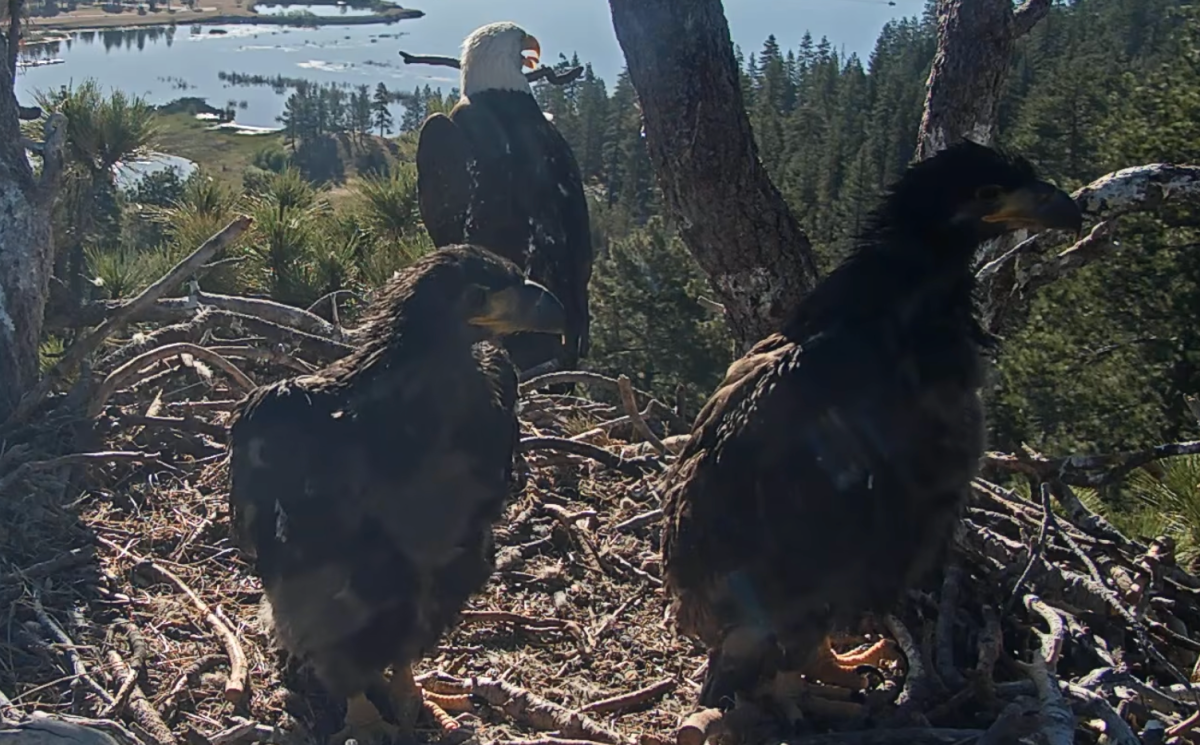
The public can witness these remarkable stages of growth and learning through the continuous livestream provided by FOBVV. This live feed offers an unparalleled opportunity to observe the intricate lives of bald eagles, from hatching to fledging.
The Roller Coaster Nesting Season of Jackie and Shadow
The 2026 nesting season for Jackie and Shadow, a pair of bald eagles who have gained widespread internet fame from their San Bernardino National Forest nest, has been a testament to resilience. This year’s successful hatching follows a period of significant challenges. In January, two of their initial eggs were tragically destroyed by ravens, a common threat in the ecosystem. However, Jackie and Shadow persevered, laying two new eggs that ultimately hatched successfully.
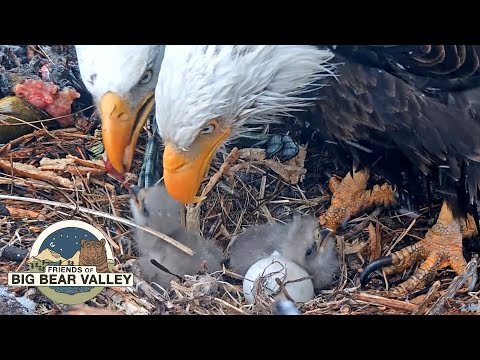
The first eaglet, Chick 1, hatched on April 4 at 9:33 p.m. PDT, with Chick 2 following closely on April 5 at 8:30 a.m. PDT. Their nest, situated in the Big Bear Valley east of Los Angeles, has become a focal point for millions of viewers worldwide, thanks to the dedicated 24-hour livestream maintained by Friends of Big Bear Valley (FOBBV). On May 1, the eaglets were officially named Sandy and Luna, continuing a tradition of fan engagement in the eagles’ lives.
Understanding the Timeline: From Hatching to Fledging
The journey of an eaglet from the nest is a carefully timed process, dictated by biological imperatives and environmental conditions. Typically, bald eagle chicks remain in the nest for a period of 10 to 14 weeks. During this time, they are entirely dependent on their parents for food and protection, undergoing rapid physical and behavioral development. Fledging, the moment the young eagles take their first flight, marks a significant transition towards independence. This stage is characterized by the birds achieving sufficient feather development for sustained flight and mastering the coordination required to navigate the skies.

Navigating the Perils: Challenges Faced by Eaglets
The path to adulthood for bald eagles is fraught with peril, and the eaglets in the nest are particularly vulnerable. Before they are capable of defending themselves or flying away from danger, they face numerous threats. Other birds of prey, including hawks, ravens, and owls, pose a constant risk, capable of attacking young, defenseless chicks. Severe weather conditions also present formidable challenges. In 2025, a harsh March snowstorm in Big Bear Valley, which brought up to two feet of snow and high winds, tragically resulted in the loss of one of Jackie and Shadow’s three chicks.
The fledgling stage itself is also a critical period, with survival rates dropping significantly. It is estimated that only about 70 percent of eaglets successfully navigate this transition. One of the most significant dangers during this phase is human-related. As young eagles begin to scavenge for food, particularly roadkill, they are at risk of being struck by vehicles, leading to injury or death. This highlights the importance of public awareness and caution in areas frequented by bald eagles.
The Legacy of Jackie and Shadow: A History of Resilience
Jackie and Shadow, a bonded pair of bald eagles, have been a fixture in the Big Bear Valley nesting landscape since 2018. Their relationship has yielded successful broods in 2019 and 2022, bringing new life to the species. However, their nesting history is also marked by setbacks. In 2023 and 2024, their eggs unfortunately failed to hatch, a reminder of the inherent challenges in avian reproduction. It is important to note that only about 50 percent of bald eagle eggs successfully hatch, meaning Jackie and Shadow have already demonstrated a higher success rate than the average, making their current brood even more remarkable.
Recounting the 2025 Season: A Storm’s Devastation
The 2025 nesting season for Jackie and Shadow was particularly poignant. Jackie laid three eggs, all of which hatched in early March. However, the nascent joy was overshadowed by a severe snowstorm that struck on March 13. The storm delivered a substantial amount of snow and high winds, battering the nest and its occupants. When the storm subsided the following morning, only two of the three chicks were visible on the live cam. FOBBV later confirmed the devastating loss of one chick due to the extreme weather. The two surviving eaglets were subsequently named Sunny and Gizmo, a selection made from over 54,000 name submissions from devoted fans, underscoring the public’s deep connection to the eagle family.
The Post-Fledging Journey: A New Chapter in Life
Once bald eagle chicks reach the age of 10 to 14 weeks and have developed the physical capacity for flight, they fledge. This marks their departure from the nest, a crucial step towards independence. Males generally tend to fledge slightly earlier than females. The dispersal patterns of young bald eagles are extensive. According to FOBBV, fledglings originating from Southern California have been documented ranging as far south as Baja California, as far north as British Columbia, and as far east as Yellowstone National Park. This wide-ranging movement highlights the migratory nature and broad territorial needs of the species.
Despite the high stakes involved in fledging, with an estimated 70 percent survival rate, the journeys of these young eagles remain largely unobserved after they leave the nest. FOBBV does not employ tagging or tracking methods for their eagles, making it impossible to follow their individual paths and migrations once they have left their natal territory. This lack of data means that the long-term fate and movements of many fledglings remain a mystery.
Opportunities for Conservation: Supporting Jackie and Shadow’s Habitat
The ongoing conservation efforts surrounding Jackie and Shadow and their habitat underscore the broader challenges facing bald eagles and other wildlife. Environmental groups are actively engaged in fundraising initiatives aimed at protecting the foraging areas vital to the eagles’ survival. A significant campaign is underway to raise $10 million to safeguard Jackie and Shadow’s foraging grounds from potential development. Individuals interested in contributing to these conservation efforts can find more information and opportunities to donate at SaveMoonCamp.org. This initiative emphasizes the interconnectedness of human activities and wildlife preservation, highlighting that the protection of iconic species like bald eagles often requires collective action and financial support.
The story of Jackie and Shadow’s 2026 eaglets, Sandy and Luna, is a vivid illustration of the natural world’s enduring cycles of life, challenge, and resilience. Their development, meticulously documented through live streaming, not only provides educational value but also fosters a deep appreciation for these magnificent birds and the critical conservation efforts required to ensure their continued presence in our wild spaces.