Mariska Hargitay Unveils a Blue Carpet for the 78th Emmy Awards as Production Details Emerge for Monday’s Star-Studded Ceremony

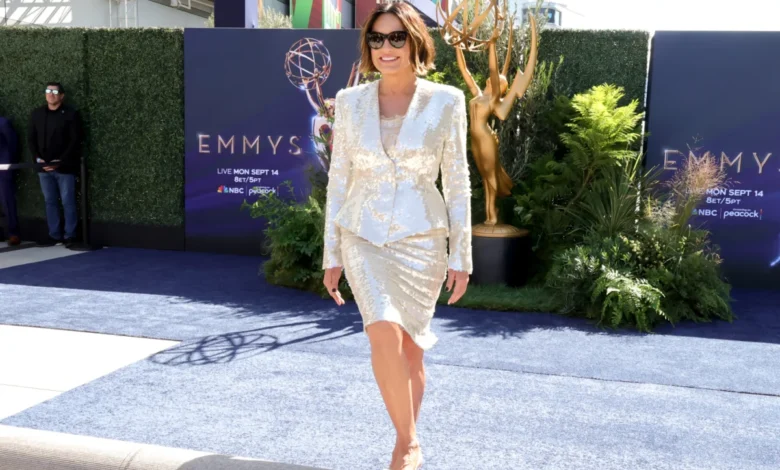
The countdown to television’s biggest night has officially transitioned from boardroom logistics to physical preparation as the 78th Emmy Awards ceremony looms just days away. In a symbolic kickoff on Thursday, host Mariska Hargitay joined a cohort of television executives in downtown Los Angeles to unveil the arrival of the carpet at the Peacock Theater. However, in a sharp departure from the traditional crimson hue that has defined the event for decades, the pathway was revealed to be a striking shade of blue. This aesthetic pivot serves as a deliberate nod to NBC’s centennial anniversary, marking a century of broadcasting history for the network.
Joining Hargitay for the photo opportunity were executive producers Jesse Collins, Dionne Harmon, and Jeannae Rouzan-Clay, alongside TV Academy chair Chris Abrego and NBC’s executive vice president of live events, Jen Neal. Beyond the visual transformation of the venue, the team utilized the rollout as a platform to unveil key programming details, confirming that singer-songwriter Noah Kahan will anchor the "In Memoriam" segment. Furthermore, the production will feature dedicated tributes to the 30th anniversary of the cult classic Buffy the Vampire Slayer and the 50th anniversary of the iconic action series Charlie’s Angels, underscoring the Academy’s commitment to balancing contemporary excellence with industry legacy.
A Career Milestone for the Emmy Host
Mariska Hargitay enters this hosting assignment with significant momentum. Last weekend, during the Creative Arts Emmy ceremony, the Law & Order: Special Victims Unit star secured two individual Emmy wins for her documentary project, My Mom Jayne. The documentary, which explores the complex legacy of her mother, Jayne Mansfield, has resonated deeply with voters, providing Hargitay with a surge of professional validation ahead of her turn as master of ceremonies.
Backstage at the Creative Arts event, Hargitay characterized this moment as a transformative "third act" in her illustrious career. Her transition from the long-running procedural drama to the high-pressure environment of live awards hosting has been a methodical process. According to producers, the preparation for the monologue and sketches has been an intensive, cross-country collaboration.
The Creative Process: A New York-to-LA Collaboration
The writing team for the 78th Emmys, spearheaded by former Late Show with Stephen Colbert head writer Ariel Dumas, has taken an unconventional approach to preparation. Rather than sequestering the host in a traditional Los Angeles writers’ room, the team established a satellite operation within the offices of Law & Order: SVU in New York.
Executive producer Dionne Harmon noted the logistical necessity of this arrangement, explaining that the team was embedded within the SVU production hub to accommodate Hargitay’s shooting schedule. This allowed the host to iterate on scripts during downtime between takes. Jesse Collins remarked on the surreal nature of the collaborative environment, noting the juxtaposition of seeing Hargitay in her "Captain Benson" tactical gear—complete with badge and firearm—while simultaneously workshopping punchlines and comedic timing.
For her part, Hargitay remains resolute about maintaining her identity during the broadcast. While she acknowledges the pedigree of the writers—whose backgrounds in late-night television are typically synonymous with traditional monologue formats—she has made it clear that she intends to eschew the "comedian" persona in favor of a more authentic, albeit unconventional, hosting style. "I gotta do it my way," Hargitay told The Hollywood Reporter. "I’m a very different, sort of unconventional host… you’ve gotta show up as your best self."
Historical Context and Expectations for the 78th Emmys
The Emmy Awards have historically served as a bellwether for the shifting tides of the television industry. In recent years, the telecast has struggled to maintain viewership numbers in an increasingly fragmented streaming landscape. By tapping a legacy star like Hargitay—whose crossover appeal spans generations—the Television Academy is likely attempting to bridge the gap between traditional broadcast loyalty and the high-octane content demands of the digital era.
The decision to honor Buffy the Vampire Slayer and Charlie’s Angels is a strategic programming choice. These franchises represent pivotal moments in the evolution of the female lead in television—a theme that aligns closely with Hargitay’s own career trajectory. By weaving these retrospectives into the fabric of the show, the producers are attempting to foster a sense of continuity that appeals to both industry insiders and the casual viewer.
Regarding the potential for cameo appearances by long-time co-stars, such as Christopher Meloni, the production team remains intentionally vague. While Harmon hinted that the host’s extensive network of friends might lead to surprises, there has been no official confirmation of guest appearances. This silence is typical of the high-stakes secrecy surrounding major award shows, where the "surprise factor" remains a primary driver for live engagement.
Logistical Challenges and Industry Implications
The transition to a blue carpet is not merely a color choice; it is an branding exercise for NBC. As the network approaches its 100th year, the visual identity of its signature events is being curated to remind viewers of the network’s foundational role in American media. The Peacock Theater, formerly known as the Microsoft Theater, has been the site of the Emmys since 2008, and the logistics of transforming the outdoor space—often subject to strict downtown Los Angeles zoning and public access rules—represent a significant operational effort.
From an analytical perspective, the 78th Emmys represent a critical juncture for the TV Academy. With the industry still recalibrating after the dual labor strikes of 2023, which forced a postponement of the 75th ceremony, this year’s show is widely viewed as a return to normalcy. However, "normal" in the current television landscape is vastly different than it was a decade ago. The reliance on established stars like Hargitay, paired with the inclusion of heritage programming, suggests a conservative approach aimed at stabilizing the broadcast’s identity.
The Road to Monday Night
As the setup continues at the Peacock Theater, the focus for the production team remains on the pacing of the telecast. Historically, the length of the Emmy ceremony has been a point of contention for both viewers and network executives. Producers Collins and Harmon have been tasked with balancing the heavy weight of awards presentation with the entertainment value required to keep the audience engaged.
The integration of Noah Kahan for the "In Memoriam" segment is a notable departure from the traditional orchestral or soft-rock accompaniments often featured during the tribute. Kahan, whose folk-pop sensibility has captured the zeitgeist over the last two years, represents a move toward modern relevance, further signaling that the 78th Emmys are looking to capture a younger demographic without alienating the traditional Academy voting base.
Strategic Outlook
As the industry prepares for the ceremony, the consensus among observers is that the success of the 78th Emmys will be measured by its ability to synthesize the gravitas of a milestone anniversary with the unpredictability of a live show. Mariska Hargitay’s commitment to "doing it her way" provides a compelling narrative hook for the evening. Her career, which has evolved from the procedural rigidity of Law & Order to a more expansive, creative, and executive role in the industry, mirrors the very evolution the television medium is currently undergoing.
The broadcast is set to air on NBC and stream on Peacock this coming Monday. While the blue carpet will be the first image viewers see, the ultimate success of the event will rely on the synthesis of the production team’s technical precision and the host’s ability to anchor the evening with grace and personal authenticity. For the Television Academy, the stakes are clear: deliver a show that respects the past while effectively navigating the complex, multi-platform future of television. As the final lights are hung and the rehearsals conclude, the industry waits to see if this "third act" for the Emmys will set a new standard for excellence in an era of rapid transition.