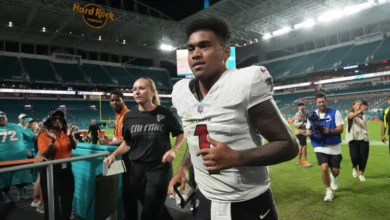
Los Angeles Dodgers Place Shohei Ohtani on 15-Day Injured List Amid Mounting Health Concerns Ahead of Postseason


The Los Angeles Dodgers have officially announced that two-way superstar Shohei Ohtani will be placed on the 15-day injured list, a pivotal decision that alters the franchise’s strategic outlook as the team prepares for the final stretch of the regular season and the upcoming October postseason. The announcement, made by Dodgers manager Dave Roberts prior to the team’s three-game series opener against the Miami Marlins, comes after weeks of intense scrutiny regarding Ohtani’s physical condition, marked by lingering ailments affecting his right arm and left knee.
The move to sideline the reigning standout introduces substantial uncertainty into the Dodgers’ lineup configurations. While the organization maintains hope that Ohtani can return in some capacity before the conclusion of the regular season, baseball analysts and medical observers suggest that his productivity moving forward will be severely compromised. The development highlights a delicate balancing act for the Dodgers’ front office and coaching staff: managing the health of a generational talent while maintaining championship aspirations in a fiercely competitive National League.
Chronology of Events and Escalating Injuries
Ohtani’s journey toward the injured list has been marked by a gradual physical decline that intensified significantly over the summer months. Following his final pitching appearance of the season on July 3, the Dodgers maintained optimism that Ohtani would eventually return to the mound. Throughout July and August, the organization continued to evaluate a potential pitching program, keeping him active on the roster as both a designated hitter and a prospective pitcher.

However, warning signs accumulated rapidly. By late August, Ohtani’s offensive production began to experience a steep downturn. A stark statistical indicator of his struggles reveals that he managed just six hits in his final 52 at-bats leading up to the roster move. Furthermore, outside of a high-altitude home run in Denver against the Colorado Rapids, Ohtani had not homered since August 5.
The physical toll became increasingly apparent during a September 2 contest, where Ohtani clearly played through visible discomfort. Despite missing four consecutive games following that stretch, he was inserted back into the starting lineup on Monday, September 7, against the Cincinnati Reds at Dodger Stadium. During that game, Ohtani fouled a ball off his foot during the seventh inning, compounding existing issues with his right arm and left knee and resulting in an 0-for-3 performance. The setback proved decisive, rendering him physically incapable of maintaining the rigorous demands required for high-level competition.
Roster Management and Injured List Regulations
The timing of Ohtani’s placement on the injured list has sparked debate among baseball analysts regarding roster management protocols. Major League Baseball regulations stipulate that standard position players must serve a minimum of 10 days on the injured list. However, because Ohtani is formally classified on the active roster as a two-way player, league rules mandate a minimum 15-day recovery window.
Critics have noted that the Dodgers could have initiated the injured list stint earlier—specifically after Ohtani exhibited physical distress on September 2—rather than allowing him to remain active through the subsequent week. By waiting until Friday, September 10, to formally execute the transaction, the organization delayed his earliest possible return date. Backdating the injured list placement to Tuesday permits Ohtani to become eligible for activation with only five games remaining in the regular season. Had the team acted immediately following his exit from the lineup on September 2, he could have been cleared to test his rehabilitated mechanics up to four days earlier.

Front Office and Managerial Perspective
Dodgers general manager Brandon Gomes and manager Dave Roberts have faced mounting questions from media outlets regarding the transparency of Ohtani’s health status. Earlier in the week, front office statements downplayed the direct correlation between Ohtani’s prolonged offensive slump and his physical ailments, suggesting that mechanical adjustments were primarily responsible for his statistical dip.
As the physical realities became undeniable, Roberts adopted a more pragmatic tone regarding Ohtani’s recovery outlook. Addressing reporters, Roberts acknowledged that a full recovery within the standard recovery window is unlikely.
"Is it going to be 100%? Probably not," Roberts conceded, reflecting the sobering reality faced by the coaching staff.
Ohtani himself addressed his physical limitations through translated remarks earlier in the week, emphasizing his willingness to adapt his approach at the plate to compensate for his physical restrictions. Recognizing that complete health might elude him for the remainder of the 2026 campaign, the designated hitter expressed a desire to utilize creative tactical adjustments to remain productive. Nevertheless, the acute trauma sustained from fouling a ball off his foot on September 7 ultimately outpaced those adaptive strategies, forcing the team’s hand.

Broader Implications for the Dodgers’ Postseason Campaign
The absence of a fully functioning Shohei Ohtani carries profound implications for the Los Angeles Dodgers as they aim for a World Series title. Throughout the 2026 season, Ohtani’s presence in the middle of the order served as a foundational pillar for the team’s offensive output.
From a tactical standpoint, opposing pitching staffs will no longer need to navigate a potent, multi-threat Ohtani capable of shifting the momentum of a game with a single swing. While the possibility remains that Ohtani could be utilized in high-leverage, situational pinch-hitting roles upon his eventual return, the expectation of him maintaining a consistent, high-volume offensive presence has been all but neutralized.
The organization’s dual focus earlier in the year—attempting to preserve his pitching capabilities while leaning heavily on his bat—has drawn scrutiny from analysts who argue that the team pushed the envelope too far in pursuit of a two-way return. As the Dodgers pivot toward the postseason, the immediate challenge shifts from maximizing Ohtani’s historic versatility to finding collective offensive production to fill the substantial void left by his absence.
With the 15-day injured list clock now ticking, the Dodgers must navigate the closing weeks of the regular season without their marquee star, relying on depth and roster flexibility to secure their division standing and prepare for the rigors of October baseball.