Decoding the Crisis on Screen: Alejandro González Iñárritu and the Cinematic Burden of Climate Accountability

The contemporary intersection of art, corporate accountability, and global climate anxiety has once again manifested in high-budget cinema, bringing complex environmental geopolitics into the cultural mainstream. At the center of this discourse is Continental Resources, a prominent American oil producer ranked among the world’s leading fossil fuel emitters. Founded by Harold Hamm—an industry pioneer who rose from poverty in Oklahoma to amass significant wealth through hydraulic fracturing—the firm has produced nearly 600 million tons of carbon dioxide since 2005. This figure equates to the combined carbon footprint of approximately two million Americans over the same period. Hamm’s trajectory, characterized by significant financial contributions to political campaigns and aggressive opposition to green energy policies, serves as a real-world archetype for modern energy magnates.
This socio-political landscape forms the backdrop for Alejandro González Iñárritu’s latest feature film, Digger. The movie centers on Digger Rockwell, a fictional Texas-accented oil executive portrayed by Tom Cruise. Rockwell has expanded his father’s wildcat enterprise into a global conglomerate featuring offshore operations in remote regions such as Greenland and Alaska. As a character study in corporate hubris, the film endeavors to examine two fundamental questions: the degree of direct moral responsibility heavy emitters bear for the displacement and mortality associated with climate change, and the efficacy of artistic mediums in addressing these global phenomena.
The Genesis of a Cinematic Satire
The narrative of Digger launches with immediate, high-stakes conflict. An on-site technician at one of Rockwell’s Greenland drilling platforms contacts the executive to report a severe methane leak. The leak has generated a major structural fracture threatening the stability of the local ice sheet. Brushing aside warnings of a potential billion-dollar infrastructure failure, Rockwell dismisses the alert. Shortly thereafter, company representatives inform him that the platform has suffered a catastrophic explosion, triggering the complete collapse of the Greenland ice sheet.
The ensuing plot contrivance introduces an imminent catastrophe: a massive iceberg set on a trajectory toward Europe, carrying the potential to cause widespread flooding and hundreds of thousands of fatalities. In response, Rockwell consults with the sitting U.S. President, played by John Goodman. Rather than halting operations, the administration and corporate leadership elect to continue extraction activities while deploying a digital censorship mechanism termed the "firewall." This software is designed to systematically scrub terms such as "methane," "iceberg," and "climate change" from global internet infrastructure. Meanwhile, political allies offer alternative proposals, ranging from military intervention via aerial bombardment to reliance on divine intervention.
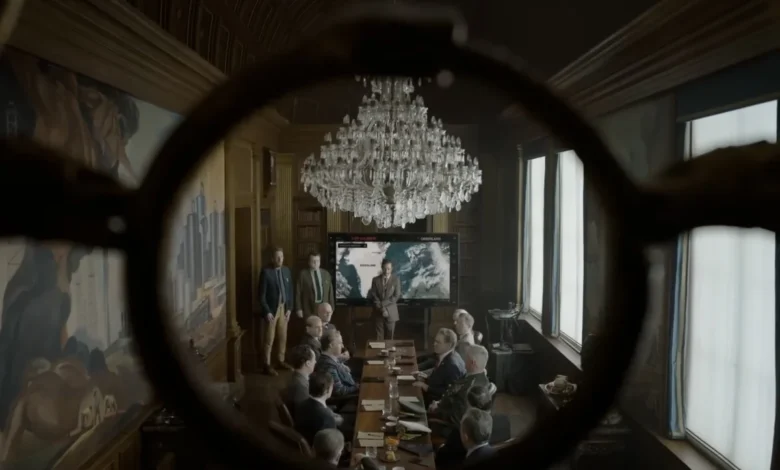
Aesthetically, Iñárritu diverges from the CNN-toned realism utilized in earlier climate satires such as Adam McKay’s Don’t Look Up. Instead, Digger employs a visual style blending Art Deco motifs—typified by boardroom murals celebrating historical oil discoveries—with symbolic iconography, including a prominent Ouroboros sculpture suspended above executive meeting spaces.
Dialogue and Thematic Friction
The film’s script integrates extensive references to contemporary climate science, policy debates, and geopolitical friction. Conversations between Rockwell and his internal scientific advisor, Ganesh (portrayed by Riz Ahmed), frequently pivot toward climate metrics, such as the disproportionate warming potential of methane emissions, or diplomatic failures like the hypothetical "COP30 fiasco," which mirrors real-world tensions surrounding international climate accords. These exchanges frequently dissolve into broader culture-war polemics, touching upon topics such as the depletion of bluefin tuna populations and the thawing of Arctic permafrost.

The narrative reaches a tonal apex during a protracted sequence in which Rockwell addresses the European Parliament. Berating European legislators, Rockwell accuses them of hypocrisy for consuming fossil fuels while condemning production practices. The parliamentary assembly responds with accusations of corporate malfeasance and indirect manslaughter, leading to a prolonged shouting match regarding global supply and demand dynamics.
Subtext, Metanarrative, and Audience Reception
Beyond its primary narrative, Digger incorporates a metanarrative layer intended to interrogate the very utility of political allegories. By framing the story as a parable about a parable, Iñárritu attempts to question whether heavy-handed cinematic warnings possess any tangible capacity to influence public behavior or corporate policy.
Historical precedent suggests that media portrayals of impending ecological collapse face severe hurdles in altering political trajectories. Following the release of prior climate-themed cinematic projects, global political trends have frequently moved in the opposite direction, marked by significant electoral support for climate-skeptic leaders and the phenomenon of "climate hushing"—a deliberate political strategy to downplay environmental risks in public discourse. Critics note that viewing a dramatization of corporate malfeasance is statistically unlikely to shift consumer habits or industrial practices any more effectively than reading raw emissions data.
Industry Implications and Critical Analysis
The release of Digger arrives at a critical juncture for both the entertainment industry and global environmental policy. As international regulatory bodies grapple with the enforcement of net-zero targets and the management of stranded assets, cultural productions increasingly serve as battlegrounds for public opinion.
Analysts observe that while high-profile cinematic projects succeed in raising baseline awareness of systemic environmental vulnerabilities, they frequently struggle to balance artistic nuance with didactic messaging. The reliance on caricature—typified by Rockwell’s eccentricities, from his defense of the fossil fuel industry to his personal attachment to a declining pet cat—risks alienating moderate audiences and policy decision-makers alike.
Ultimately, Digger reflects the profound difficulty of translating complex systemic crises into traditional narrative structures. Whether the film functions as an effective critique of modern capitalism or merely as an exhausting exercise in stylistic excess, it underscores the enduring tension between artistic expression and the pragmatic realities of global energy politics.
Related posts: