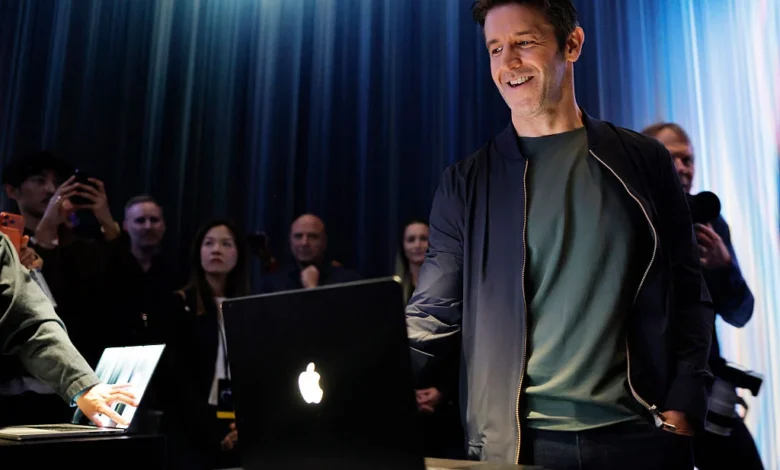
Apple Inc. finds itself at a fascinating crossroads in its illustrious corporate history. As the consumer technology landscape rapidly evolves, driven by aggressive advancements in generative artificial intelligence and autonomous software agents, Cupertino’s leadership is facing unprecedented questions regarding its pace of innovation. In a comprehensive and revealing interview with veteran tech journalist Steven Levy for Wired, newly appointed Apple CEO John Ternus offered a robust defense of the tech giant’s deliberate, measured approach to artificial intelligence, pushing back against persistent industry narratives that the company has fallen behind competitors in the AI race.
The interview arrives at a pivotal moment for Apple. Having stepped into the role of Chief Executive Officer at the beginning of September 2026, Ternus is steering the ship through one of the most volatile and transformative periods in modern computing. For years, critics and market analysts have scrutinized Apple for what appeared to be a sluggish entry into the generative AI boom, contrasting its methodical rollout with the breakneck, sometimes chaotic feature releases of rivals like Google, Microsoft, and OpenAI. Yet, as Ternus made clear during his sit-down with Levy, Apple’s strategy is not a product of hesitation, but rather a calculated philosophy centered on user experience, integration, and purpose-driven technology.
The Chronology of Apple’s AI Evolution: From Delays to Delivery
To fully understand Apple’s current positioning in the artificial intelligence sector, it is necessary to examine the timeline of events leading up to this point. For much of 2024 and 2025, the technology sector buzzed with reports that Apple was struggling internally to adapt its hardware and software ecosystems to the demands of large language models and advanced machine learning frameworks.
The most prominent casualty of these perceived delays was the anticipated overhaul of Siri. Originally slated for earlier deployment, the next-generation, deeply integrated version of Apple’s virtual assistant faced multiple setbacks. Consumers and tech commentators alike grew restless as months turned into over a year of waiting for a Siri capable of contextual, multi-app task execution driven by advanced AI.
However, the narrative shifted during the summer of 2026 when Apple finally released the long-awaited, overhauled version of Siri. While initial reviews noted that the rollout felt somewhat anticlimactic to an industry desensitized by daily breakthroughs in generative AI, the update marked a foundational shift in how Apple users interacted with their devices. Rather than releasing a standalone chatbot or a flashy, experimental tool, Apple integrated conversational intelligence directly into the operating system’s core architecture.
Despite this summer milestone, skepticism lingered across Wall Street and Silicon Valley. Critics continued to argue that Apple’s hardware-first business model—relying heavily on iPhone, Mac, and iPad sales—could be disrupted if software paradigms shifted entirely toward cloud-based AI agents. It was against this backdrop of lingering market anxiety that John Ternus assumed the chief executive mantle, setting the stage for his recent public defense.
Addressing the Critics: "We Like Where We’re At"
Confronted directly about the widespread perception that Apple entered the generative AI race late, Ternus acknowledged the noise surrounding the company while firmly rejecting the premise. "Everyone has an opinion," Ternus remarked during the Wired interview, before offering a concise assessment of his internal confidence: "I really like where we’re at."
Ternus elaborated on Apple’s core product philosophy, emphasizing that the company refuses to develop technology merely to chase market trends or satisfy short-term Wall Street pressures. "We’re absolutely going to leverage AI in our new products," Ternus stated. However, he drew a sharp distinction between Apple’s methodology and that of its competitors. "We don’t want to ship AI for AI’s sake. When we’re doing it right, people won’t have to think about whether it was AI that made this happen or more traditional software. What matters is, did we build something that they really love?"

This philosophy echoes Steve Jobs-era principles of invisible technology, where complex underlying engineering is masked by seamless, intuitive user interfaces. By embedding machine learning deeply into silicon—such as through the continuous evolution of Apple’s Neural Engine found in M-series and A-series chips—Apple aims to process intelligence locally and privately, prioritizing user security over massive cloud-dependent data harvesting.
The Threat of AI Agents and the Future of Apps
One of the most provocative segments of Steven Levy’s interview touched upon the existential threat that autonomous AI agents pose to the traditional software ecosystem. As artificial intelligence models become increasingly capable of executing multi-step tasks across the web and operating systems on behalf of users, industry forecasters have predicted the eventual decline of traditional smartphone applications. If an AI agent can book a flight, order groceries, and manage calendar coordination natively through natural language, the need for individual, dedicated apps diminishes significantly.
When pressed on whether this technological trajectory could fundamentally disrupt Apple’s lucrative App Store economy and device ecosystem, Ternus offered a philosophical yet grounded perspective. "That could make life really easy, I suppose," Ternus acknowledged, before pivoting to the core ethos of his organization. "But the creation of products is a deeply human and personal thing, something that we love to do."
This response highlights a fundamental tension in modern tech strategy. While pure-play AI companies envision a future where software interfaces dissolve into conversational prompts, Apple remains fundamentally anchored to the physical and experiential joy of hardware-software integration. For Apple, the device—the physical form factor, the tactile screen, the meticulously engineered casing—is just as important as the intelligence running inside it.
Market Implications and Broader Industry Impact
Ternus’s remarks and the broader strategic positioning of Apple carry significant implications for the global technology market. As regulatory bodies worldwide increase scrutiny over dominant tech platforms and their monopolistic control over ecosystems, Apple’s integrated hardware-software approach faces both legal and commercial tests.
Furthermore, Wall Street analysts remain divided on whether Apple’s deliberate pace will prove to be a masterclass in risk management or a costly miscalculation. Proponents argue that Apple’s user-privacy guarantees, combined with its massive installed base of over two billion active devices, provide a unique moat. When Apple does deploy consumer-facing AI features widely, it immediately reaches a massive, pre-existing audience that values reliability over experimental novelty.
Conversely, bears argue that the speed of AI innovation leaves no room for patience. In fields like autonomous driving, advanced robotics, and generative media production, iterative developments happen on a weekly basis. If competitors establish unbreakable network effects around their AI agents, Apple risks seeing its hardware commoditized into a mere delivery mechanism for third-party intelligence.
Conclusion: A New Chapter for Apple Under Ternus
As John Ternus settles into his tenure as CEO, his early public statements signal continuity combined with a pragmatic realism regarding the technological shifts of the late 2020s. By defending Apple’s measured integration of artificial intelligence, Ternus is signaling to both consumers and shareholders that the company will not compromise its standards of user experience, privacy, and craftsmanship for the sake of speed.
Whether this philosophy will maintain Apple’s dominance in an era defined by artificial intelligence remains one of the defining questions of the modern technology landscape. For now, Apple is betting that when the dust settles on the AI hype cycle, consumers will ultimately reward the company that got it right, rather than the one that simply got there first.