Arizona Primaries Set Stage for High-Stakes Gubernatorial Showdown and Critical Congressional Battles Amidst Shifting Political Landscape

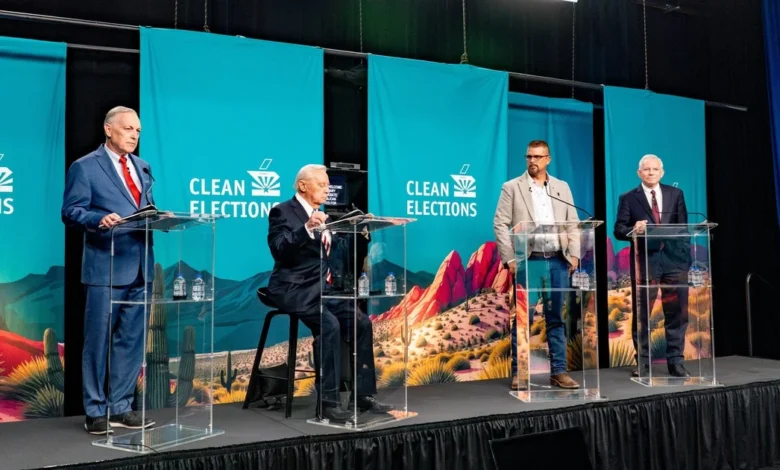
Arizona voters are poised to cast their ballots on Tuesday, July 22, 2026, in a primary election that will determine the Republican challenger to incumbent Democratic Governor Katie Hobbs, while also shaping the battle for control of key congressional districts. This electoral event unfolds in a state that has become a quintessential political battleground, reflecting broader national ideological divides and the enduring influence of former President Donald Trump.
Historically a reliably Republican stronghold, Arizona has witnessed a dramatic political transformation in recent years, evolving into a swing state capable of delivering victories to either party. Evidence of this shift is abundant: while six of its nine House representatives are Republicans, the state currently has a Democratic governor, and both of its U.S. senators are Democrats. The presidential elections further underscore this volatility, with Arizona narrowly favoring Joe Biden in 2020 before flipping back to support President Trump in 2024. This dynamic environment makes every primary contest a crucial precursor to the general election, with implications stretching far beyond the Grand Canyon State.
The 2020 election cycle, in particular, left an indelible mark on Arizona’s political landscape. It was one of the states most aggressively targeted by Mr. Trump with his unsubstantiated claims of widespread voter fraud. These allegations, despite being repeatedly debunked by courts and election officials, have continued to resonate deeply within Arizona’s political discourse, becoming a central theme in many campaigns and influencing voter confidence in the electoral system. As primary day approaches, the lingering effects of these claims are palpable, particularly in the Republican contests.
The Gubernatorial Primary: A Clash of Republican Ideologies and a Referendum on Election Integrity
Governor Katie Hobbs, a Democrat, faces no opposition in her party’s primary, ensuring her direct path to the November general election. Her focus remains squarely on bread-and-butter issues, with her campaign emphasizing affordability for Arizonans and advocating for reforms to the state’s school voucher program, a stance popular with her progressive base and moderate voters. Hobbs’s 2022 victory over Trump-backed Kari Lake was notably narrow, underscoring the state’s competitive nature and setting the stage for another potentially razor-thin race. Lake, who vehemently echoed Mr. Trump’s false claims about the 2020 election, has since been nominated by President Trump to lead the U.S. Agency for Global Media (USAGM), which oversees Voice of America and other international broadcasting services. Her nomination, however, awaits confirmation by the Senate, a process that has become a proxy battle over the influence of election skepticism.
On the Republican side, four candidates are vying for the nomination, but the contest is largely dominated by two prominent U.S. Representatives: Andy Biggs and David Schweikert. The former, Representative Andy Biggs, has garnered the coveted endorsement of President Trump, a significant advantage in a state where the former president’s influence among the Republican base remains formidable.
Andy Biggs: A Standard-Bearer for the Trump Wing
Representative Biggs, who has served Arizona’s 5th Congressional District for five terms, is a well-known figure on the national conservative stage, having previously chaired the ultra-conservative House Freedom Caucus. He has been one of the most vocal proponents of Mr. Trump’s election fraud claims, playing a central role in the efforts to challenge the 2020 election results. His alleged involvement in plans to bring protestors to Washington on January 6, 2021, and his attempts to persuade state officials that the election had been stolen, led to a subpoena from the now-defunct Jan. 6 select committee. His name appeared frequently in the committee’s final report, cementing his image as a staunch Trump loyalist and a champion of election integrity concerns within the Republican Party.
Early polls suggest Biggs holds a lead in the primary race. Francisco Pedraza, head of Arizona State University’s Center for Latina/os and American Politics Research, predicts that a general election matchup between Biggs and Hobbs would be a "tight race." Pedraza highlights that the 2020 election claims and the question of "whether we can trust our election systems" will be a central and recurring theme throughout the campaign. This concern is not unfounded; ASU’s research on the 2024 election revealed that a significant portion of Arizona voters – one in three – expressed low confidence in the fair counting of absentee or mail-in ballots. "That is some evidence that when thought leaders – and especially elected officials, public officials, including the president of the United States – when they continue to bang on this drum that there’s fraud happening despite no evidence that that is the case, it sticks, and so people’s beliefs are really tainted," Pedraza observed. This sentiment underscores the challenge Hobbs will face in deflecting these claims while focusing on her policy agenda.
David Schweikert: The Pragmatist Seeking Executive Action
In contrast to Biggs, Representative David Schweikert, first elected to Congress in 2010 amidst the Tea Party wave, presents himself as a more pragmatic conservative. Representing the Scottsdale area, Schweikert announced his gubernatorial bid last year, citing frustration with the persistent gridlock in Congress. "We have a body that can’t even pass its appropriation bills," he lamented to the Arizona Republic, signaling a desire to shift from legislative inertia to executive action.
Schweikert’s platform is expected to lean heavily on fiscal conservatism and state-level governance issues, potentially offering a different appeal to Republican primary voters who might be weary of the constant focus on past election disputes. While he shares conservative principles with Biggs, his emphasis on governance and legislative effectiveness could differentiate him from the more ideologically rigid wing of the party. His primary challenge will be to rally a sufficient base of support against Biggs’s Trump-backed momentum.
The outcome of the Republican gubernatorial primary will undoubtedly shape the narrative for the general election. Should Biggs secure the nomination, the general election campaign will likely be dominated by intense debates over election integrity, cultural issues, and the legacy of the Trump administration, forcing Governor Hobbs to vigorously defend the state’s electoral processes while simultaneously promoting her policy achievements. A Schweikert nomination might pivot the debate more towards economic policies, state budget management, and pragmatic solutions to Arizona’s challenges, potentially appealing to a broader swath of independent and moderate voters.
Arizona’s 1st Congressional District: A National Bellwether
The departure of Representative David Schweikert from the U.S. House to pursue the governorship has opened up Arizona’s 1st Congressional District, creating a highly competitive "toss-up" race that is being closely watched by national political strategists. This district, which encompasses parts of Scottsdale and other suburban areas, has become increasingly purple due to demographic shifts and urban growth, making it a critical battleground in the broader fight for control of the U.S. House of Representatives. Sabato’s Crystal Ball rankings by the UVA Center for Politics have categorized AZ-01 as a toss-up, indicating its volatility and potential to swing either way.
The Republican Primary for AZ-01
Several Republicans are vying for the GOP nomination, each bringing a distinct profile to the race.
- Jay Feely: A former Arizona Cardinals kicker, Feely has secured President Trump’s endorsement, leveraging his name recognition and the former president’s backing to build a campaign focused on conservative principles and potentially appealing to voters beyond traditional political circles.
- Joseph Chaplik: A former state Representative, Chaplik offers a more traditional conservative profile, emphasizing legislative experience and a proven track record in state politics.
- John Trobough: A businessman, Trobough may position himself as an outsider, potentially self-funding his campaign to highlight his independence from established political machines.
The Republican primary will test the enduring power of a Trump endorsement against candidates with strong local roots or significant personal resources. The winner will face a formidable challenge in the general election.
The Democratic Primary for AZ-01
On the Democratic side, the primary is also a keenly contested affair, featuring two prominent figures.
- Marlene Galán-Woods: A former broadcast journalist, Galán-Woods has received the backing of the Democratic Congressional Campaign Committee (DCCC), indicating national party confidence in her electability. Her candidacy, however, has drawn scrutiny due to her past political affiliations; she was a registered Republican until 2018 and previously supported GOP politicians. Addressing these criticisms, Galán-Woods told the Arizona Republic that the Republican Party has fundamentally changed, asserting that it "has been driven off a cliff by Donald Trump and people like (incumbent U.S. Rep.) David Schweikert." Her campaign will likely focus on healthcare access, educational investment, and economic opportunity, aligning with mainstream Democratic platforms.
- Amish Shah: A former state legislator, Shah previously defeated Galán-Woods in the 2024 primary for this district (when Schweikert was running for re-election there). He brings legislative experience and a strong base from his prior campaigns, positioning himself as a consistent Democratic voice.
The Democratic primary will determine which candidate is best positioned to capitalize on the district’s shifting demographics and harness national party support. The winner will face a tough fight in November, with both parties pouring significant resources into this pivotal race, understanding that AZ-01 could be instrumental in determining which party controls the House.
Arizona’s 5th Congressional District: Scandal, Loyalty, and Self-Funding
With Representative Andy Biggs vacating his seat to run for governor, Arizona’s 5th Congressional District presents another compelling primary contest. Unlike AZ-01, this district is considered a "Safe Republican" seat by Sabato’s Crystal Ball, meaning the winner of the Republican primary is highly favored to win the general election in November. This makes the GOP primary the de facto general election, intensifying the internal party battle.
The Republican Primary for AZ-05
The Republican primary has been dominated by two main contenders, one of whom has faced significant controversy.
-
Mark Lamb: The former Pinal County Sheriff, Lamb has branded himself "America’s Sheriff" and, like Biggs, has received President Trump’s endorsement. When launching his campaign, Lamb emphasized his focus on "faith in God, Jesus Christ, my family," appealing to a conservative, religious base. He initially led in early polling, riding on the strength of his public persona and presidential backing.
However, Lamb’s campaign has been rocked by a multi-part investigation published by the Arizona Republic in May, which alleged years of sexual misconduct, explicit messages, and abuse of power. The report also indicated that Lamb was investigated by the Church of Jesus Christ of Latter-day Saints regarding these claims. Lamb’s campaign has vehemently denied the allegations, with his wife stating in a Facebook post in May that "after all we’ve been through, a massive smear campaign is certainly not going to stop us from doing what’s right." Despite the serious nature of the allegations, President Trump reaffirmed his support for Lamb just last week, underscoring the enduring power of the former president’s endorsement, even in the face of significant negative press.
-
Daniel Keenan: A wealthy construction owner, Keenan has emerged as a formidable challenger to Lamb. He has significantly self-funded his campaign, pouring $1.6 million of his own money into the race. A recent poll conducted by a GOP polling firm and backed by Keenan’s campaign reportedly showed him with a slim lead, indicating that his financial resources and campaign efforts might be effectively countering Lamb’s name recognition and Trump’s endorsement, particularly in light of the allegations. Keenan’s campaign strategy likely focuses on presenting himself as a credible, business-oriented alternative, potentially appealing to Republicans looking for a candidate untainted by scandal.
The AZ-05 primary is a fascinating case study in modern Republican politics, pitting the weight of a presidential endorsement and a strong conservative brand against a well-funded challenger and serious allegations of misconduct. The outcome will reveal the extent to which primary voters prioritize loyalty to Trump and conservative identity over personal conduct and traditional campaign financing.
The Democratic Primary for AZ-05
While three Democrats are running to challenge the Republican winner, the district’s strong Republican leanings mean that the Democratic primary receives less attention. The focus remains squarely on the highly competitive and controversial GOP contest, as its victor is almost certainly destined for Congress.
Broader Context: Arizona as a Microcosm of National Political Trends
The Arizona primaries are more than just local contests; they represent a microcosm of the national political landscape in 2026. The enduring theme of "election integrity," fueled by Mr. Trump’s persistent claims, continues to be a potent force, particularly within the Republican Party. Pedraza’s research from ASU underscores how this narrative, despite lacking factual basis, deeply impacts voter confidence and shapes campaign strategies. Candidates like Andy Biggs effectively harness this sentiment, while others like Governor Hobbs must navigate it carefully, aiming to reassure voters about the robustness of the state’s electoral system.
The "Trump factor" remains paramount in Republican primaries. His endorsements, even for candidates facing serious challenges like Mark Lamb, demonstrate his unparalleled influence over the GOP base. This dynamic forces other Republican candidates to either align with or skillfully differentiate themselves from the former president’s agenda and rhetoric.
Arizona’s shifting demographics, particularly the growth of urban and suburban areas like Maricopa County, have fundamentally altered its political calculus. Once a Republican bastion, these areas are now competitive, making statewide races and crucial congressional districts like AZ-01 genuinely toss-ups. This demographic evolution ensures that both parties invest heavily in the state, making it a critical proving ground for national campaign strategies and messaging.
Beyond the specter of election claims, Arizona voters are grappling with a range of pressing issues. Affordability, including housing costs and inflation, remains a top concern, as highlighted by Governor Hobbs’s campaign focus. Immigration, given Arizona’s border state status, is a perennial and highly charged issue, influencing both state and federal races. Water rights and management, particularly in the face of persistent drought conditions, also represent a critical policy challenge that candidates must address. Education funding, school choice, and the balance between state and local control over curricula are additional battlegrounds that resonate deeply with families across the state.
As Arizonans head to the polls, the outcomes of these primaries will not only determine the candidates for the November general election but will also offer critical insights into the evolving preferences of voters, the enduring power of political endorsements, and the pervasive influence of national political narratives on state-level contests. The path to control of the U.S. House and the future direction of Arizona’s state government will be significantly shaped by the choices made on this pivotal primary day.