Victoria Chang’s Tree of Knowledge: A Meditation on History, Nature, and the Erasure of the Past

The landscape of California is often defined by the towering, peeling presence of the eucalyptus tree. Introduced to the region in the 1850s by Australians arriving for the Gold Rush, these trees were originally intended to provide timber for a rapidly expanding frontier. While they eventually proved unsuitable for construction, they became an indelible part of the state’s sensory identity, known for their distinct medicinal scent and silver-green leaves. However, in contemporary California, the eucalyptus is a subject of environmental contention; considered an invasive species, its oily bark and shedding limbs are notorious for fueling the state’s increasingly catastrophic wildfires. For poet and author Victoria Chang, a single eucalyptus tree across from her Los Angeles home became the catalyst for a profound exploration of mortality, history, and the human condition.
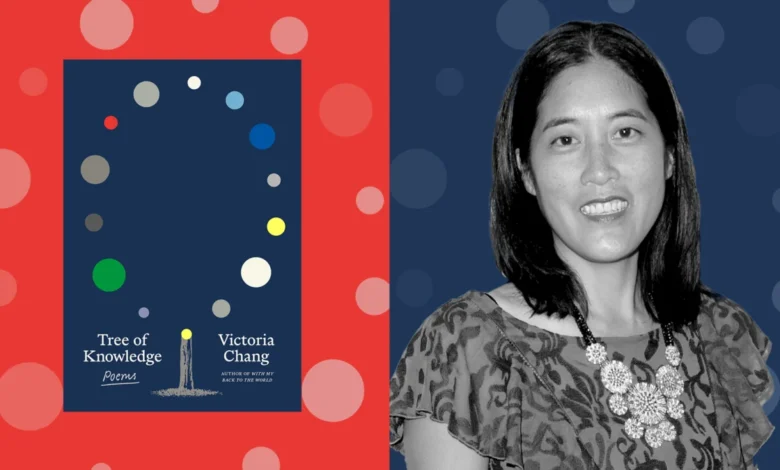
In 2023, Chang witnessed the removal of this massive specimen. Over the course of several days, a crew dismantled a living entity that had likely taken decades, if not a century, to reach its height. This moment of ecological erasure prompted Chang to reflect on the nature of observation and the ease with which history—both natural and human—can be discarded. These reflections culminated in her latest poetry collection, Tree of Knowledge, published by Farrar, Straus and Giroux. The book, which shares its title with a series of paintings by the pioneering Swedish abstract artist Hilma af Klint, serves as a complex archive of personal and collective trauma, environmental stewardship, and the nuances of the Asian American experience.
The Catalyst of Ecological and Personal Loss
The removal of the eucalyptus tree served as a metaphor for the fleeting nature of existence. Chang noted that while the tree was a constant in her daily life, she had rarely given it the attention it deserved until it was being destroyed. This realization mirrors a broader human tendency to ignore the foundations of our environment and history until they are on the verge of vanishing. In Tree of Knowledge, Chang uses this incident to pivot into a wider discussion on what it means to be a steward of the Earth.
The collection is not merely an environmental lament; it is a meticulously researched inquiry into the "archives" of life. Chang’s work often intersects with visual art, and in this volume, she engages with paintings and sculptures that feature trees, noting how art often preserves what reality destroys. By placing her poetry in conversation with figures like Hilma af Klint, Chang bridges the gap between the abstract and the tangible, arguing that the act of "seeing" is the first step toward empathy.
The Eureka Expulsion: A Chronology of Erasure
At the heart of the collection is "Eureka," a long-form poem that delves into one of the darkest chapters of California’s history: the 1885 expulsion of Chinese Americans from the city of Eureka. This event was not an isolated incident but part of a broader "Chinese Must Go" movement that swept across the American West during the late 19th century, fueled by economic anxiety and systemic racism.
The chronology of the Eureka expulsion is a stark reminder of the fragility of civil rights. On February 6, 1885, a white city council member named David Kendall was killed by a stray bullet during a shootout between two rival Chinese gangs in the city’s Chinatown. In response, a "Committee of Fifteen" was formed by the city’s white residents. By the following evening, an estimated 300 Chinese residents were ordered to leave the city within 48 hours. Under the threat of hanging, these individuals were forced to abandon their homes, businesses, and belongings. They were herded onto two steamships, the City of Chester and the Humboldt, and sent to San Francisco.
For over a century, Eureka remained a "sundown town" for Chinese people, with a city ordinance effectively banning them from the area until the mid-20th century. This historical "cleansing" became known as the "Eureka Method," a template for similar expulsions in other Pacific Northwest towns like Tacoma and Seattle. Chang’s poem collapses time, weaving the 1885 atrocities into the present day. She utilizes images of Chinese laborers in canneries, literally stitched through with red thread, to symbolize the violent and interconnected nature of this history.
Immigration Policy and the First-Generation Experience
Chang’s exploration of history is also deeply personal, rooted in the archives of her own family. She contrasts the current climate of anti-immigrant rhetoric with the era in which her parents arrived in the United States. Her mother emigrated from China in the 1960s, a period marked by the passage of the Immigration and Nationality Act of 1965 (also known as the Hart-Celler Act). This landmark legislation abolished the National Origins Formula, which had heavily favored Northern Europeans, and opened the door for "technical" and skilled workers from Asia.
In her 2021 memoir, Dear Memory, and again in Tree of Knowledge, Chang reflects on how her mother was able to sponsor numerous relatives, with approvals often granted within days. This "welcoming" atmosphere stands in stark contrast to the modern bureaucratic and social hurdles faced by immigrants. Chang describes the psychological complexity of being a first-generation American—a person who feels a profound sense of gratitude for their country while simultaneously feeling like a perpetual outsider. She posits that while some must leave their physical countries of birth, children of immigrants often feel they have had to leave "countries they’ve never seen" to assimilate into an American identity that does not always fully claim them.
Stewardship and the Responsibility to Future Generations
As a mother of two teenagers, Chang views the themes of Tree of Knowledge through the lens of legacy. She argues that being a "senior person" with life experience carries a mandate to be a good steward, not just of the land, but of history and culture. Her work asks how the next generation can be raised to avoid the pitfalls of racism, misogyny, and rampant consumerism.
This sense of responsibility extends to the digital age. Chang expresses concern over the rise of Artificial Intelligence and its tendency to "strip down and simplify" complex human experiences. In her view, poetry and art are essential tools for maintaining nuance and depth in a world increasingly dominated by algorithms. By engaging with the difficult histories of the past—such as the Eureka expulsion—Chang believes society can better navigate the challenges of the present.
Broader Impact and Implications
The release of Tree of Knowledge comes at a time when the United States is grappling with its historical narrative, particularly as it approaches its 250th anniversary. Chang’s work contributes to a growing movement of "archival poetry," where writers use primary sources, historical records, and personal artifacts to fill the gaps in the traditional American story.
The environmental themes in the book also resonate with current global discussions on climate change and invasive species management. The eucalyptus tree, once a symbol of California’s potential, is now a symbol of its vulnerability. By drawing a line between the destruction of a tree and the expulsion of a community, Chang suggests that all forms of erasure are linked.
Ultimately, Tree of Knowledge is a call to action. It demands that readers look closer at the world around them—at the trees that shade their streets and the histories that have been buried beneath their feet. Chang’s insistence on "nuance" serves as a defense against the flattening of human experience. As she notes, the only way to move forward is to learn about the past, ensuring that the stories of those marginalized by history are not just remembered, but integrated into the collective consciousness of the nation. Through her work, the "red thread" of history is made visible, reminding us that we are all, in some way, stewards of the memories we inherit.