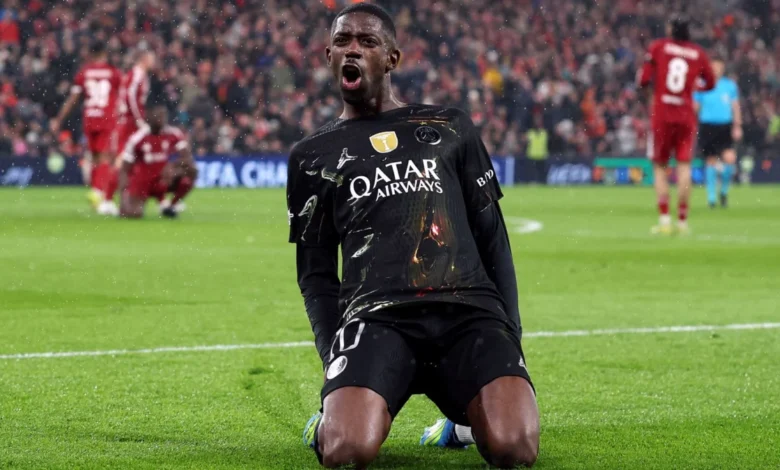
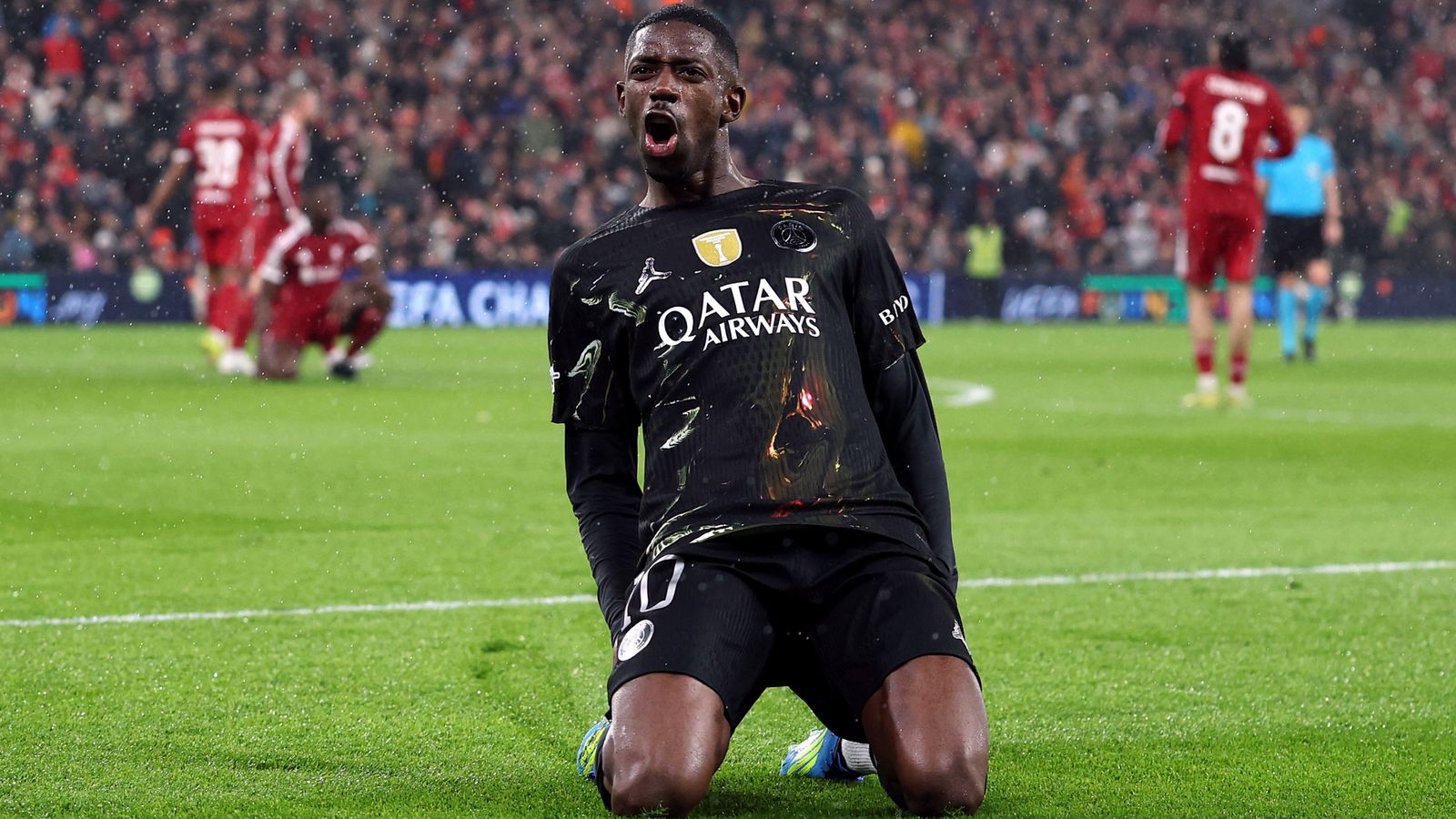
Liverpool’s hopes of a Champions League triumph were extinguished at the quarter-final stage for the second consecutive season, as a resolute Paris Saint-Germain secured a 2-0 victory at Anfield, sealing a comprehensive 4-0 aggregate win. Despite a spirited second-half performance fueled by the passionate Anfield faithful, Arne Slot’s side ultimately succumbed to the clinical finishing of the reigning European champions, with Ousmane Dembele proving to be the decisive difference-maker.
The deficit from the first leg in Paris, a 2-0 defeat, presented a formidable challenge. However, buoyed by the electric atmosphere at Anfield, Liverpool displayed a renewed sense of urgency and attacking intent. They unsettled the experienced PSG side for significant periods, creating genuine scoring opportunities that, had they been converted, could have dramatically altered the complexion of the tie. The turning point, or rather the moment that encapsulated Liverpool’s frustrating evening, came in the second half when a penalty award for a challenge on Alexis Mac Allister was controversially overturned by VAR.
The initial decision, a penalty granted by the on-field referee for a challenge by PSG’s Willian Pacho on Mac Allister, appeared to be a clear-cut opportunity for Liverpool to halve the aggregate deficit and inject renewed belief into their comeback bid. However, a lengthy VAR review led to the penalty being rescinded, a decision that irked both the players and the home support. Liverpool defender Ibrahima Konate, speaking to Amazon Prime post-match, articulated the prevailing sentiment: "For me, it was a clear penalty. I was behind the referee. If we get the penalty and score, it would have been completely different." This sentiment was echoed by former Liverpool midfielder and Sky Sports pundit Tim Sherwood, who commented, "I still think it was a penalty. There was contact into the back of the leg. He is entitled to go down with that contact." Sherwood further observed, "Liverpool were the better team tonight. If they play like that, they will 100 per cent qualify for the Champions League. This tie was lost in the first leg. Why didn’t they go over there and have a go?"
Liverpool’s attacking strategy under Slot was characterized by a clear intent to overturn the deficit. The starting lineup featured Alexander Isak, a forward option intended to provide an additional threat. Following an injury to Hugo Ekitike before the half-hour mark, Mohamed Salah was introduced, signalling a further aggressive shift in the team’s formation. The introduction of Rio Ngumoha for Joe Gomez later in the game amplified the sense of a desperate, all-out assault, as the Kop desperately yearned for a classic Anfield European night.
Despite their considerable effort and the momentum they generated at times, Liverpool’s campaign in the Champions League has now officially concluded without silverware. The focus for the club must now irrevocably shift to securing qualification for next season’s Champions League, a crucial objective that hinges on their performance in the remaining Premier League fixtures, where a top-five finish is paramount.
The Controversial Penalty Decision
The penalty incident involving Alexis Mac Allister and Willian Pacho remains a focal point of discussion. While the initial award might be considered ‘soft’ by some, the subsequent VAR review sparked considerable debate. The replays, which were scrutinised extensively, showed a degree of contact as Pacho’s challenge appeared to catch Mac Allister’s trailing leg. Liverpool’s perspective, as articulated by Konate, is that the contact was sufficient to warrant a penalty and that the subsequent overturning significantly impacted the game’s trajectory.
Tim Sherwood’s analysis further underscored the potential ramifications of the decision. His assertion that the tie was effectively decided in the first leg at Parc des Princes is a valid point, as Liverpool’s inability to register an away goal or secure a more favourable deficit in Paris has proven to be a significant handicap. The aggregate scoreline of 4-0, while reflecting PSG’s superiority over two legs, perhaps doesn’t fully encapsulate the ebb and flow of the second leg at Anfield, where Liverpool, particularly in the second half, demonstrated they could indeed unsettle the European champions.
Liverpool’s Enduring Finishing Woes
A recurring theme for Liverpool throughout their Champions League campaign, and indeed at times in their domestic season, has been a concerning underperformance in front of goal relative to their underlying expected goals (xG) statistics. Heading into the quarter-final tie, Liverpool had scored 24 goals from an expected-goals total of 27.8 in the Champions League, making them the most significant underperformers in this metric among the eight remaining quarter-finalists. This statistical anomaly was starkly evident once again at Anfield.
The Reds unleashed a total of 21 shots against PSG, yet only managed to force the opposition goalkeeper into making five saves. This disparity highlights a critical deficiency: a lack of cutting edge and precision in the final third. Despite their commitment to attacking play, evidenced by the numerous bodies thrown forward, Liverpool’s attempts were often characterized by misplaced passes, wild finishes, poor decision-making in crucial moments, and a general tentativeness when the opportunity arose to seize control and convert chances.
For experienced players like Mohamed Salah, the desire to perform and influence the game remains strong, but the physical demands of the season appear to be taking their toll, impacting his effectiveness. Similarly, for talents like Florian Wirtz, who has been a significant acquisition, this tie presented an opportunity to demonstrate the mentality required to deliver in high-stakes European encounters, an opportunity that, in the context of the result, felt missed. Alexander Isak, still finding his rhythm and full fitness after a challenging period, is yet to fully impact the team in the way many had hoped, suggesting the season has somewhat bypassed his immediate influence.
The Anfield faithful, despite the ultimate disappointment, acknowledged and appreciated the team’s endeavour and the significantly improved tempo of their play. The final scoreline, a stark 2-0 defeat, arguably does not reflect the moments where Liverpool genuinely unsettled the formidable PSG side in the second half. However, as the dust settles, it is clear that familiar frailties, particularly in their inability to convert chances and their vulnerability in decisive moments, ultimately proved to be their undoing.
Player Ratings and Key Performers
Liverpool: Mamardashvili (6), Frimpong (6), Konate (7), Van Dijk (6), Kerkez (6), Gravenberch (7), Mac Allister (6), Szoboszlai (7), Wirtz (6), Ekitike (6), Isak (5).
Substitutes: Salah (6), Gakpo (7), Gomez (6), Ngumoha (7), Jones (6).
Paris Saint-Germain: Safonov (7), Hakimi (7), Marquinhos (7), Pacho (6), Mendes (6), Joao Neves (6), Vitinha (7), Zaire-Emery (6), Doue (6), Dembele (8), Kvaratskhelia (6).
Substitutes: Hernandes (6), Barcola (7), Beraldo (n/a).
Player of the Match: Ousmane Dembele
The individual performances offer a glimpse into the team dynamics. Ibrahima Konate and Dominik Szoboszlai were among Liverpool’s higher-rated players, contributing defensively and offensively respectively. Ryan Gravenberch also showed flashes of his potential. For PSG, Ousmane Dembele’s match-winning brace earned him the player of the match award, highlighting his crucial role in securing their passage to the semi-finals. The defensive solidity of Marquinhos and the midfield control provided by Vitinha were also key factors in PSG’s success.
The Road Ahead for Liverpool and PSG
For Liverpool, the immediate aftermath of this European exit necessitates a swift recalibration. Their primary objective now becomes securing a return to the Champions League next season through their Premier League performance. Manager Arne Slot will be tasked with ensuring his team maintains focus and consistency in the league to meet this crucial target. The club’s investment in the squad and the high expectations surrounding them mean that consistent European qualification is not merely a desire but a necessity.
Paris Saint-Germain, on the other hand, are hitting their stride at a critical juncture of the season. Their victory at Anfield marked their sixth consecutive win across all competitions, a testament to their growing momentum under Luis Enrique. This impressive run of form positions them as genuine contenders for the Champions League title. Their semi-final opponents will be either Bayern Munich or Real Madrid, setting up a potentially thrilling encounter between two of Europe’s elite clubs. PSG’s ability to maintain this high level of performance in the latter stages of the competition will be keenly observed.
Historical Context and Future Implications
Liverpool’s quest for a record-extending seventh Champions League title has been thwarted. The club has a rich history in this prestigious competition, with their last triumph coming in 2019. However, this season’s campaign has ended prematurely, marking a significant disappointment for a club that has consistently challenged at the highest level in recent years. The focus will now turn to domestic matters and building towards future European campaigns.
For Paris Saint-Germain, this season represents a significant opportunity to finally clinch the Champions League trophy, a prize that has eluded them despite substantial investment and star-studded squads. Their progress to the semi-finals, coupled with their current winning streak, suggests they have the quality and the form to go all the way. The coming weeks will reveal whether they can translate their domestic dominance and European pedigree into ultimate continental glory. The narrative of their season, and indeed the legacy of their current generation of players, may well be defined by their performances in the final four.
The broader implications of Liverpool’s exit extend beyond this season’s trophy cabinet. It raises questions about squad depth, tactical adaptability, and the mental fortitude required to navigate the intense demands of both domestic and European competitions. For PSG, their continued presence in the tournament underscores their status as a European superpower and highlights the success of their long-term strategy to build a team capable of winning the ultimate club prize. The Champions League narrative continues, with the semi-final matchups promising to deliver compelling football and further drama.
Related posts: