Blue Origin Unveils Major Upgrades to New Glenn Rocket to Revolutionize Launch Frequency and Payload Efficiency

KENNEDY SPACE CENTER, Fla. — Blue Origin, the aerospace company founded by Jeff Bezos, announced two transformative engineering upgrades to its New Glenn launch vehicle on Thursday, marking a strategic pivot toward rapid reusability and significantly reduced production costs. Speaking at the UP.Summit conference held at the historic Shuttle Landing Facility, Blue Origin CEO Dave Limp outlined an ambitious vision for the rocket’s future, one that aims to facilitate a launch cadence exceeding 1,000 missions per year. These developments, headlined by the introduction of the Northstar engine and the GS3 third-stage module, represent a fundamental shift in how the company approaches the economics of orbital logistics, deep space exploration, and lunar infrastructure support.
The Strategic Imperative for Cost Reduction
The aerospace industry is currently witnessing an unprecedented surge in demand for launch services, driven by the proliferation of low Earth orbit (LEO) satellite constellations, the growth of the commercial space station economy, and the renewed focus on lunar surface operations. Dave Limp emphasized that the current cost structures associated with heavy-lift launch vehicles remain a bottleneck for the broader space economy. "There has never been higher demand for launch, ever," Limp stated during the keynote address.
To meet this demand, Blue Origin is transitioning from a traditional aerospace manufacturing philosophy toward a high-volume, automated production model. By targeting the architecture of the first-stage propulsion system, the company is attempting to lower the barrier to entry for both commercial and government payloads. The Northstar engine is the centerpiece of this effort, designed not merely as a performance upgrade, but as a manufacturing marvel intended to streamline the assembly line process to a fraction of its current duration.
Northstar: A Leap in Propulsion Engineering
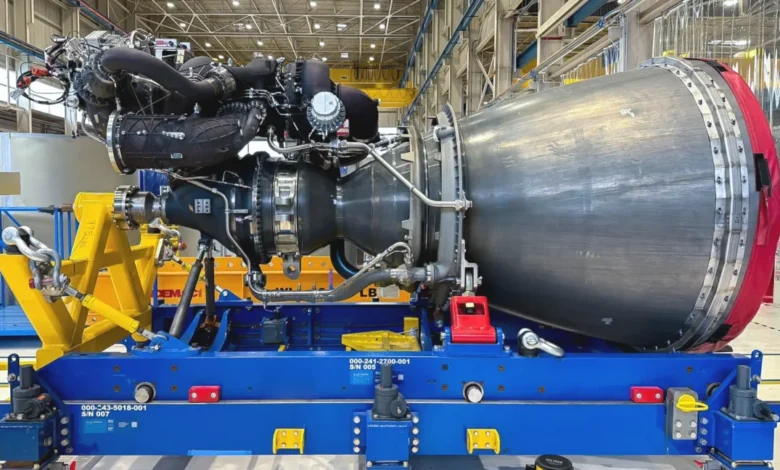
The Northstar engine is positioned as the successor to the BE-4, the liquid oxygen and liquefied natural gas (methane) engine currently powering the first stage of the New Glenn vehicle. While the BE-4 is a sophisticated piece of engineering that also powers United Launch Alliance’s (ULA) Vulcan Centaur rocket, the Northstar represents a refined evolution of that technology.
Technical specifications provided by Blue Origin indicate that the Northstar engine achieves its performance gains through radical simplification. By reducing the total part count by 50 percent compared to the BE-4, Blue Origin engineers have significantly minimized the points of failure and the complexity of the assembly process. Perhaps most notably, 65 percent of the engine’s components are now capable of being produced via additive manufacturing (3D printing). This transition to 3D printing is a critical component of the company’s goal to reduce the manufacturing cost of each engine to just 25 percent of the current BE-4 price point.
In terms of performance, the Northstar is expected to deliver a starting thrust of 715,000 pounds, a significant increase over the 640,000 pounds of thrust generated by the BE-4. Despite this increase in power, the engine boasts a 30 percent reduction in mass. Blue Origin confirmed that testing is already well underway, with a formal test-firing campaign currently active. The company clarified that it will maintain production of the BE-4 to fulfill its contractual obligations to ULA, ensuring that the Vulcan program remains unaffected by the transition to Northstar for Blue Origin’s own fleet.
Expanding Reach with the GS3 Third Stage
Complementing the Northstar engine is the development of the GS3, a dedicated hydrogen-oxygen third stage for the New Glenn rocket. This upgrade is specifically designed to address the challenges of high-energy orbital maneuvers, such as direct injection into geostationary orbit (GEO) or trans-lunar injection for payloads destined for the Moon.
The addition of the GS3 stage effectively expands the performance envelope of the New Glenn vehicle, allowing it to carry heavier scientific instruments, lunar landers, or infrastructure modules into deep space. By utilizing a high-efficiency hydrogen-oxygen fuel cycle, the GS3 will provide the "extra kick" required to transition from Earth orbit to deep space destinations with greater mass efficiency. This development aligns with Blue Origin’s broader mission to support NASA’s Artemis program and the growing commercial interest in the cislunar economy.
Chronology and Context of the New Glenn Program
The development of New Glenn has been a multi-year effort marked by a rigorous, iterative approach to aerospace engineering.
- 2016: Jeff Bezos formally announces the development of the New Glenn rocket, named after astronaut John Glenn, emphasizing its role as a heavy-lift vehicle designed for reusability.
- 2018–2021: Blue Origin focuses heavily on the development and qualification of the BE-4 engine, encountering various technical challenges inherent in large-scale engine development.
- 2023: The company achieves a major milestone with the successful delivery of BE-4 engines to ULA for the Vulcan launch vehicle.
- 2024: Blue Origin advances its testing of the New Glenn first stage, conducting integrated vehicle testing at the Kennedy Space Center.
- 2024 (Current): The introduction of the Northstar engine and the GS3 stage signals the next phase of the program, shifting from initial launch capability to high-frequency operational scaling.
The decision to develop these upgrades follows years of industry analysis suggesting that the true profitability of commercial launch providers lies not in a single, high-performance mission, but in the ability to achieve high flight rates with reliable, reusable hardware.
Economic and Industrial Implications
The implications of Blue Origin’s strategy are substantial. By aiming for a cadence of 1,000 launches per year, the company is betting on a future where the cost of access to space is sufficiently low to invite entirely new sectors of the economy to operate in orbit.
Industry analysts observe that the move toward 3D-printed engine components is a growing trend among "NewSpace" companies, mirroring strategies employed by competitors like SpaceX and Relativity Space. However, Blue Origin’s scale—backed by the resources of Jeff Bezos—allows for a level of infrastructure investment that few others can match. The transition to a "single-day assembly" for engines would represent one of the fastest production rates in the history of liquid-fuel rocket propulsion, rivaling automotive production speeds.
Furthermore, the impact on the supply chain is likely to be positive. A robust, high-volume production line requires consistent raw material procurement and advanced manufacturing talent, stimulating growth in the Florida aerospace corridor. By standardizing the Northstar engine, Blue Origin effectively creates a modular platform that could potentially be adapted for other vehicles or deep space initiatives in the future.
Official Response and Future Outlook
While Blue Origin has not yet provided a specific timeline for the first flight of a Northstar-equipped New Glenn, the company’s public disclosure of the testing campaign suggests that the technology is maturing rapidly. The engineering community has reacted with cautious optimism, noting that while the technical goals are aggressive, the underlying principles of design simplification and additive manufacturing are well-proven in smaller-scale applications.
The market reaction to these announcements reflects a broader confidence in the trajectory of the launch industry. As global governments and private enterprises scramble to secure launch slots for the next decade, Blue Origin’s pivot toward manufacturing efficiency positions it to be a dominant player in the heavy-lift market.
"To get access to space at a lower cost, we have to look at every part of the vehicle," Limp noted during his closing remarks at the summit. "This is going to be a game-changer."
As Blue Origin moves forward, the success of the New Glenn program will likely be measured by its ability to integrate these upgrades into its existing launch infrastructure without significant delays. With the Northstar engine and the GS3 stage, the company is attempting to rewrite the operational manual for orbital launch, moving beyond the era of bespoke aerospace engineering and into a new age of industrialized, high-frequency space access. Whether these ambitions materialize into the projected 1,000 launches per year will depend on the continued success of the current test campaigns and the scalability of the company’s Florida-based manufacturing facilities. For now, the aerospace sector remains fixed on the Kennedy Space Center, waiting to see how the next generation of the New Glenn vehicle will reshape the boundaries of human reach into the solar system.