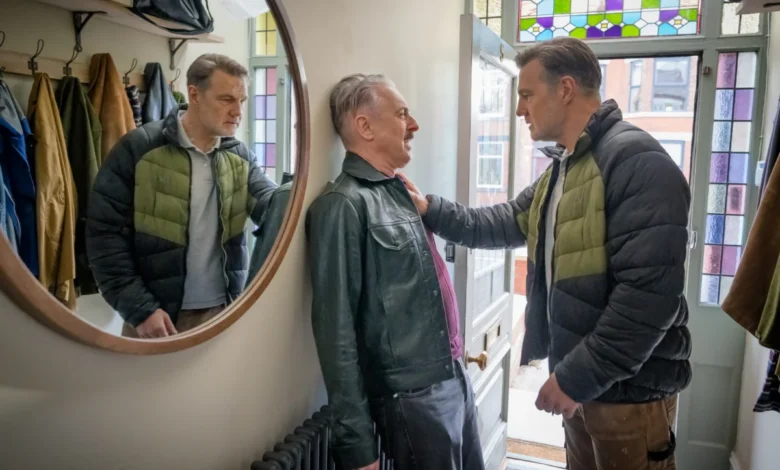
The latest television project from acclaimed writer Russell T. Davies, which arrives on Starz this October following a successful summer run on Channel 4, serves as a searing interrogation of the contemporary queer experience. The series derives its title from a poignant piece of dialogue delivered by the character Melba, portrayed by Paul Rhys. Reflecting on a shifting cultural climate, the sixty-something character notes that he once navigated the world with an unapologetic, exuberant "Ta-da!" but now finds himself choosing to "tiptoe. Just in case." This transition from performative joy to cautious survival defines the central tension of the five-hour miniseries.
The narrative trajectory of Tip Toe is established in its opening sequence, which depicts the grim reality of Leo Struthers, a Manchester-based gay bar owner played by Alan Cumming. Leo is found dead, hanging from a streetlight outside his home. By framing the series with this definitive act of fatal violence, Davies shifts the focus from the "who" or "how" of the crime to the "why"—an exploration of the societal atmosphere that permits such outcomes. Directed by Peter Hoar, the series utilizes a non-linear structure to contrast the vibrant, hopeful life Leo led in the days preceding his murder with the encroaching, systemic hatred that ultimately claimed him.
A Chronology of Declining Safety
The series employs a ten-day countdown to structure its narrative. By jumping back from the tragedy to the mundane, increasingly tense events of the week prior, the production highlights the fragility of queer safety. Leo’s life, as presented in the days leading up to his death, is characterized by a stubborn optimism. He serves as a foil to other characters like Melba, who are deeply cognizant of the rising tide of queerphobia. While Leo repeatedly suggests that the "pendulum of public opinion" will eventually swing back toward tolerance, the viewer is acutely aware that, in this specific instance, time has already run out.
The episodes detail the initial friction between Leo and his neighbor, Clive Goss, portrayed by David Morrissey. The interactions begin as a series of social irritations—a lock-out, an awkward encounter involving Clive’s teenage son, and the class-based tensions inherent in their proximity. However, these interactions quickly evolve into a microcosm of the current culture war. As the series progresses, the threat of violence moves from a background hum—manifested in the fears of characters like the bartender Zee (Iz Hesketh) and the drag performer Regime (Dominic Holmes)—to a focused, localized conflict centered on Leo’s home.
The Socio-Political Context of Modern Queerphobia
Tip Toe enters a landscape where the discourse surrounding LGBTQ+ rights has become increasingly polarized. In the 2010s, legislative victories such as marriage equality and the normalization of queer representation in media suggested a trajectory of permanent progress. However, the current decade has been marked by what many sociologists describe as a "backlash period."
According to reports from organizations such as the Anti-Defamation League and various national monitoring bodies, incidents of hate crimes targeting LGBTQ+ individuals have seen a marked increase in the United Kingdom and the United States over the past five years. This "queerphobia" is often fueled by online disinformation, which the series illustrates through the character of Clive, who consumes rage-bait content that reinforces his prejudices. The series poses a fundamental, uncomfortable question for modern society: What happens when visibility no longer correlates with acceptance? As Leo muses within the script, the concern is no longer a lack of knowledge about queer lives, but a deliberate refusal to grant them legitimacy.
Performance and Character Analysis
The performances in Tip Toe are central to its ability to balance tragedy with human intimacy. Alan Cumming’s portrayal of Leo provides the necessary magnetism to keep the viewer engaged. His performance emphasizes the character’s humanity, ensuring that Leo is not reduced to a symbolic victim. Conversely, David Morrissey’s portrayal of Clive avoids the tropes of a one-dimensional villain. Instead, the performance captures a man who is actively choosing to be cruel, displaying moments of vulnerability or curiosity that are systematically suppressed by his own ideological rigidity.
The supporting cast, including Jackson Connor as the closeted teenager George, provides a bridge between the generations. Through his interactions with Leo, the audience witnesses the intergenerational transmission of both trauma and wisdom. However, the series is not without its critical blind spots. The character of Steph, played by Elizabeth Berrington, serves as a vessel for the subtle, often ignored bigotry of cisgender women within the queer community. While her role is designed to highlight these tensions, some narrative critics have noted that the lack of resolution regarding her character’s prejudices leaves a significant thematic gap in the series’ otherwise biting commentary.
Implications and Thematic Weight
The primary strength of Tip Toe lies in its refusal to offer easy answers or "teachable moments." By rejecting the traditional tropes of redemptive arcs or optimistic resolutions, the series forces the audience to sit with the reality of its conclusion. It posits that violence against marginalized groups is not an accident of history but a series of choices made by individuals who refuse to recognize the common humanity of their neighbors.
From a sociological perspective, the series serves as a mirror to the current "culture of grievance." The juxtaposition between Leo’s self-assured, open lifestyle and Clive’s reactionary, fear-based existence reflects a wider societal rift. The series suggests that while "tiptoeing" might be a survival mechanism for those under threat, it is an insufficient response to the systemic forces at play.
Broader Media Impact
As a work of television, Tip Toe joins a growing body of work that rejects the "it gets better" narrative in favor of a more critical, grounded assessment of modern life. By centering the story in Manchester, the production draws on the city’s rich history of queer activism and nightlife, effectively anchoring its abstract arguments in a tangible, recognizable community.
The series is likely to spark debate regarding the role of media in shaping public sentiment. By depicting the specific mechanics of radicalization—showing how a man like Clive moves from casual rudeness to active hostility—the series provides a roadmap of the radicalization process that is as educational as it is harrowing.
In conclusion, Tip Toe is a work that prioritizes emotional honesty over comfort. It does not promise that the "pendulum" will swing back, nor does it suggest that individual kindness is enough to counter systemic hatred. Instead, it offers a stark, necessary reminder of the cost of indifference. For viewers, the series provides no catharsis in the traditional sense, but rather a profound sense of urgency regarding the current state of human rights and the necessity of confronting prejudice with absolute clarity. Whether the audience views the series as a tragedy or a warning, its impact is undeniable: it captures the "now" with a precision that makes it a defining piece of television for the current era.