Arizona Education Policy Shift Sparks Concerns Over English Language Learner Proficiency Standards

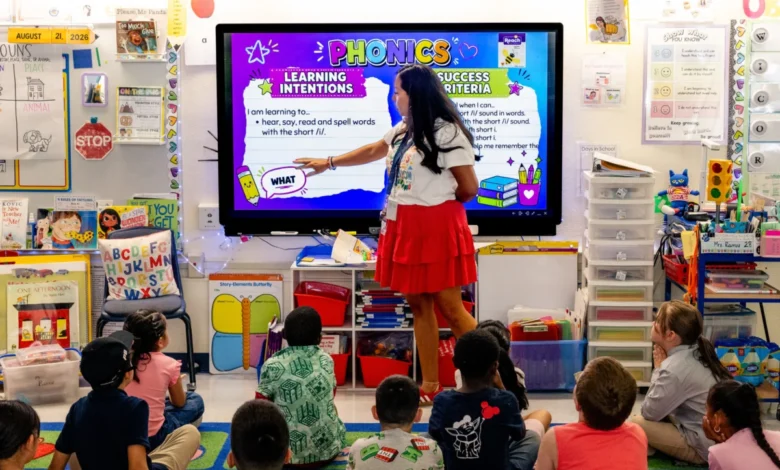
Samantha Ramos stands at the front of her second-grade classroom at John B. Wright Elementary School in Tucson, a small microphone clipped to her lanyard to ensure her instructions cut through the ambient hum of the classroom. She raises her right palm to her left shoulder, a precise gesture her students mirror instantly. This physical coordination is a cornerstone of her phonics instruction, a method designed to help children grasp the nuances of the English language. Today, the focus is the short "i" sound. Ramos guides her students through the word "will," assigning a specific movement to each letter—the shoulder for "w," the elbow for "i," and the hand for the double "l." It is a methodical, intensive process for students who are primarily Spanish-speaking and are navigating the state’s rigorous "structured English immersion" requirements.
This classroom scene is part of a broader, statewide mandate that has defined Arizona’s educational landscape for over a quarter of a century. Under these policies, English language learners (ELLs) are segregated for significant portions of the school day—often ranging from two to four hours—to focus exclusively on English acquisition. This "English-only" framework, solidified by the passage of Proposition 203 in 2000, prohibits bilingual education, forcing students to master English before they can fully integrate into mainstream classrooms to receive core instruction in subjects like science and mathematics.
A Sudden Surge in Proficiency Rates
In the 2026 academic year, the Tucson Unified School District, along with the rest of the state, witnessed a dramatic shift in its English language learner data. The percentage of students classified as proficient in English more than doubled, jumping from 10% in 2025 to 24% in 2026. At first glance, the data suggests a miraculous improvement in pedagogical efficacy. However, the surge is not the result of a sudden breakthrough in teaching methods or student performance. Instead, it is the direct consequence of the Arizona Department of Education’s decision to lower the passing threshold for the Arizona English Language Learner Assessment (AZELLA).

The policy change, championed by outgoing Superintendent of Public Instruction Tom Horne, has ignited a fierce debate among educators, linguists, and civil rights advocates. Critics argue that by lowering the bar for proficiency, the state is effectively pushing students out of necessary language services before they are truly prepared to handle the rigors of an all-English curriculum.
Chronology of Conflict: The AZELLA Legacy
The history of Arizona’s language assessment policies is one of persistent friction between the state and federal authorities. Following the 2000 passage of Proposition 203, the state began its transition to English-only instruction. However, the mechanisms used to measure student progress have been the subject of multiple federal investigations.
Between 2006 and 2012, the U.S. Departments of Justice and Education conducted a review of the AZELLA, concluding that the test was an invalid measure of English language proficiency. The findings were stark: thousands of students had been prematurely exited from support programs despite lacking the fundamental reading and writing skills needed to succeed in mainstream classes. This led to a 2010 settlement agreement in which Arizona promised to revamp its testing and provide compensatory services to students who had been harmed by the inaccurate assessments.
A second settlement followed four years later, requiring the state to raise the proficiency threshold and implement more rigorous testing standards. Throughout this period, researchers such as Ida Rose Florez, a former professor at Arizona State University, published studies characterizing the AZELLA as "ineffective and obsolete," noting that the test often failed to differentiate between children who genuinely required linguistic support and those who did not. Despite these warnings, the test remained the primary arbiter of a student’s academic placement.

Data-Driven Decisions or Political Expediency?
The recent decision to lower the passing scores for 2026 was justified by the Arizona Department of Education through a benchmarking exercise involving native English speakers. Deputy Superintendent Margaret Dugan noted that the department had previously failed to use native speakers as a baseline for the test’s difficulty, an oversight she attributed to the disruptions of the COVID-19 pandemic in 2020.
When the department finally administered the test to native English speakers, nearly half failed. State officials argued that if native speakers could not pass the test at a high rate, the exam itself was flawed. Consequently, they adjusted the passing scores—ranging from 962 for high schoolers to 944 for kindergartners—to "normalize" the results.
However, psychometric experts remain skeptical. Anju Kuriakose, the department’s director of psychometrics, noted that the baseline data was heavily skewed toward kindergarten and first-grade students, who have not yet developed the complex language skills required of older students. Researchers warn that using early-elementary data to set standards for all grade levels creates an artificial inflation of proficiency, masking the true needs of older students who require specialized help.
The Human Impact and Academic Disparity
For families like that of Juana Casas, a mother in the Tucson Unified School District, the goal is simple: ensure their children do not fall behind. Casas, who watched her eldest daughter struggle under the weight of the English-only mandate, feels relief that her son, Arturo, has finally passed the AZELLA. But for many, the "passing" grade is a double-edged sword.

The academic implications are severe. English language learners in Arizona already face significant achievement gaps. Data from the Center for the Future of Arizona shows that in 2025, there was a 31% disparity in reading proficiency between ELL students and their native-speaking peers, and a 23% gap in mathematics. By exiting students from support programs prematurely, schools risk widening this gap. Once a student is reclassified as "proficient," they no longer receive the intensive language services provided by the state, yet they may still lack the academic vocabulary necessary to grasp complex scientific or historical concepts.
Furthermore, there is a financial disincentive for schools to keep students in the program. Funding for English learners is tied to enrollment in the structured English immersion curriculum. As more students are reclassified, schools lose the targeted funding necessary to support those who continue to struggle. Patricia Sandoval-Taylor, the district’s director for language development, points out that while state law requires schools to monitor reclassified students for two years, the state provides no additional funding to support the tutoring or summer school sessions that these students often require to catch up.
Looking Toward the Future
The debate over Arizona’s English-only laws is ultimately a debate about the philosophy of education. Proponents argue that rapid immersion is the fastest path to integration, while linguists and researchers point to decades of data showing that bilingual and dual-language models are more effective for both language acquisition and overall academic achievement.
As Tom Horne prepares to leave office in December following his defeat in the Republican primary, his legacy regarding English instruction remains polarizing. He has consistently defended his policies, citing his previous tenure as a time when reclassification rates reached 31%. However, audits from the Arizona Auditor General during that same period questioned the reliability of that data, suggesting that the "success" Horne touts may have been a statistical illusion rather than an educational achievement.

In the classroom, teachers like Samantha Ramos are left to navigate the reality of these policies. Ramos views her students’ progress with genuine pride, celebrating the hurdles they overcome in a system that often seems designed to exclude them. Yet, the broader scientific consensus remains unchanged: the most successful educational environments are those that support a child’s native language while simultaneously building proficiency in a second. In Arizona, the political insistence on an English-only approach continues to stand in stark contrast to the research, leaving tens of thousands of students to navigate a system where, as experts like Katie Bernstein suggest, "the worst outcomes are students who are not given any language services" at all.