Michael Carrick future: Man Utd head coach position increasingly in doubt but no final decision made

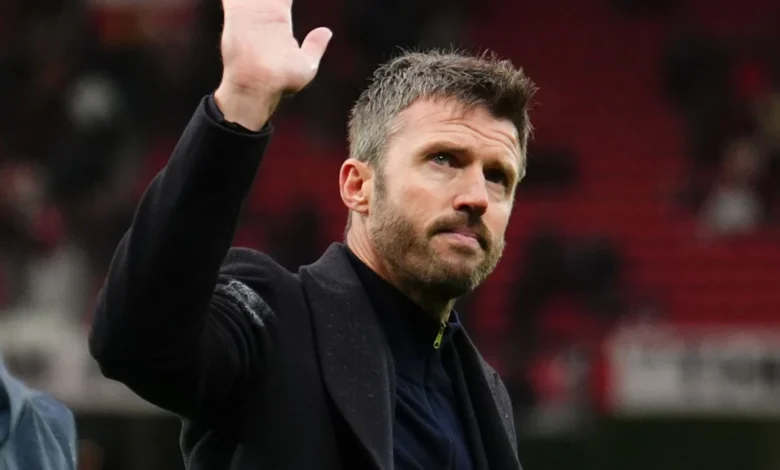
The tenure of Michael Carrick as Manchester United head coach has reached a critical juncture, with the club’s leadership currently conducting a deep-dive evaluation of the team’s performance. While reports indicate that no definitive decision regarding his departure has been finalized, the internal review—spearheaded by director of football Jason Wilcox—is expected to conclude before the resumption of Premier League action following the current international window. The club is operating under the directive that a strategic decision must be reached regarding the team’s trajectory before the squad travels to Anfield to face Liverpool, a fixture that looms large on the horizon.
A Season of Unprecedented Struggles
The current campaign has statistically been the most difficult in the club’s modern history. With only one victory in their last 11 competitive fixtures, Manchester United find themselves in a precarious position. The defensive frailties have been particularly glaring; the team has conceded 30 goals across all competitions, a record that currently ranks as the worst among clubs in the "big five" European leagues. This defensive instability, coupled with a lack of offensive consistency, has led to their worst-ever start to a Premier League season.
The pressure on Carrick intensified following a demoralizing 3-0 home defeat to Bournemouth two weeks ago. At that stage, the board granted him a reprieve, stipulating a three-match window to demonstrate a reversal in fortunes. Despite some signs of resilience in recent outings—notably a dramatic comeback against Roma in the Champions League and a late-fought draw against Aston Villa—the team’s overall league standing remains abysmal. The club’s hierarchy is now tasked with determining whether these recent flashes of spirit are genuine indicators of improvement or merely temporary reprieves in a downward spiral.
The Strategic Dilemma: Succession and Stability
A significant concern for the United board is the potential for a leadership vacuum. If the decision is made to terminate Carrick’s contract, the club is reportedly keen to avoid the installation of an interim manager, preferring a definitive long-term appointment. However, the lack of substantive discussions with alternative candidates suggests that the board is exercising extreme caution.
The market for high-caliber managers remains active, with figures such as Julian Nagelsmann and Eddie Howe currently unattached and reportedly open to discussions. Despite their availability, the United leadership remains unconvinced that a managerial change is the singular panacea for the club’s systemic issues. This hesitation is rooted in a belief that the current squad has under-performed significantly relative to their potential, particularly given the expectations established during the previous season, when a third-place finish secured a return to Champions League football.
Why Carrick Retains His Position for Now
There are three primary factors contributing to the board’s current "wait and see" approach. First, the relationship between the fanbase and Carrick remains remarkably cordial. Unlike many managerial crises where the stadium atmosphere turns toxic, the Manchester United faithful continue to show support for the former midfielder. His legacy as a player—a winner of five Premier League titles and the Champions League—affords him a degree of patience that would likely not be extended to an outsider.
Second, there is a prevailing belief within the dressing room and the Carrington training complex that the players have not "downed tools." The recent comebacks against Roma and Aston Villa are being cited as evidence that the squad remains committed to the coaching staff’s vision. While the results have been insufficient, the effort levels displayed in the final stages of recent matches suggest a level of cohesion that management is reluctant to disrupt prematurely.
Third, the club’s hierarchy is engaged in a broader philosophical debate regarding the team’s identity. There is an acknowledgment that the club has drifted from its historical standards. The current internal review is not merely looking at the head coach, but rather at the fundamental structure of the football operations department.
Contextualizing the Decline: A Broader Perspective
The challenges facing Manchester United extend beyond the technical area. Sky Sports News chief reporter Kaveh Solhekol has highlighted that the crisis is symptomatic of deeper, structural issues within the club. "The club needs to become Manchester United again," Solhekol noted. "They need to turn into a club who are capable of winning the title regularly, winning the European Cup again. It doesn’t matter who’s in charge, in my opinion. You could have Carlo Ancelotti, Pep Guardiola or Jurgen Klopp. But with the present ownership structure, I don’t think things are going to change."
This sentiment reflects a growing narrative among pundits and supporters that changing the manager is a superficial remedy for a profound organizational malaise. The "circus" surrounding the club’s daily operations has created a high-pressure environment where players often struggle to perform to their ceiling. The concern is that if the current path remains unchanged, the club risks losing its status as a perennial European contender, potentially falling into the middle-tier of English football.
Timeline of Recent Events
- Two Weeks Ago: Manchester United suffer a 3-0 home defeat to Bournemouth, leading to a board ultimatum for Carrick.
- Mid-Week: A strategic review is launched, led by Jason Wilcox, to evaluate the coaching staff and squad performance.
- Recent Weekend: A high-scoring 4-4 draw against Aston Villa provides a glimmer of hope but fails to mask the broader defensive issues.
- Current Status: Players are on a brief break due to international commitments, with the training ground at Carrington seeing reduced activity. This has provided the board with a tactical window to conduct their assessment without the immediate glare of matchday scrutiny.
- Upcoming Deadline: A final decision is expected before the Premier League returns, with the match against Liverpool serving as the de facto deadline for the board’s internal assessment.
Implications for the Future
The decision facing Manchester United is not merely about who occupies the manager’s office; it is about defining the club’s path for the next five years. The board must decide if they are witnessing a coach struggling to adapt to a difficult squad, or a squad that is fundamentally ill-equipped for the demands of elite football.
If the board chooses to stick with Carrick, they are betting that the recent displays of character are the foundation of a recovery. If they choose to move on, they are admitting that the current project has failed and that a major overhaul—perhaps involving higher-profile names—is necessary.
The coming days will be critical. With the international break offering a rare moment of stillness, the Manchester United hierarchy must balance the loyalty to a club legend against the cold reality of the league table. For Michael Carrick, the goal remains clear: to convince the decision-makers that he is the man to navigate the club out of its deepest crisis in decades. For the club, the mandate is even simpler: to restore the standards that once made Manchester United the envy of the footballing world. As the review continues, the eyes of the footballing world remain firmly fixed on Old Trafford, awaiting a signal of intent that will define the rest of their season.
Related posts: