Donald Trump Delivers Lengthy, Uneven Speech at Rescheduled White House Correspondents’ Dinner

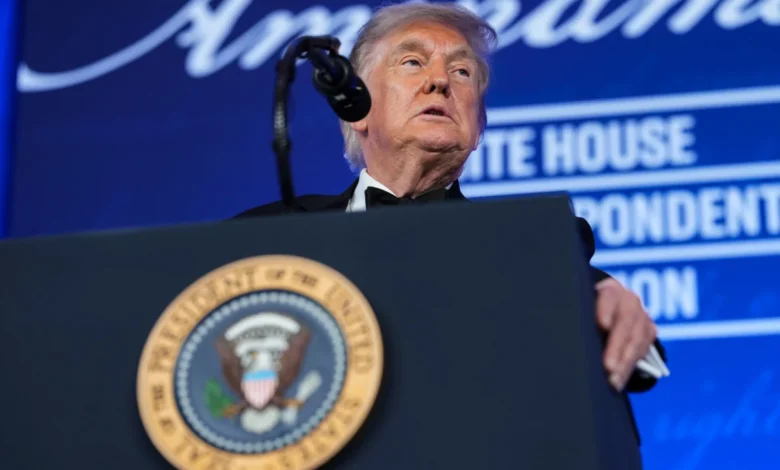
The rescheduled White House Correspondents’ Association Dinner on Friday night saw President Donald Trump deliver an hour-long address that critics and observers characterized as a meandering blend of familiar campaign rhetoric and a series of poorly received jokes. This marked Trump’s first appearance as president at the prestigious annual event, which had been postponed from its traditional April date following a security incident where an individual attempted to breach the ballroom and was subsequently subdued by the Secret Service. Historically, presidents have utilized this platform to engage in lighthearted banter with the press, often employing humor to poke fun at journalists and their work. However, President Trump’s address deviated significantly from this norm, largely devolving into a rally-style monologue interspersed with personal criticisms directed at members of the media, occasionally including remarks about their physical appearance.
A Troubled Evening for Humor and Connection
The atmosphere within the Waldorf-Astoria ballroom, which is considerably smaller than the typical venue at the Washington Hilton, was described by attendees as largely unresponsive. One notable moment occurred when a joke about an elderly U.S. senator’s personal life failed to elicit any laughter, a reaction that prompted Trump himself to question the audience’s reception. "Does anybody get that? I thought that was actually great. That was actually the only thing I thought was good in this whole frickin’ stupid speech. It was the only good one, and that went down with not exactly great laughter," the President remarked, acknowledging the apparent disconnect.
Throughout the lengthy speech, which was punctuated by extended periods of silence and audience fidgeting, it became evident that many of the President’s intended humorous remarks were not resonating with the assembled journalists and their guests. The stream-of-consciousness delivery jumped between various topics, leaving many in the audience appearing uncomfortable or disengaged. This lack of positive audience reaction was a stark contrast to the expected dynamic of the event, which typically involves a degree of reciprocal humor between the President and the press corps.
A "Trump White House Correspondents’ Dinner"?
In an attempt to inject a sense of occasion, President Trump humorously suggested that the event’s name might need to change to secure his future attendance. "Tonight’s event is even crazier than the last time," he quipped, referencing the earlier security scare. He then relayed an anecdote, citing CBS News’ David Ellison (CEO of Paramount, CBS’s parent company), who allegedly informed him that "next year, they’re going to call it the Trump White House Correspondents’ Dinner." The President added, with a clear implication, that "Changing the name is the only way you’re going to get me back here." This statement, while delivered with a smile, underscored the often-strained relationship between the President and the media.
The hour-long address reportedly tested the patience of many attendees, with only the most ardent supporters of the President showing consistent enthusiasm. The sparse reactions from the wider audience created long stretches of near silence, a palpable indicator of the speech’s overall reception. Following the conclusion of Trump’s remarks and the subsequent performance by mentalist Oz Pearlman, a noticeable number of guests began to depart the ballroom, suggesting a collective desire to conclude the evening.
A Notable Gathering Amidst Political Tensions
The event, though rescheduled and relocated, brought together a significant number of administration officials alongside members of the press. Notably, Chief Legal Officer Makan Delrahim was present just hours after a significant business development: the decision to postpone the planned merger between Paramount and Warner Bros. Discovery due to antitrust challenges. At a Paramount table with Delrahim were other cabinet members, including Pete Hegseth and presidential advisor Stephen Miller, accompanied by his wife, Katie Miller. Other high-profile attendees included Secretary of Health and Human Services Robert Kennedy Jr. and his wife Cheryl Himes, Commerce Secretary Howard Lutnick, Department of Homeland Security Secretary Markwayne Mullin, and Acting Attorney General Todd Blanche, who later became the subject of one of mentalist Oz Pearlman’s demonstrations.
The presence of these officials at an event dedicated to celebrating journalistic endeavors highlighted the complex and often adversarial relationship between the Trump administration and the press. The juxtaposition of these figures with journalists, some of whom have extensively investigated the administration, created an undercurrent of tension throughout the evening.
Award Presentations and Presidential Interactions
The evening’s proceedings began with the presentation of annual awards to journalists, some of whom were recognized for their investigative reporting on sensitive topics related to the President. When reporters from The Wall Street Journal accepted an award for their work on the Jeffrey Epstein story, President Trump offered a handshake but then demonstratively raised his hands in the air with a slight smile. Wolf Blitzer, who was presenting the award, pointedly reminded the audience that Trump had previously sued The Wall Street Journal for $20 billion over the same story. This moment underscored the ongoing legal and public battles between the President and various media outlets.
Upon taking the lectern, Trump specifically targeted Josh Dawsey of The Wall Street Journal and CNN host Kaitlan Collins, delivering personal attacks that, like his earlier attempts at humor, were met with significant silence from the audience. Weijia Jiang, the outgoing president of the White House Correspondents’ Association, maintained a stoic demeanor as the President launched into these more personal digressions, which many observers characterized as resembling a roast more than a traditional presidential address. In response to the personal attacks on its journalists, CNN released a statement during the speech defending its staff.
A Speech of Tangents and Familiar Themes
While President Trump appeared to have a prepared set of remarks, he frequently deviated from the script, allowing personal anecdotes and political grievances to steer the direction of his speech. These detours included familiar political attacks, such as criticisms of Adam Schiff’s appearance, and an extended discussion about his vision for a White House ballroom. At one point, he drew attention to the chandeliers at the Waldorf-Astoria venue, a building he had previously owned and operated as a Trump hotel, highlighting his personal connection to the location. Despite the biting nature of some of his criticisms of the press, the sheer length of the speech and the wide range of topics covered may have diluted the impact of his more pointed insults.
A Hint at Future Attendance and Security Concerns
As mentalist Oz Pearlman took the stage, he humorously remarked on President Trump’s statement about attending next year’s event, suggesting, "I thought he was going to be speaking until next year, actually." This comment seemed to acknowledge the extended nature of Trump’s address and perhaps a lingering uncertainty about his actual commitment to future events.
The current year’s dinner was a direct result of the security incident that disrupted the April event. The original gathering at the Washington Hilton was cut short after a gunman attempted to breach security measures outside the ballroom. The audible sounds of the incident caused panic among the guests, and the Secret Service swiftly escorted President Trump and Vice President JD Vance from the dais. Following this disruption, President Trump had encouraged the White House Correspondents’ Association to reschedule, which ultimately led to the current arrangements at the Waldorf-Astoria, a venue with enhanced security protocols.
The Broader Context: A Strained Relationship
The attention surrounding this year’s White House Correspondents’ Dinner was amplified by the ongoing contentious relationship between President Trump and the press. Throughout his presidency, Trump has frequently engaged in lawsuits against media organizations and has openly criticized news coverage as "fake news." He has also threatened to revoke broadcast licenses and, in one instance, his Justice Department subpoenaed reporters from The New York Times for their sources regarding articles about security vulnerabilities in the new Air Force One. This particular subpoena was later withdrawn following a federal judge’s criticism of the government’s methods.
President Trump had previously skipped the WHCA dinners in previous years, sometimes opting to hold counter-programming events. His decision to attend this year placed him directly at an event that celebrates the journalists he has often publicly attacked. The recognition of reporters from The Wall Street Journal for their work on the Jeffrey Epstein story, a story that included details of a letter reportedly bearing Trump’s signature, served as a poignant reminder of the ongoing friction. Trump has consistently denied sending such a letter and has pursued legal action against The Wall Street Journal, its publisher, and Rupert Murdoch. The dynamic at the dinner, therefore, was a complex interplay of tradition, political theater, and the enduring tension between the presidency and the press.
Related posts: