Michigan Launches Its First Residential Virtual Power Plant Pilot to Harness Clean Energy and Modernize the Grid


Ann Arbor, Michigan — In an ordinary-looking, fossil-fuel-free townhouse development nestled in Ann Arbor, a quiet technological revolution is taking shape. Mitch and Lori Hall live at Veridian at County Farm, a pioneering net-zero-energy sustainable community where homes generate as
much solar electricity as they consume, using advanced battery storage systems to capture daytime power for evening use. Soon, however, the clean energy generated by the Halls and their neighbors will no longer be confined to their individual walls. Instead, it will be harnessed to support the broader municipal power grid.
In the coming weeks, residents of Veridian will begin enrolling in Michigan’s very first residential pilot program for a virtual power plant (VPP). Under this initiative, Detroit-based utility DTE Energy will gain the capability to remotely manage and orchestrate a network of residential home batteries. When grid operators face extreme demand surges or capacity constraints, they can draw upon the stored solar energy within these home batteries, injecting power back into the utility grid precisely when and where it is needed most.
This milestone project highlights a rapidly accelerating national movement. As the American electrical grid faces unprecedented demand spikes driven by building electrification and a massive surge in energy-hungry data centers, utilities are increasingly turning to distributed energy resources (DERs) as a flexible, fast-acting solution. What was once viewed as an experimental niche technology is quickly becoming a foundational pillar of modern energy planning.
Bridging the Gap Between Distributed Generation and Utility Needs
For decades, the standard model of electrical delivery has been strictly centralized and linear: massive power plants generate electricity, which travels through high-voltage transmission lines and local distribution networks to reach end consumers. This architecture is increasingly strained by the modern era’s unique pressures. Extreme weather events driven by climate change, aging physical infrastructure, and skyrocketing industrial power loads have created severe reliability challenges for grid operators across the United States.
Virtual power plants offer an innovative alternative. By using software to aggregate the capacity of thousands of smaller, distributed energy devices—such as rooftop solar panels, electric vehicle chargers, and home battery storage systems—VPPs can function collectively like a traditional, large-scale power plant.
For utilities, this model provides crucial operational flexibility. According to DTE Energy President and Chief Executive Officer Joi Harris, the newly launched pilot represents a vital opportunity to evaluate an approach that could ultimately lower the cost of meeting climbing energy demands while dramatically strengthening grid reliability.
“This pilot is an opportunity to test an approach that could ultimately provide a lower-cost way to meet growing energy needs and strengthen reliability,” Harris said in a public statement.
Industry experts note that traditional methods of meeting peak energy demand often require utilities to build expensive new transmission infrastructure or dispatch fossil-fuel-fired "peaker plants." These facilities are notoriously expensive to operate, run infrequently, and generate high volumes of greenhouse gas emissions, with the financial burden ultimately passed down to everyday ratepayers. By smoothing out demand peaks through distributed battery networks, utilities can bypass these costly investments, yielding significant long-term economic benefits for consumers.
The Genesis of Veridian: Biomimicry Meets Urban Planning
The integration of Veridian’s microgrid into a utility-scale virtual power plant is the culmination of years of strategic planning. The concept began to take shape in 2019, when Matt Grocoff, founder of sustainability-focused development firm Thrive Collaborative, envisioned a neighborhood built on the principles of ecological mimicry.
Grocoff sought to design a community that operated less like an extractive industrial consumer and more like a resilient natural ecosystem. In a forest, for example, individual trees do not simply drain nutrients from the soil; they produce energy via photosynthesis and share those resources symbiotically through an intricate, interconnected underground network of fungal webs.
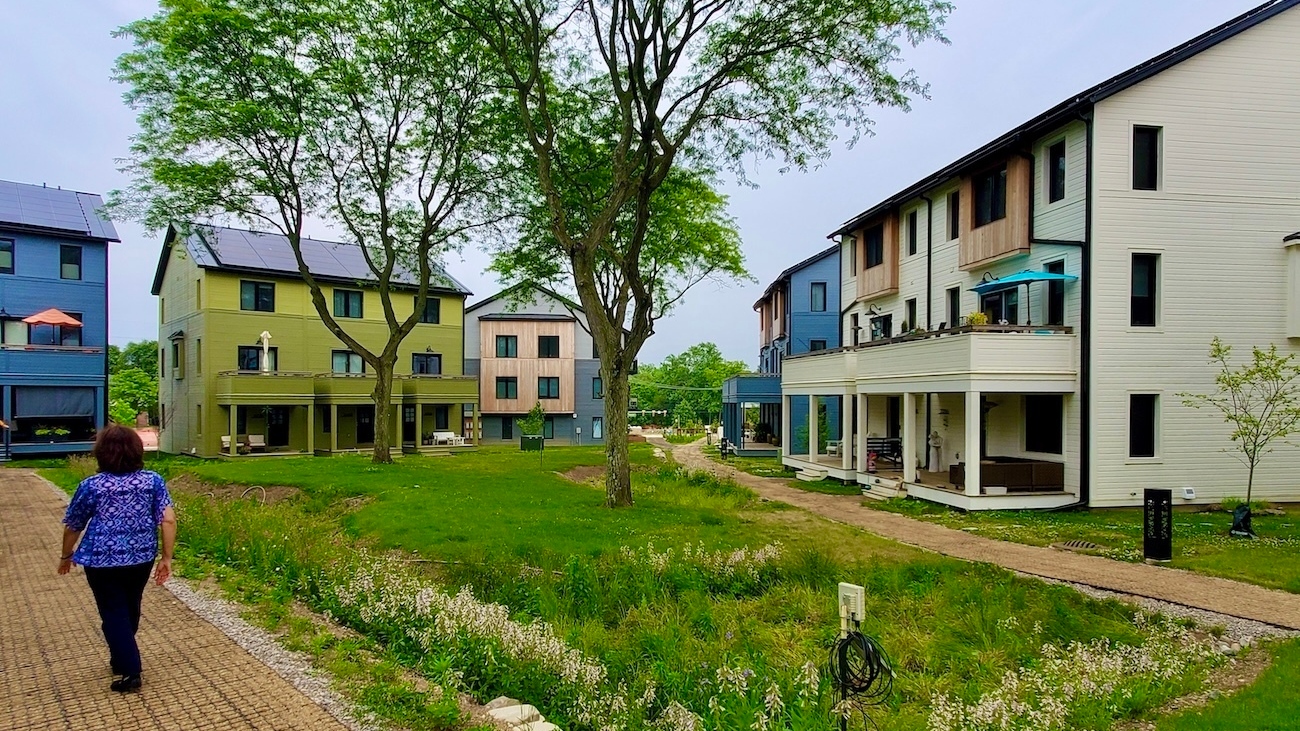
Translating that biological concept into real estate development, Grocoff imagined a residential community where individual homes produce their own clean electricity and share it dynamically across a peer-to-peer network, rather than relying solely on a one-way, top-down energy delivery model.
“Every Veridian home can be producing energy that it needs and mutually beneficially sharing it across a network of energy rather than a linear grid that flows in only one direction,” Grocoff explained.
To realize this vision, Thrive Collaborative partnered with sustainable builders and technology providers. At present, 44 market-rate homes equipped with solar panels and advanced home batteries have been constructed out of a planned total of 120 residences. Additionally, the development features 50 affordable housing units, which are slated for future energy upgrades.
The backbone of the community’s energy storage infrastructure is provided by Sonnen USA, a major manufacturer of intelligent residential energy storage systems. Sonnen’s proprietary software platform will serve as the technological bridge, allowing DTE Energy to safely and securely coordinate the fleet of batteries without compromising homeowner comfort or system integrity.
How the VPP Operates for the Everyday Consumer
For participating residents like Mitch Hall, the system’s primary appeal lies in its seamless automation and financial incentives. While homeowners retain full autonomy over their energy usage and emergency backup reserves, they are compensated by the utility for contributing their stored capacity to the broader grid.
“This pilot should work well for the residents, too,” Hall noted, pointing out that DTE will financially reward participants for enrolling in the project. Furthermore, because the utility automatically draws upon the batteries during periods of peak grid strain—when wholesale electricity prices are typically at their highest—homeowners are spared the burden of manually monitoring market fluctuations.
“A neat part about the virtual power plant is you don’t have to spend a lot of time learning and trying to optimize,” Hall added. “DTE will manage that battery for you.”
While DTE Energy did not disclose the exact financial compensation structure for participating households ahead of publication, residential VPP programs across the country typically offer upfront installation rebates, ongoing bill credits, or direct payments for energy dispatched during grid emergency events.
The Pilot Phase: Scaling for the Future
During the initial phase of the Michigan pilot, DTE expects nearly 100 battery-equipped homes within the Veridian community to participate. Geoff Ferrell, executive vice president of Sonnen USA’s VPP business unit, describes the development as an ideal test bed for modern grid integration.
The Veridian initiative is projected to deliver up to approximately 300 kilowatts of power continuously for a three-hour window during peak stress events. This localized output will give DTE engineers precise empirical data regarding how residential battery fleets behave under varying operational conditions, providing a robust empirical foundation for scaling the program across a wider service territory.
Ferrell draws parallels to another landmark Sonnen-facilitated VPP project that began as a modest pilot before expanding rapidly across multiple states. That initiative launched in 2017 at Soleil Lofts, a newly constructed solar-paneled apartment complex located outside Salt Lake City, Utah.
Even before Sonnen finished installing storage units across all 600 apartment units, utility provider Rocky Mountain Power and state regulators recognized the immense potential of the preliminary data. The program was swiftly expanded to open up participation to residential customers throughout the utility’s entire service footprint. Today, the initiative—now formally known as the Wattsmart Battery program—encompasses approximately 7,900 homes and businesses across Utah, Wyoming, and Idaho.

The National Landscape and the Push for Immediate Scale
Despite clear success stories in states like Utah, California, and Vermont, the widespread adoption of virtual power plants has historically faced institutional friction. Many traditional utilities have lacked regulatory incentives to embrace distributed energy, while high upfront costs for residential solar and battery systems have put home energy storage out of reach for many lower- and middle-income Americans.
However, the rapid acceleration of electricity demand nationwide has forced a paradigm shift. According to recent forecasts from the Brattle Group, harnessing 524 gigawatts of distributed energy resources through virtual power plants could save U.S. households an average of $122 per year by 2050.
Kevin Brehm, a manager in the carbon-free electricity practice at clean energy think tank RMI, emphasizes that the electrical grid is currently sitting on an immense amount of untapped capacity. While applauding DTE’s initiative, Brehm argues that utilities should consider bypassing cautious, small-scale pilots altogether in favor of rapid, large-scale deployment.
“Do you need another pilot?” Brehm asked, noting that a wealth of established VPP frameworks already exist across the United States for utilities to model their programs after.
Nevertheless, Brehm acknowledges that for utilities taking their first cautious steps into distributed resource management, structured pilots like the one at Veridian serve a valuable purpose. When Rocky Mountain Power launched its initial Utah pilot, company employees quickly gained technical fluency in operating residential battery fleets, allowing them to smoothly integrate distributed storage into long-term resource planning. Brehm suggests that DTE Energy would benefit from following a similar trajectory toward rapid scaling once the initial data is validated.
Broad Economic and Environmental Implications
As the energy transition accelerates, the implications of projects like the Veridian VPP extend far beyond the borders of Ann Arbor. Industry analysts view residential virtual power plants as a crucial line of defense against climate-induced grid failures, extreme weather disruptions, and soaring utility bills.
By decentralizing power generation and turning passive consumers into active "prosumers"—individuals who both consume and supply electricity—communities can drastically reduce their carbon footprints while enhancing local energy security. During regional blackouts or severe winter storms, homes equipped with solar and battery storage maintain critical power for heating, refrigeration, and communication, easing the strain on emergency first responders and municipal infrastructure.
The success of the Veridian pilot is already inspiring external real estate developers and municipal planners across the country. Grocoff reports that Thrive Collaborative has received a wave of inquiries from developers nationwide who are eager to replicate the model, including the planners behind the Peace Hill sustainable community project in Townsend, Washington.
“We’re getting calls from all over the country,” Grocoff said. “It’s really exciting.”
As DTE Energy prepares to flip the switch on Michigan’s first residential VPP pilot in the coming weeks, all eyes will be on Ann Arbor. If the project successfully demonstrates the reliability, economic viability, and consumer appeal of distributed battery orchestration, it could pave the way for a statewide transformation of Michigan’s energy landscape—proving that the most powerful solutions to our modern grid challenges may not come from building larger power plants, but from connecting the homes we already live in.