Trans Rights Protesters Target Flagship Harry Potter Store Opening on Oxford Street Over J.K. Rowling Views

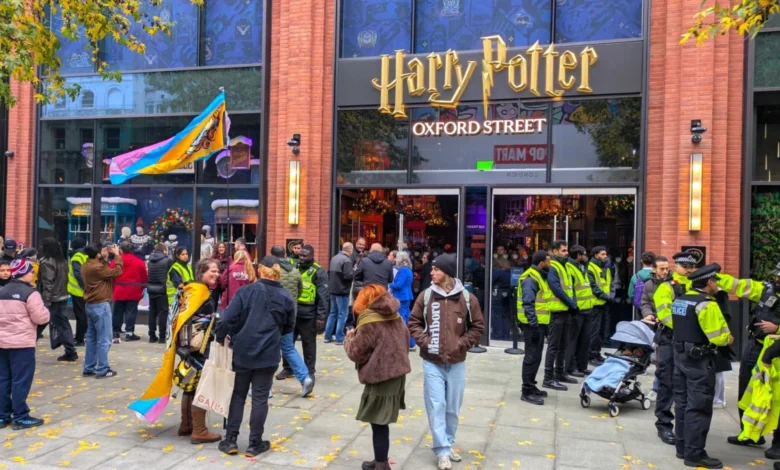
The grand opening of the United Kingdom’s largest Harry Potter retail destination on London’s prestigious Oxford Street was met with unexpected friction as a demonstration led by transgender rights advocates converged outside the venue. Eager fans, many draped in the familiar burgundy, gold, green, and blue scarves of their favorite Hogwarts houses, lined up for hours to gain entry to the two-story flagship emporium. However, their anticipation was juxtaposed with the loud chants and sharp criticisms of a coalition of protesters who directed their grievances squarely at the franchise’s creator, author J.K. Rowling.
Standing just feet away from the surging crowds of consumers, approximately a dozen demonstrators utilized megaphones to broadcast slogans, most notably accusing the billionaire author of having "blood on her hands." Protestors held aloft a series of placards bearing stark messages, including "Trans kids deserve to grow up. Trans adults deserve to grow old." In a striking visual juxtaposition, one demonstrator hoisted a transgender pride flag emblazoned with the crest of Hufflepuff, a Hogwarts house traditionally associated with patience, dedication, and fair play.
The demonstration highlights the ongoing, deeply polarized cultural friction surrounding the multibillion-dollar literary and cinematic franchise. While the magical world created by Rowling continues to draw immense commercial loyalty and multi-generational consumer engagement, it simultaneously serves as a flashpoint in the broader, highly contentious debate concerning sex, gender identity, and civil rights in the United Kingdom and beyond.
Security Presence and Store Response
The Metropolitan Police deployed nearly ten officers to the scene to monitor the situation, working in tandem with a heavy contingent of private security personnel outfitted in high-visibility vests. Despite the emotionally charged atmosphere and the provocative nature of the slogans, the protest remained peaceful throughout the observation period.
Patrons waiting to enter the store—which spans two expansive floors, features architectural nods to Diagon Alley, and includes a dedicated Butterbeer bar—appeared largely unfazed, continuing to socialize, take photographs, and prepare for their retail experience.
Management for the retail location sought to balance the enthusiasm of the consumer base with an acknowledgment of civil liberties. In an official statement released shortly after the demonstration began, a spokesperson for the Harry Potter Shop on Oxford Street emphasized a dual commitment to commerce and free expression.
"Harry Potter Shop Oxford Street is thrilled to open our doors and welcome in hundreds of fans," the spokesperson said. "We support everyone’s right to the peaceful expression of personal viewpoints and look forward to a day full of magic."
Perspectives from the Demonstration
The protest was organized to draw public attention to what organizers described as Rowling’s sustained and active hostility toward the transgender community. A protest organizer who identified simply as West and declined to provide their full legal name spoke at length regarding the motivation behind the demonstration.
West accused the author of "personally funding transphobia from the ground up," specifically pointing to Rowling’s financial contributions to legal campaigns in the United Kingdom. These campaigns have sought to clarify and restrict the legal definition of a woman to biological sex rather than gender identity, a stance that has made Rowling a prominent figure in the ongoing British discourse surrounding the Gender Recognition Act and sex-segregated spaces.
When challenged by reporters regarding the appropriateness of chanting aggressive slogans such as "blood on her hands" in the presence of families and young children waiting to enter a retail store, West stood firm.
"Yes, absolutely," West responded, adding, "I would hope that [parents] become aware and don’t subject their children [to Harry Potter]."
West maintained that the demonstration was conducted within legal and peaceful boundaries, emphasizing that many of those protesting were once deeply devoted admirers of the wizarding world.
"A lot of us here today, a lot of trans people, and a lot of allies, are massive Harry Potter fans," West said. "But the fact is that the franchise is not worth the loss of human dignity."
When asked to provide a direct correlation between the author’s public statements and the phrase "blood on her hands," West pointed to statistical data regarding mental health challenges and suicide rates within the transgender community.
"There are extremely high suicide rates among the trans community," West alleged. "By removing trans rights, by removing trans protections, she is making the world unsafe for people."
J.K. Rowling and the Broader Cultural Debate
J.K. Rowling declined to issue a direct comment in response to the Oxford Street demonstration. However, the author has established a clear, well-documented public position regarding her advocacy, maintaining that she is uncompromising in her defense of what she defines as hard-won sex-based rights for women.
In a social media post published earlier in the week on the platform X (formerly Twitter), Rowling articulated her perspective, arguing that modern trans rights campaigns advocate "for women to lose their sex-based rights to accommodate men who say they’re women."
Rowling’s transition from a universally beloved children’s author to a polarizing political commentator has been one of the most visible cultural transformations of the past decade. Her public commentary, which began intensifying around 2020, has alienated a significant portion of her original readership, including prominent actors from the cinematic adaptations such as Daniel Radcliffe, Emma Watson, and Rupert Grint, all of whom have publicly expressed support for transgender rights.
Conversely, Rowling has received substantial support from various conservative commentators, feminist organizations, and public figures who argue that biological reality must be preserved in law, language, and policy, particularly regarding domestic violence shelters, prisons, sports, and healthcare facilities.
Economic and Social Implications for the Franchise
The Oxford Street protest underscores a persistent challenge for Warner Bros. Discovery and the various corporate entities managing the intellectual property rights of the Wizarding World: how to insulate a multi-billion-dollar commercial asset from the deeply entrenched political controversies of its creator.
Despite recurring calls for boycotts across social media platforms over the past several years, the commercial appetite for Harry Potter-related merchandise, video games, theme park attractions, and books has remained remarkably resilient. The launch of the Oxford Street flagship store—designed to capture the massive foot traffic of central London’s premier shopping district—demonstrates that corporate stakeholders remain confident in the enduring power of the brand.
Nevertheless, events such as the demonstration outside the new London store illustrate that the cultural shadow cast by the ongoing debate over gender identity will continue to follow the franchise. As public spaces and retail locations become physical arenas for ideological disputes, brands tied to controversial creators must increasingly navigate the delicate intersection of consumer loyalty, corporate neutrality, and public dissent.