Argentina’s World Cup Dream Dashed as Enzo Fernández Sees Red in Dramatic Final Loss to Spain

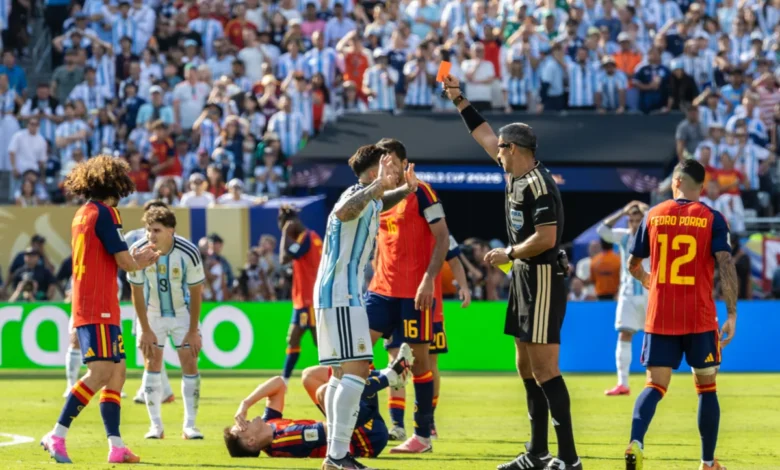
The 2026 FIFA World Cup final was a stage for dreams and nightmares, and for Argentine midfielder Enzo Fernández, it delivered a devastating double dose. Just five days after his heroic equalizer propelled Argentina into the championship match, Fernández found himself on the wrong side of history, sent off in second-half stoppage time and ultimately watching his team fall 1-0 to Spain in extra time. The red card, a moment of lost composure on football’s grandest stage, transformed him from savior to scapegoat, stripping Argentina of its last realistic hope of retaining its title.
A Tale of Two Halves: From Hero to Hounded
Enzo Fernández had captured the hearts of a nation in the semifinal against England with a spectacular late strike that leveled the score and ignited a path to the final. This brilliance, however, was overshadowed by a critical lapse in judgment during the decisive match against a formidable Spanish side. The narrative of the final saw Argentina struggle offensively, unable to register a single shot on target throughout regulation time, a testament to Spain’s suffocating defensive strategy. As the match crept towards the possibility of penalties, Fernández’s frustration and subsequent actions became the focal point of a dramatic conclusion.
The Ill-Fated Moments: A Timeline of Disappointment
The pressure of the World Cup final is immense, and for Fernández, it proved to be an unbearable weight. The critical sequence of events unfolded in the latter stages of the second half:
-
82nd Minute: First Yellow Card: As the clock ticked down and Argentina’s attacking struggles became increasingly apparent, Fernández received his first yellow card. The booking was issued for dissent after he vehemently protested a refereeing decision by Slovenian official Slavko Vincic. This initial caution, while seemingly a product of mounting frustration, would soon carry far greater significance. Manager Lionel Scaloni later reflected on the incident, suggesting, "I think the first yellow card could have been avoided by the referee, but it is what it is."

-
90th Minute: The Red Card: The defining moment arrived in the dying minutes of regulation time. As Spanish defender Pau Cubarsí advanced with a loose ball near the midfield line, Fernández committed a rash and mistimed challenge. The tackle left Vincic with no alternative but to brandish a second yellow card, resulting in an immediate red card and Fernández’s dismissal from the field. This decision not only left Argentina a man down in the crucial closing moments but also eliminated any possibility of him participating in the ensuing 30 minutes of extra time.
Fernández’s slow walk towards the tunnel was met with a roar from the Spanish supporters and a stunned silence from the thousands of Argentine fans present at MetLife Stadium. The reality of their disadvantage, with an additional half-hour of play looming, had become starkly clear.
Historical Context: A Place on an Infamous List
Enzo Fernández’s sending-off in the 2026 World Cup final etched his name into a rare and often regrettable category of football history. He became only the sixth player ever to be dismissed in a FIFA World Cup final. This exclusive club includes players whose moments of indiscipline have irrevocably shaped the outcome of the sport’s most prestigious match. While Fernández’s goal in the semifinal was a moment of individual brilliance that propelled his team forward, his red card in the final will forever be a defining mistake of the championship game.
Managerial Disappointment and Analysis
Following the match, Argentina’s manager, Lionel Scaloni, expressed his disappointment, particularly regarding the circumstances leading to Fernández’s dismissal. While acknowledging the referee’s decision, Scaloni hinted at a broader critique of the officiating in such a high-stakes encounter. "Of course he wasn’t thinking about booking him with a second yellow card," Scaloni stated regarding Fernández’s mindset. "It’s a World Cup Final and I think there’s things that could have been avoided." The sentiment suggests a feeling that certain decisions might have been handled differently given the magnitude of the occasion.
Spain’s Dominance and Argentina’s Offensive Woes

The narrative of the 2026 World Cup final was one of Spanish control and Argentine struggle. Spain, a nation with a rich footballing history and a reputation for technical prowess, executed a masterful game plan. Their suffocating press and disciplined defensive structure limited Argentina’s attacking options throughout the match. Prior to Fernández’s red card, Argentina had failed to register a single shot on goal in 90 minutes, highlighting their inability to break down Spain’s resolute defense.
The stark statistics underscore Spain’s superiority on the day. While Fernández’s red card undeniably hampered Argentina’s ability to fight back, the team’s offensive impotence throughout regulation time suggests that overcoming Spain would have been an arduous task regardless of the numerical disadvantage.
Broader Implications and the Weight of a Nation’s Expectations
The loss in the 2026 World Cup final represents a significant setback for Argentina, a nation that breathes football and carries immense expectations for its national team. For Enzo Fernández, the experience will undoubtedly be a difficult one to process. His potential to be remembered as a hero of this tournament has been overshadowed by a moment of lost discipline that had profound consequences.
The implications of this loss extend beyond the immediate disappointment. It raises questions about Argentina’s tactical approach, their ability to perform under extreme pressure, and the mental fortitude of key players in critical moments. While Spain celebrates their hard-fought victory, Argentina is left to reflect on what might have been, a narrative tragically punctuated by Enzo Fernández’s red card. The dream of retaining the World Cup, so vibrantly kept alive by his semifinal heroics, was ultimately extinguished by a single, ill-timed challenge.
The Road Ahead: Argentina’s Future in the Post-World Cup Landscape
The 2026 FIFA World Cup final concludes a tournament that has once again captivated the globe. For Argentina, the immediate aftermath will be a period of introspection and rebuilding. The talent within the squad remains, and the experience of this final, however painful, can serve as a catalyst for future growth. The legacy of this particular World Cup for Argentina will be complex, marked by both moments of brilliance and a final, crushing disappointment, epitomized by the dramatic downfall of Enzo Fernández. The journey of football is one of constant cycles, and while this chapter closes with heartbreak for Argentina, the pursuit of future glory will undoubtedly continue.