American Airlines pilot and air traffic controller engage in conversation regarding unexplained aerial phenomena near Baltimore

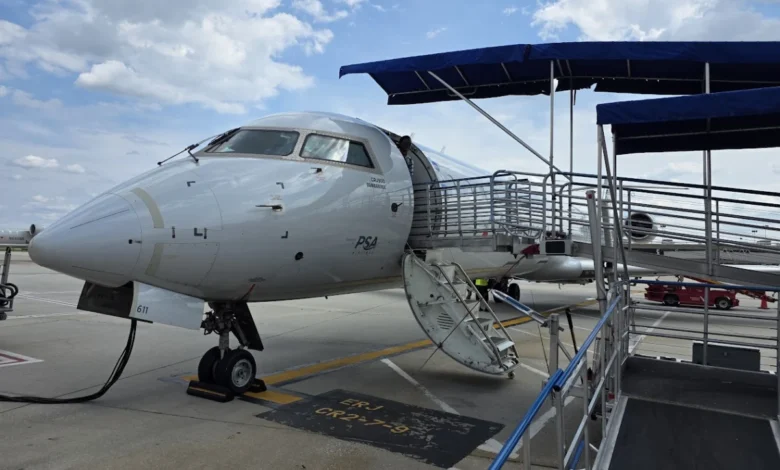
On Saturday, November 21, a routine flight operated by PSA Airlines, an American Airlines subsidiary, became the subject of aviation scrutiny following an unusual exchange between a pilot and an air traffic controller over the skies of Maryland. American Eagle flight 5432, a Bombardier CRJ-900 regional jet, departed Washington National Airport (DCA) at 4:27 p.m. en route to Philadelphia. While cruising, the flight crew received a cockpit traffic alert, a standard system notification designed to warn pilots of nearby aircraft. However, the ensuing dialogue between the cockpit and ground control veered into the territory of the unexplained.
The Chronology of the Exchange
As the flight transited near Baltimore, the pilot of the CRJ-900 (N596NN) queried air traffic control regarding a traffic advisory he had received on his flight deck display. The system had indicated the presence of another aircraft, but the display failed to provide an identifying data tag or altitude reading, a phenomenon that can occur when an aircraft’s transponder is not broadcasting specific secondary surveillance information.
The air traffic controller informed the pilot that he had already passed the only nearby aircraft in the vicinity—a plane flying under Visual Flight Rules (VFR) at an altitude of 2,300 feet. The controller explicitly stated, “There’s nobody around you at all.” The pilot, noting the persistence of the warning, remarked that his instrumentation was “being weird.”
In a departure from standard aviation phraseology, the controller responded by referencing local reports of unidentified aerial phenomena (UAP). She informed the pilot that there had been previous accounts of anomalous sightings in the vicinity of Martin State Airport. She recounted a specific interaction with another pilot who had observed an aircraft “zigzagging” in front of his flight path, an incident for which the controller noted there was “no primary target” on her radar display—meaning no physical object was reflecting radar waves at that location. The conversation concluded with the pilot humorously acknowledging that the experience would make for a “good story to tell my family,” before the aircraft was handed off to Philadelphia approach control.
Technical Explanations and Radar Anomalies
From an aviation safety perspective, traffic advisory anomalies are not entirely unprecedented. When an airliner is operating at or below 15,500 feet, its Traffic Collision Avoidance System (TCAS) can issue an alert if it detects a transponder signal that lacks altitude encoding. These “ghost” signals often appear on cockpit displays without the standard data tags that pilots rely on for situational awareness.
Furthermore, industry experts have noted that false collision warnings are a documented issue in the Washington D.C. terminal area. In the preceding year, several instances were reported where aircraft flying at precisely 2,300 feet triggered erroneous alerts. These technical glitches are often attributed to radar processing errors or environmental interference, which provide a more grounded, prosaic explanation than extraterrestrial or paranormal theories. Nevertheless, the fact that these alerts consistently manifest at a specific altitude has drawn the attention of aviation safety researchers who study the reliability of transponder-based tracking.
A Pattern of Reported Sightings
The November 21 incident is not an isolated occurrence within the aviation industry; it joins a growing body of anecdotal evidence from professional pilots regarding unexplained sightings. These reports have historically faced skepticism, yet they have become increasingly significant as the federal government has shifted its posture toward transparency regarding UAP.
In 2018, a Learjet pilot over Arizona reported an unidentified object passing directly overhead. When air traffic control requested that an American Airlines flight in the area keep watch, the crew confirmed seeing a highly reflective object hovering thousands of feet above their cruising altitude. Similarly, in February 2021, an American Airlines flight (AA2292) traveling from Cincinnati to Phoenix encountered a fast-moving, cylindrical object that appeared to transit directly over the jet. While American Airlines initially expressed uncertainty regarding the origin of the radio transmission, they later confirmed that the audio was authentic. The Federal Bureau of Investigation (FBI) eventually opened and closed a file on the matter, citing a lack of jurisdiction over what was deemed a non-criminal, airborne mystery.
Historical Context and Government Transparency
The Baltimore incident occurred just one day after the Pentagon released a new tranche of documents and videos related to UAP, fueling further public interest. These disclosures include historical data, such as a 1952 Central Intelligence Agency (CIA) briefing that detailed unexplained radar returns around Washington National and Andrews Air Force Base. During that period, the U.S. Air Force dispatched interceptors to investigate radar contacts that exhibited flight characteristics impossible for the aircraft of that era, yet the pilots returned having identified nothing.

The modern push for transparency has yielded high-fidelity data points, such as a 2023 radar slide analyzed by the Department of Defense. The analysis documented eight distinct radar hits in a span of just 84 seconds. If those hits originated from a single object, the calculations suggest the craft was traveling at speeds exceeding 1,650 miles per hour, far beyond the capability of conventional civilian aircraft and challenging the performance envelopes of known military platforms.
Implications for Aviation Safety and Policy
The professional reaction to the November 21 incident highlights the tension between the rigorous, data-driven nature of aviation and the inherent mystery of unidentified radar returns. For air traffic controllers, the primary responsibility remains the separation of aircraft. When radar systems—which are designed to track transponders—detect movement without a corresponding physical return, controllers are left to balance the safety of the flight path with the uncertainty of the environment.
The implications of these sightings are twofold. First, they raise questions about the limitations of current civilian radar infrastructure and the potential for these "anomalies" to interfere with flight safety or cause unnecessary pilot distraction. Second, they contribute to a broader societal conversation regarding the nature of the objects detected by both radar and human observation.
While the aviation community largely views these occurrences through the lens of sensor error or atmospheric interference, the persistent nature of these reports—particularly those corroborated by multiple cockpit crews—has prompted a shift in how such reports are handled. No longer dismissed outright as mere folklore, these events are now increasingly subject to administrative review, even if the conclusions remain elusive.
As the airline industry continues to modernize its tracking technologies, the hope is that better data collection will provide clarity. Until then, interactions like those involving American Eagle flight 5432 serve as a reminder that the skies remain a complex environment, where the boundaries of what is "normal" are constantly being tested by both the technological capabilities of our systems and the persistent, unexplained phenomena observed by those who navigate them daily. Whether these are phantom radar returns or something more complex, they remain a part of the modern pilot’s experience in the 21st-century airspace.