Jermaine Eluemunor Defies Stereotypes and Thrives as the NFL’s Lone English-Born Star Following Career-Defining Move to the New York Giants

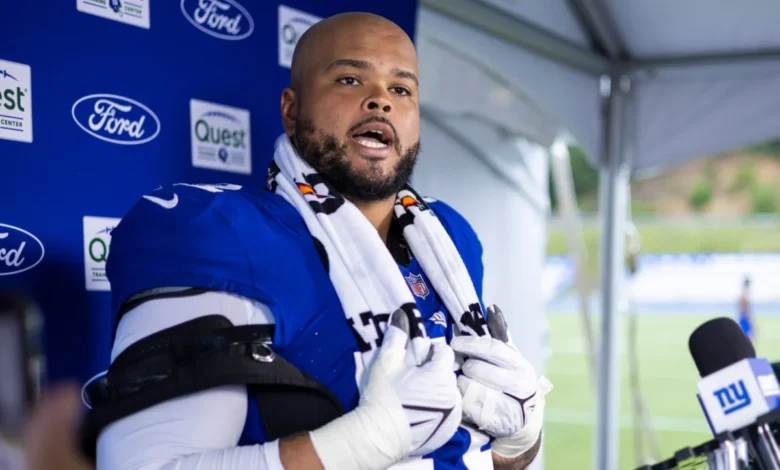
In the modern landscape of professional American sports, a cynical and persistent trope frequently shadows major financial transactions. It is a narrative written countless times across various franchises: a talented athlete receives their first significant, life-changing contract, and their statistical output, effort, or competitive drive experiences an immediate and steep decline. Sportswriters, fans, and front offices alike have grown accustomed to the post-payday letdown—a phenomenon where security seemingly breeds complacency. However, New York Giants right tackle Jermaine Eluemunor is systematically dismantling this professional stereotype, offering a compelling counter-narrative of resilience, relentless work ethic, and an insatiable appetite for physical dominance.
As the only active National Football League player born in England, Eluemunor occupies a unique cultural and athletic space within the sport. More importantly, his performance on the gridiron places him firmly in the increasingly exclusive tier of professional football players who not only maintain their elite level of play after securing financial security but actually elevate their game to new heights. Rather than resting on the laurels of a hard-earned multi-year deal, the offensive lineman has utilized his newfound stability as a launching pad for the most productive chapter of his professional career, redefining what it means to be a modern NFL journeyman-turned-cornerstone.
The Pursuit of Total Dominance: Inside Eluemunor’s Mindset
For Eluemunor, the motivation to excel extends far beyond the financial remuneration that accompanies a starting role in the highest-grossing sports league in the world. While many athletes might view a lucrative contract as the ultimate validation of their career goals, the Giants offensive lineman treats financial success merely as a byproduct of a much deeper, more aggressive competitive philosophy.
In a candid interview with the media, Eluemunor laid bare the internal drive that separates him from his peers who might fall victim to the comfort of a guaranteed paycheck.
"I’m not where I want to be," Eluemunor stated. "Even once I get to where I want to be, I’m still going to play my ass off. I just love playing this game, being great, and beating up on people. It’s OK to win my rep, but I don’t just want to win. I want to go dominate. When you put my film on, I want you to say, ‘Damn, he’s messing this guy up.’ It’s cool getting paid, but that’s my motivation."
This uncompromising commitment to physical intimidation and technical mastery is precisely what has endeared him to his coaching staff and teammates in East Rutherford. In a demanding sport where offensive linemen are often judged by the plays they quietly prevent rather than the statistics they accumulate, Eluemunor’s visible aggression and vocal leadership have made him an indispensable anchor on the Giants’ front line. His desire to leave opposing pass rushers demoralized on film aligns with the old-school, blue-collar identity that the Giants franchise historically strives to project.
From London to the Gridiron: A Long and Winding Chronology
To fully understand and appreciate Eluemunor’s current trajectory, one must examine the arduous journey that preceded his arrival in New York. Unlike elite collegiate prospects who are drafted in the first round and immediately handed starting jobs with multi-million-dollar guarantees, Eluemunor’s path to NFL stability was defined by perseverance, positional fluidity, and the constant threat of roster turnover.
Born in London, England, before moving to the United States during his youth, Eluemunor did not follow the traditional American youth football pipeline. He adapted to the sport later in life, eventually developing into a standout collegiate player at Texas A&M. His raw physical traits and immense upside caught the attention of NFL scouts, leading to his selection in the fifth round of the 2017 NFL Draft by the Baltimore Ravens.
However, the early years of his professional career were characterized by transience. For his first five seasons in the league, Eluemunor operated primarily as a journeyman, bouncing across multiple organizations and fighting for roster spots rather than cementing himself as a weekly fixture on an offensive line. Stints with the Baltimore Ravens, New England Patriots, and Miami Dolphins tested his resolve, as he was frequently asked to fill in as a versatile backup or a spot starter wherever injuries created immediate needs.
The turning point in his professional narrative began to take shape when he joined the Las Vegas Raiders. In 2022, the Raiders finally provided him with the opportunity to secure a consistent starting role. During his time in Las Vegas, Eluemunor demonstrated that he possessed the durability and technical baseline required to handle the rigors of playing tackle against elite NFL edge defenders on a weekly basis.
Despite proving his competence, it was not until his subsequent move to the New York Giants that Eluemunor finally unlocked the final stage of his professional evolution. For the first time in his career, he was not merely viewed as a utility starter or an emergency plug-and-play option along the line of scrimmage. Instead, the Giants coaching staff handed him the keys to the right tackle position, allowing him to settle into a permanent home, refine his technique without the anxiety of shifting positions, and build lasting chemistry with the players lined up beside him.
Breaking the Mold: The Economics and Psychology of NFL Contracts
Eluemunor’s continued upward trajectory provides a fascinating case study for sports economists and team front offices analyzing player performance post-signing. In professional sports literature, the "contract year phenomenon"—where players dramatically elevate their performance in the final season of their deal to maximize their next payday—is a well-documented occurrence. Conversely, the subsequent drop in production after signing a long-term agreement has plagued countless franchises, often leaving teams hamstrung by the salary cap and burdened by underperforming assets.
The phenomenon is driven by a complex mix of physical fatigue, psychological relief, and changing external motivations. Once a player achieves financial security, the extreme baseline anxiety of potential career-ending injuries without a safety net can sometimes subtly alter their competitive edge.
Eluemunor’s active resistance to this psychological trap highlights the importance of intrinsic motivation in elite athletics. For the London-born lineman, the joy of competition and the visceral satisfaction of physical dominance act as perpetual engines that do not rely on external financial milestones. By maintaining—and arguably accelerating—his competitive intensity after securing financial stability, Eluemunor has delivered exceptional value to the Giants’ front office, proving that high-character veterans with a journeyman background can outperform their contract valuations.
Implications for the New York Giants and the Broader NFL Landscape
The implications of Eluemunor’s success extend far beyond his individual stat line. For the New York Giants, securing stable, high-level play at the right tackle position is a critical component of offensive stabilization. In an era where franchise quarterbacks require pristine pockets and running lanes must be consistently carved out against increasingly sophisticated defensive fronts, offensive line continuity is paramount.
By locking down the right side of the line with a player who possesses both the physical capabilities and the psychological makeup of an elite competitor, the Giants have alleviated one of their major roster anxieties. Furthermore, Eluemunor’s leadership style serves as a valuable cultural touchstone within the locker room. Younger linemen entering the professional ranks can observe a veteran who refuses to plateau, modeling a daily standard of excellence that transcends contract status.
On a broader scale, Eluemunor’s continued prominence reinforces the globalization of the NFL. As the league aggressively expands its international footprint through regular-season games in London, Germany, and beyond, the visibility of international players takes on added significance. While the vast majority of NFL rosters continue to be populated by American-born athletes who navigated the traditional NCAA system, Eluemunor stands as a rare and successful ambassador of the sport’s global potential—proving that an athlete can cross an ocean, overcome cultural and structural hurdles, navigate years of professional uncertainty, and ultimately emerge as one of the premier right tackles in professional football.
As the season progresses and opposing defensive coordinators scheme to neutralize the Giants’ offensive attack, they will continue to find themselves matched against an offensive lineman who views every single snap not as a job requirement, but as an opportunity to assert dominance. For Jermaine Eluemunor, the contract has been signed, the stability has been earned, but the hunt for perfection on the football field is only just beginning.